


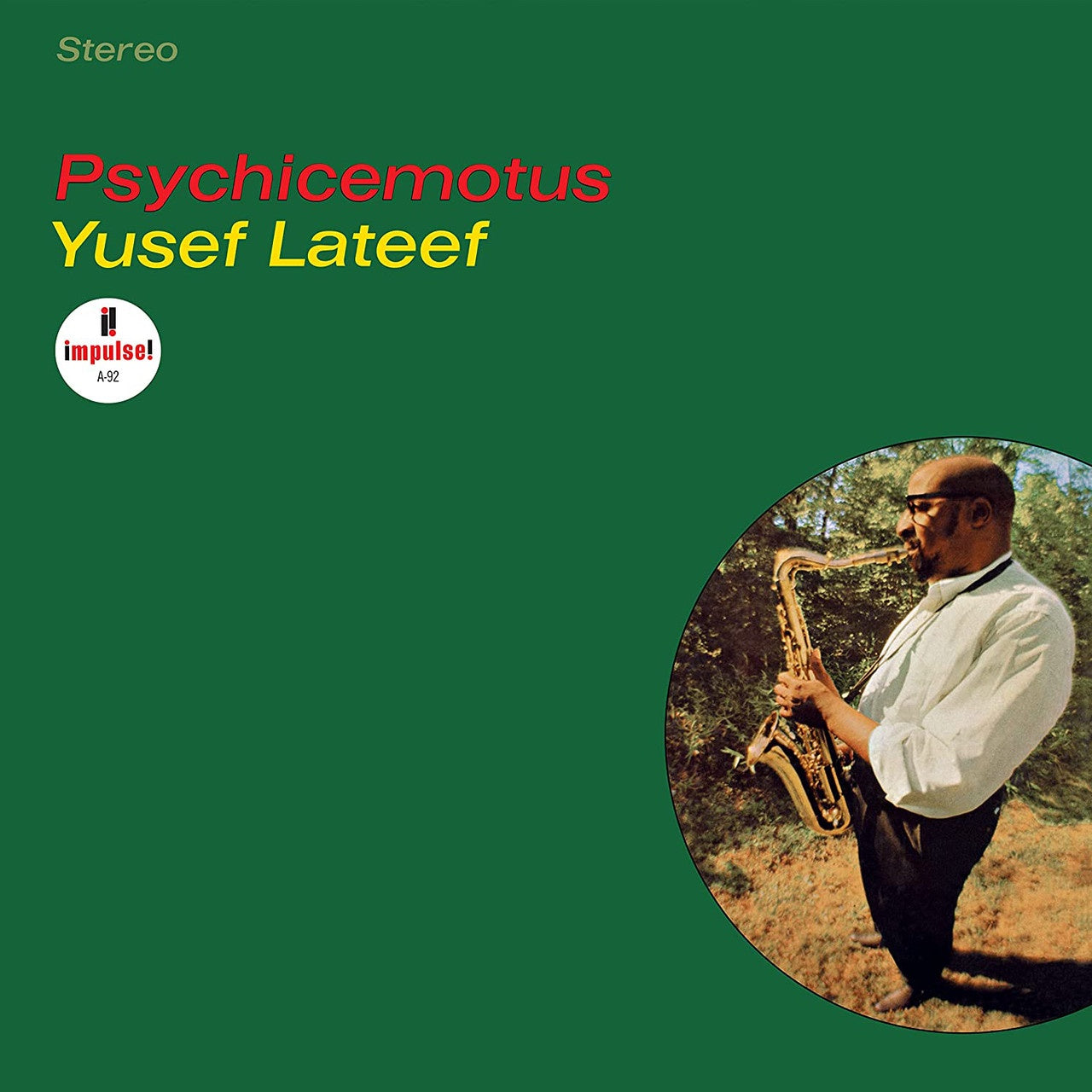
Yusef Lateef Psychicemotus (Verve By Request Reissue)
-
Regular price
-
$48.00 SGD
-
Regular price
-
-
Sale price
-
$48.00 SGD
- Unit price
-
per
Couldn't load pickup availability
About
Psychicemotus: Yusef Lateef’s 1966 exploration: An album whose intellectual foundation never compromises its emotive intimacy or, crucially, its swing.
Psychicemotus may be the quintessential Yusef Lateef album title – a word of his own invention referencing the symbiotic parts of his practice: the cerebral (psychic) and the emotional (emotus). A multi-instrumentalist, composer, bandleader, scholar/educator, author and visual artist, Lateef (1920-2013) emerged from the fertile Detroit bebop lineage that produced luminaries like Elvin Jones, Donald Byrd, Barry Harris, Tommy Flanagan, Curtis Fuller, Louis Hayes and Dorothy Ashby. His thirst for knowledge and spiritual perspective, however, was uniquely his own.
In 1948 he converted to the Islamic Ahmadiyya Movement and changed his name (from William Emmanuel Huddleston), while embracing an array of non-Western instruments and infusing global harmonic scales and exotic timbric textures into his work. One early on-the-nose album title, 1957’s Jazz For the Thinker, reflected this studied approach. But Lateef would come to reject “jazz,” believing it a demeaning descriptor from outside the culture. Instead he preferred another one of his neologisms, “autophysiopsychic music.” And if the term never quite caught on, his definition was indisputably easy to understand: “This word means music from one’s physical, spiritual and mental self, i.e., music from the heart.”
It also well describes Psychicemotus, an album whose intellectual foundation never compromises its emotive intimacy or crucially, its swing. Lateef heads up a quartet completed by bassist Reggie Workman, pianist Georges Arvanitas, and drummer James Black. On a fast-paced burner like “Semiocto” led by Lateef’s tenor, they’re positively classic-Coltrane-quartet-esque in passion and precision. While Lateef’s synthesis of influences informs everything herein, James Black – New Orleans-born and imbued with the city’s second line rhythmic heritage – steps out as the unit’s kinetic engine. The title cut, a sublime conversation in syncopation dominated by Workman’s elastic bass, Lateef’s flute and Black’s drums, is particularly animated by the latter’s genius command of dynamics. The group’s interplay is equally compelling on more reflective material. “Bamboo Flute Blues” pays direct homage to NOLA funeral parades, Lateef playing bluesy long tones on an F pentatonic scale flute of his own design while Black taps the snare with his fingertips. It’s surpassed in gentle beauty here only by “First Gymnopedie,” a flute treatment of a late-1800s piece by influential French composer Erik Satie accented by tom-tom, cymbal, and rimshots that’s fondly reminiscent of Lateef’s beloved 1961 reading of “Love Theme From ‘Spartacus.’”
“Medula Sonata” – the track that really puts the psychic in Psychicemotus – is the LP’s most ambitious and unconventional piece. A kind of abstract brainstem/anatomical score with Indian bells as a prominent texture, its improvised exchanges between Lateef’s tenor and the rest of the players evokes the subtle spontaneity of nerve signals abuzz. By contrast, takes on Great American Songbook standards like “Why Do I Love You,” and “I’ll Always Be in Love With You” are simply gorgeous reminders of the romantic warmth of Lateef’s tenor.
Ever the unpinnable leader, Lateef concludes the program with one last curveball, shining a solo spotlight on pianist Arvanitas for Fats Waller’s “Ain’t Misbehavin’.” Whether Lateef intended it as such or not, the French import/son of Greek parents’s dexterous interpretation of the legendary Harlemite’s classic serves as a fitting coda – a testimony to the music’s fundamental humanity. “I’m very glad to be in America and to learn new things musically!” Arvanitas practically glows in a quote from the album’s original liner notes. Under Yusef Lateef’s tutelage he could not have enjoyed a better teacher. — (via Label)
—
Psychicemotus was released in 1965 and features Yusef Lateef on various flutes and tenor saxophone, Georges Arvanitas on piano, bassist Reggie Workman, and drummer James Black. And while the Coltrane era of modal and free jazz was in full swing, Lateef always followed his own muse, and continued looking forward while looking back to ancient musics. His use of bamboo and Chinese wood flutes on the title track and "Bamboo Flute Blues" added not only dimension and texture, but rhythmic invention to standard jazz forms. Yet his readings of Jerome Kern's and Oscar Hammerstein's "Why Do I Love You," on which he plays tenor, swings elegantly while incorporating both hard bop and angular outside playing in his solo.
Arvanitas is a near perfect foil for Lateef in that while he's not as technically flashy as Barry Harris, he is a deeply sympathetic player who uses accents and ostinati as grounding points, and prefigures rhythmic changes rather than just comping. The beautiful reading of Erik Satie's "First Gymnopedie" on which Lateef plays flute is an utterly beautiful, restrained, and adventurous reading, and is allowed to resonate rhythmically with hand-percussion fills by Black. While not Lateef's finest recording for Impulse (Live at Pep's takes the —cake), it certainly is a worthy and memorable one. — (via AllMusic)
—
Verve By Request Series features transfers from the analog tapes remastered on 180-gram vinyl.
—
↓
Label: Verve Records, UMe, Impulse!
Series: Verve By Request
Format: Vinyl, LP, Album, Reissue, Stereo, Gatefold
Reissued: 2023 / Original Release: 1965
Genre: Jazz
Style: Post Bop, Modal, Free Jazz
File under: Jazz // Jazz - Saxophone
⦿
Share
- Regular price
- $48.00 SGD
- Regular price
-
- Sale price
- $48.00 SGD
- Unit price
- per
Couldn't load pickup availability
About
Psychicemotus: Yusef Lateef’s 1966 exploration: An album whose intellectual foundation never compromises its emotive intimacy or, crucially, its swing.
Psychicemotus may be the quintessential Yusef Lateef album title – a word of his own invention referencing the symbiotic parts of his practice: the cerebral (psychic) and the emotional (emotus). A multi-instrumentalist, composer, bandleader, scholar/educator, author and visual artist, Lateef (1920-2013) emerged from the fertile Detroit bebop lineage that produced luminaries like Elvin Jones, Donald Byrd, Barry Harris, Tommy Flanagan, Curtis Fuller, Louis Hayes and Dorothy Ashby. His thirst for knowledge and spiritual perspective, however, was uniquely his own.
In 1948 he converted to the Islamic Ahmadiyya Movement and changed his name (from William Emmanuel Huddleston), while embracing an array of non-Western instruments and infusing global harmonic scales and exotic timbric textures into his work. One early on-the-nose album title, 1957’s Jazz For the Thinker, reflected this studied approach. But Lateef would come to reject “jazz,” believing it a demeaning descriptor from outside the culture. Instead he preferred another one of his neologisms, “autophysiopsychic music.” And if the term never quite caught on, his definition was indisputably easy to understand: “This word means music from one’s physical, spiritual and mental self, i.e., music from the heart.”
It also well describes Psychicemotus, an album whose intellectual foundation never compromises its emotive intimacy or crucially, its swing. Lateef heads up a quartet completed by bassist Reggie Workman, pianist Georges Arvanitas, and drummer James Black. On a fast-paced burner like “Semiocto” led by Lateef’s tenor, they’re positively classic-Coltrane-quartet-esque in passion and precision. While Lateef’s synthesis of influences informs everything herein, James Black – New Orleans-born and imbued with the city’s second line rhythmic heritage – steps out as the unit’s kinetic engine. The title cut, a sublime conversation in syncopation dominated by Workman’s elastic bass, Lateef’s flute and Black’s drums, is particularly animated by the latter’s genius command of dynamics. The group’s interplay is equally compelling on more reflective material. “Bamboo Flute Blues” pays direct homage to NOLA funeral parades, Lateef playing bluesy long tones on an F pentatonic scale flute of his own design while Black taps the snare with his fingertips. It’s surpassed in gentle beauty here only by “First Gymnopedie,” a flute treatment of a late-1800s piece by influential French composer Erik Satie accented by tom-tom, cymbal, and rimshots that’s fondly reminiscent of Lateef’s beloved 1961 reading of “Love Theme From ‘Spartacus.’”
“Medula Sonata” – the track that really puts the psychic in Psychicemotus – is the LP’s most ambitious and unconventional piece. A kind of abstract brainstem/anatomical score with Indian bells as a prominent texture, its improvised exchanges between Lateef’s tenor and the rest of the players evokes the subtle spontaneity of nerve signals abuzz. By contrast, takes on Great American Songbook standards like “Why Do I Love You,” and “I’ll Always Be in Love With You” are simply gorgeous reminders of the romantic warmth of Lateef’s tenor.
Ever the unpinnable leader, Lateef concludes the program with one last curveball, shining a solo spotlight on pianist Arvanitas for Fats Waller’s “Ain’t Misbehavin’.” Whether Lateef intended it as such or not, the French import/son of Greek parents’s dexterous interpretation of the legendary Harlemite’s classic serves as a fitting coda – a testimony to the music’s fundamental humanity. “I’m very glad to be in America and to learn new things musically!” Arvanitas practically glows in a quote from the album’s original liner notes. Under Yusef Lateef’s tutelage he could not have enjoyed a better teacher. — (via Label)
—
Psychicemotus was released in 1965 and features Yusef Lateef on various flutes and tenor saxophone, Georges Arvanitas on piano, bassist Reggie Workman, and drummer James Black. And while the Coltrane era of modal and free jazz was in full swing, Lateef always followed his own muse, and continued looking forward while looking back to ancient musics. His use of bamboo and Chinese wood flutes on the title track and "Bamboo Flute Blues" added not only dimension and texture, but rhythmic invention to standard jazz forms. Yet his readings of Jerome Kern's and Oscar Hammerstein's "Why Do I Love You," on which he plays tenor, swings elegantly while incorporating both hard bop and angular outside playing in his solo.
Arvanitas is a near perfect foil for Lateef in that while he's not as technically flashy as Barry Harris, he is a deeply sympathetic player who uses accents and ostinati as grounding points, and prefigures rhythmic changes rather than just comping. The beautiful reading of Erik Satie's "First Gymnopedie" on which Lateef plays flute is an utterly beautiful, restrained, and adventurous reading, and is allowed to resonate rhythmically with hand-percussion fills by Black. While not Lateef's finest recording for Impulse (Live at Pep's takes the —cake), it certainly is a worthy and memorable one. — (via AllMusic)
—
Verve By Request Series features transfers from the analog tapes remastered on 180-gram vinyl.
—
↓
Label: Verve Records, UMe, Impulse!
Series: Verve By Request
Format: Vinyl, LP, Album, Reissue, Stereo, Gatefold
Reissued: 2023 / Original Release: 1965
Genre: Jazz
Style: Post Bop, Modal, Free Jazz
File under: Jazz // Jazz - Saxophone
⦿
Share
- Choosing a selection results in a full page refresh.