


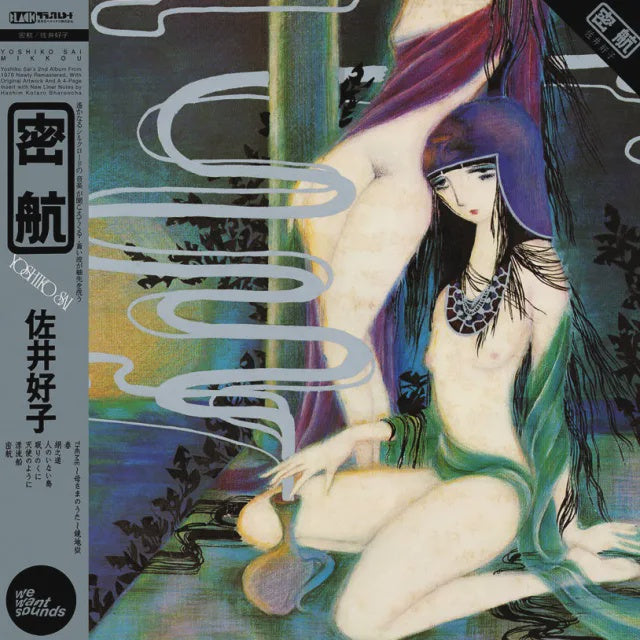
Yoshiko Sai 佐井好子 Mikkou 密航 (Coloured Vinyl)
-
Regular price
-
$70.00 SGD
-
Regular price
-
-
Sale price
-
$70.00 SGD
- Unit price
-
per
Couldn't load pickup availability
About
— The Analog Vault // Essential Listening —
Yoshiko Sai’s debut Mikkou, released in 1975 on Teichiku, introduced a singular voice in Japan’s psychedelic folk underground. Sai’s songwriting pairs surreal, poetic lyrics with lush arrangements that blur folk, jazz and progressive rock. Backed by guitarist Ryoji Shigeta and other underground players, the album unfolds like dream logic: tracks such as “Taiji no Yume” and “Byakuya” balance fragility with hallucinatory depth. The mood is intimate yet uncanny, with Sai’s delicate vocals floating over shifting textures. Initially overlooked, Mikkou has since been reappraised as a cult classic, prized by collectors for its originality and emotional intensity. It remains a cornerstone of 1970s Japanese folk experimentation. — The Analog Vault
—
The album, produced by ace arranger Isamu Haruna, keeps the same formula as Mangekyou with Yoshiko Sai’s beautiful songs and dreamy vocals over cool funky arrangements, this time featuring legendary guitarist Masayoshi Takanaka. This is the first time Mikkou is widely available outside of Japan, with remastered audio, original artwork, and a 4 page insert including new liner notes by Hashim Kotaro Bharoocha who interviewed Yoshiko Sai for this special occasion.
Yoshiko Sai holds a singular place in Japanese music history. Since her 1975 debut Mangekyou, the Japanese singer-songwriter has captivated listeners with her ethereal voice, poetic lyrics, and enigmatic presence, earning a devoted cult following that endures decades later. Building on the highly acclaimed reissue of her debut Mangekyou. Produced by Isamu Haruna and featuring some of Japan’s finest session musicians, including the cult guitarist Masayoshi Takanaka, the record showcases Sai’s signature blend of poetic songwriting and ethereal vocals, carried by subtly funky arrangements. Yet Mikkou represents a bold broadening of her artistic palette, drawing inspiration from the Silk Road and the rich cultural heritage of her native Nara.
Sai’s compositions on Mikkou explore themes of femininity, freedom, and the passage of generations. Tracks such as “Kaasama no Uta” (“Mother’s Song”) and “Tenshi no Youni” (“Like an Angel”) blend blues, jazz, and folk sensibilities with evocative instrumentation including tabla, sitar, and dulcimer, reflecting the album’s Silk Road influences. — (via The Vinyl District)
—
Yoshiko Sai had a short run of somewhat obscure albums in the mid/late 70s before stepping off the scene until 2001 and later being retroactively discovered and acclaimed on YouTube (this review is, of course, one such discovery). Unlike some other similar cases, Sai is not to be mistaken for a blast-from-the-past meme in the vein of Plastic Love; her work has aged well and has a somewhat timeless quality to it, occasional psychedelic overtones aside. There's a sense that no matter where and when any particular listener happened to be, this album could have washed up on them and found a way to play out its rich weave of visions regardless; it has a strong enough sense of the remote to create its own space.
Its spaciousness is in large thanks to a reserve in composition that comes out distinctly and quite accessibly: the album is almost relaxed; it evokes a deeply mellow, exotic atmosphere but it’s performed with just the right edge of palpable concertion to maintain a note of suspense and (if you will) mystique. In this sense the artwork is perfectly matched; there’s a slightly decadent yet unextravagant sense of the imaginary at work here. A familiar point of comparison for many would be Taeko Onuki’s Sunshower, but while that album married pop with jazz and drew its inspiration from the bustle of the city, Mikkou finds its counterparts in folk and psychedelia and lets its scope drift whimsically to more remote quarters. It’s rarely minimal, but it is certainly sparse.
This an appropriate reflection of the psychedelic influences here; Mikkou is fundamentally a folk album steered in a pop direction by its vocal performance and further characterised by a psychedelic overtone. It rarely explores this full-on, but it does give the psych-oriented instrumentation freedom to colour the sound accordingly thanks to the clean, immediate mix. The exceptions to this are the opener and closer, which embraces psychedelic grooves complete with distorted guitar and wah-laden keyboards; these tracks are striking in their own right (particularly the dramatic closer/title-track) and they complement the mellower central portion of the album effectively.
Timelessness is key here, I suppose; from its texture to its title (trans. ‘stowaway’) Mikkou has the feeling of a lost treasure. The feeling of unearthing a past classic is now part of the album’s heritage and its sense of atmosphere is more than strong enough to withstand the concession that the unearthing in question was the result of a means as prosaic as YouTube; this is a striking and deeply captivating album that has only gained weight through its long history of obscurity. — (via Sputnik Music)
\
2025 Limited edition reissue
Deep Blue vinyl
Vinyl Goes Around pressing
Japan edition with Obi
—
Vinyl Tracklist:
A1 Theme~Haha Sama No Uta~Kagami Jigoku
A2 Haru
A3 Kinu No Michi
B1 Hito No Inai Shima
B2 Nemuri No Kuni
B3 Tenshi No Yōni
B4 Hyōryū Sen
B5 Mikkō
↓
Label: P-Vine Records
Format: Vinyl, LP, Album, Limited Edition, Reissue, Deep Blue Vinyl
Reissued: 2025 / Originally Released: 1976
Genre: Rock, Jazz, Electronic
Style: Folk Rock, Psychedelic Rock, Avantgarde, Female Vocals
File under: TAV Essential Listening
File under: Japanese Folk/Rock
⦿
Share
- Regular price
- $70.00 SGD
- Regular price
-
- Sale price
- $70.00 SGD
- Unit price
- per
Couldn't load pickup availability
About
— The Analog Vault // Essential Listening —
Yoshiko Sai’s debut Mikkou, released in 1975 on Teichiku, introduced a singular voice in Japan’s psychedelic folk underground. Sai’s songwriting pairs surreal, poetic lyrics with lush arrangements that blur folk, jazz and progressive rock. Backed by guitarist Ryoji Shigeta and other underground players, the album unfolds like dream logic: tracks such as “Taiji no Yume” and “Byakuya” balance fragility with hallucinatory depth. The mood is intimate yet uncanny, with Sai’s delicate vocals floating over shifting textures. Initially overlooked, Mikkou has since been reappraised as a cult classic, prized by collectors for its originality and emotional intensity. It remains a cornerstone of 1970s Japanese folk experimentation. — The Analog Vault
—
The album, produced by ace arranger Isamu Haruna, keeps the same formula as Mangekyou with Yoshiko Sai’s beautiful songs and dreamy vocals over cool funky arrangements, this time featuring legendary guitarist Masayoshi Takanaka. This is the first time Mikkou is widely available outside of Japan, with remastered audio, original artwork, and a 4 page insert including new liner notes by Hashim Kotaro Bharoocha who interviewed Yoshiko Sai for this special occasion.
Yoshiko Sai holds a singular place in Japanese music history. Since her 1975 debut Mangekyou, the Japanese singer-songwriter has captivated listeners with her ethereal voice, poetic lyrics, and enigmatic presence, earning a devoted cult following that endures decades later. Building on the highly acclaimed reissue of her debut Mangekyou. Produced by Isamu Haruna and featuring some of Japan’s finest session musicians, including the cult guitarist Masayoshi Takanaka, the record showcases Sai’s signature blend of poetic songwriting and ethereal vocals, carried by subtly funky arrangements. Yet Mikkou represents a bold broadening of her artistic palette, drawing inspiration from the Silk Road and the rich cultural heritage of her native Nara.
Sai’s compositions on Mikkou explore themes of femininity, freedom, and the passage of generations. Tracks such as “Kaasama no Uta” (“Mother’s Song”) and “Tenshi no Youni” (“Like an Angel”) blend blues, jazz, and folk sensibilities with evocative instrumentation including tabla, sitar, and dulcimer, reflecting the album’s Silk Road influences. — (via The Vinyl District)
—
Yoshiko Sai had a short run of somewhat obscure albums in the mid/late 70s before stepping off the scene until 2001 and later being retroactively discovered and acclaimed on YouTube (this review is, of course, one such discovery). Unlike some other similar cases, Sai is not to be mistaken for a blast-from-the-past meme in the vein of Plastic Love; her work has aged well and has a somewhat timeless quality to it, occasional psychedelic overtones aside. There's a sense that no matter where and when any particular listener happened to be, this album could have washed up on them and found a way to play out its rich weave of visions regardless; it has a strong enough sense of the remote to create its own space.
Its spaciousness is in large thanks to a reserve in composition that comes out distinctly and quite accessibly: the album is almost relaxed; it evokes a deeply mellow, exotic atmosphere but it’s performed with just the right edge of palpable concertion to maintain a note of suspense and (if you will) mystique. In this sense the artwork is perfectly matched; there’s a slightly decadent yet unextravagant sense of the imaginary at work here. A familiar point of comparison for many would be Taeko Onuki’s Sunshower, but while that album married pop with jazz and drew its inspiration from the bustle of the city, Mikkou finds its counterparts in folk and psychedelia and lets its scope drift whimsically to more remote quarters. It’s rarely minimal, but it is certainly sparse.
This an appropriate reflection of the psychedelic influences here; Mikkou is fundamentally a folk album steered in a pop direction by its vocal performance and further characterised by a psychedelic overtone. It rarely explores this full-on, but it does give the psych-oriented instrumentation freedom to colour the sound accordingly thanks to the clean, immediate mix. The exceptions to this are the opener and closer, which embraces psychedelic grooves complete with distorted guitar and wah-laden keyboards; these tracks are striking in their own right (particularly the dramatic closer/title-track) and they complement the mellower central portion of the album effectively.
Timelessness is key here, I suppose; from its texture to its title (trans. ‘stowaway’) Mikkou has the feeling of a lost treasure. The feeling of unearthing a past classic is now part of the album’s heritage and its sense of atmosphere is more than strong enough to withstand the concession that the unearthing in question was the result of a means as prosaic as YouTube; this is a striking and deeply captivating album that has only gained weight through its long history of obscurity. — (via Sputnik Music)
\
2025 Limited edition reissue
Deep Blue vinyl
Vinyl Goes Around pressing
Japan edition with Obi
—
Vinyl Tracklist:
A1 Theme~Haha Sama No Uta~Kagami Jigoku
A2 Haru
A3 Kinu No Michi
B1 Hito No Inai Shima
B2 Nemuri No Kuni
B3 Tenshi No Yōni
B4 Hyōryū Sen
B5 Mikkō
↓
Label: P-Vine Records
Format: Vinyl, LP, Album, Limited Edition, Reissue, Deep Blue Vinyl
Reissued: 2025 / Originally Released: 1976
Genre: Rock, Jazz, Electronic
Style: Folk Rock, Psychedelic Rock, Avantgarde, Female Vocals
File under: TAV Essential Listening
File under: Japanese Folk/Rock
⦿
Share
- Choosing a selection results in a full page refresh.