


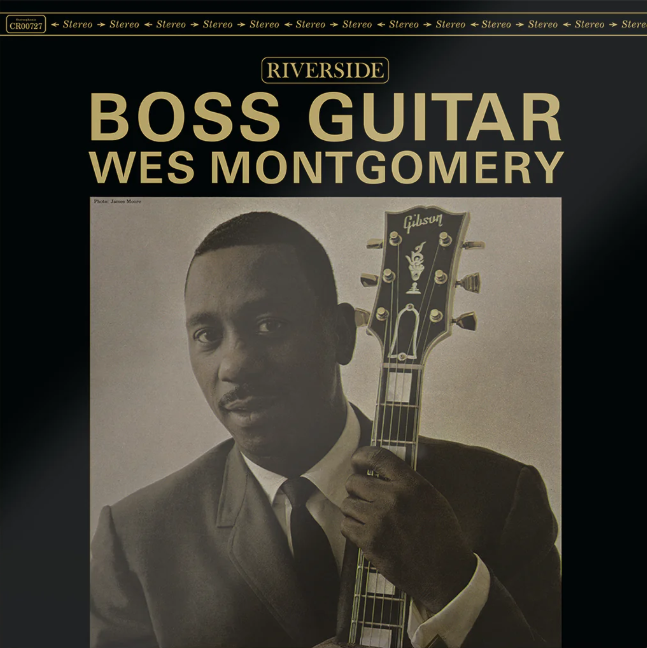
Wes Montgomery Boss Guitar (2025 Craft Recordings reissue)
Craft Recordings / Riverside Records
-
Regular price
-
$60.00 SGD
-
Regular price
-
-
Sale price
-
$60.00 SGD
- Unit price
-
per
Couldn't load pickup availability
About
Originally released in 1963, Boss Guitar is the 8th album from influential and prolific jazz guitarist Wes Montgomery. Released on the legendary Riverside label it also features Melvine Rhyne (organ) and Jimmy Cobb (drums) across a selection of standards and Montgomery originals. This new edition of the album is released as part of the Original Jazz Classics Series on 180-gram vinyl pressed at RTI with all-analog mastering from the original tapes at Cohearent Audio and a Stoughton Tip-On Jacket. — (via Label)
—
Wes Montgomery recorded Boss Guitar at age 38, near the end of his acclaimed Riverside years and just five years before his death. While the records that followed would give him some radio hits (and lose him some fans), the 1963 session was a time when he really could make the bold claim of the album’s title. The previous year, Montgomery had placed fourth in the then influential Playboy Jazz Poll among reader ballots, and had been named “All-Stars’ All-Star Guitar” among voting musicians (an electorate that included Cannonball Adderley, Miles Davis, John Coltrane, Paul Desmond, Duke Ellington, Stan Getz, Dizzy Gillespie, Oscar Peterson and Frank Sinatra, among others).
The role of boss carries through to the way he worked with his trio. Montgomery had often employed Mel Rhyne’s organ for his sessions. Drummer Jimmy Cobb had worked with Adderley, Coltrane, Davis, Getz, Gillespie and Billie Holiday. But both were primarily backing musicians, and scarcely solo throughout the eight tracks cut for the album. It is Boss Guitar, front and center. Which isn’t too much of a good thing. Montgomery was a naturally lyrical player, hopping octaves with ease, never sounding out of place but never predictable. He sashays through “Besame Mucho” and strolls along “Days of Wine and Roses.” And while the trio mostly plays popular songs of the day, the two Montgomery compositions here stand out among the rest.
This issue is newly remastered (with the latest bit of logo-worthy technology) and includes the original liner notes as well as the notes from the 1989 reissue. Two bonus tracks (also on the 1989 version) don’t stray far from the original versions, but do keep the party going a little longer. — (via All About Jazz)
—
Wes Montgomery recorded Boss Guitar at age 38, near the end of his acclaimed Riverside years and just five years before his death. While the records that followed would give him some radio hits (and lose him some fans), the 1963 session was a time when he really could make the bold claim of the album’s title. The previous year, Montgomery had placed fourth in the then influential Playboy Jazz Poll among reader ballots, and had been named “All-Stars’ All-Star Guitar” among voting musicians (an electorate that included Cannonball Adderley, Miles Davis, John Coltrane, Paul Desmond, Duke Ellington, Stan Getz, Dizzy Gillespie, Oscar Peterson and Frank Sinatra, among others).
The role of boss carries through to the way he worked with his trio. Montgomery had often employed Mel Rhyne’s organ for his sessions. Drummer Jimmy Cobb had worked with Adderley, Coltrane, Davis, Getz, Gillespie and Billie Holiday. But both were primarily backing musicians, and scarcely solo throughout the eight tracks cut for the album. It is Boss Guitar, front and center. Which isn’t too much of a good thing. Montgomery was a naturally lyrical player, hopping octaves with ease, never sounding out of place but never predictable. He sashays through “Besame Mucho” and strolls along “Days of Wine and Roses.” And while the trio mostly plays popular songs of the day, the two Montgomery compositions here stand out among the rest.
This issue is newly remastered (with the latest bit of logo-worthy technology) and includes the original liner notes as well as the notes from the 1989 reissue. Two bonus tracks (also on the 1989 version) don’t stray far from the original versions, but do keep the party going a little longer. — (via All About Jazz)
—
I have very fond memories of Boss Guitar – it was the first jazz LP I ever bought with my own money, and I got it from the old Ray’s Jazz Shop on Shaftesbury Avenue back in early 1990. I still have that very copy, and although I won’t be selling it off, it has been superseded by this superb new all-analogue Craft OJC edition, mastered and cut by Kevin Gray: my old 1980s OJC sounded great, but this new version sounds absolutely sensational.
One of Wes’ better albums from his early 1960s peak, before he started playing smooth jazz in 1966, Boss Guitar is a classic organ trio recording. It’s remarkable for the space each player is allowed to develop their ideas: definitely a case of ‘less is more’.
Although the opener, a gloriously peppy version of ‘Besame Mucho’ is the best (and best known) track – Wes plays the lead hot and this usually laidback tune takes on a unique, fiery intensity – it’s the slower songs that allow him and his bandmates to really express themselves.
Thus, a leisurely take on Henry Mancini’s theme to the movie Days of Wine and Roses shows off the beauty of the melody. The ballad ‘For Heaven’s Sake’, made famous by Billie Holiday, features some of Montgomery’s softest, most tender playing; meanwhile ‘The Breeze And I’ features some of his most precise, yet laid-back, chording.
While it may not be Wes’ finest or most groundbreaking release Boss Guitar is certainly one of his most enjoyable: technically accomplished without being cold, smooth without being cheesy; and well, just goddamn cool. — (via Jazzwise)
Vinyl Tracklist
A1 Besame Mucho
A2 Dearly Beloved
A3 Days Of Wine And Roses
A4 The Trick Bag
B1 Canadian Sunset
B2 Fried Pies
B3 The Breeze And I
B4 For Heaven's Sake
↓
Label: Craft Recordings // Riverside Records
Format: Vinyl, LP, Album, Reissue, Stereo, 180g
Reissued: 2025 / Originally Released: 1963
Genre: Jazz
Style: Hard Bop
File under: Audiophile Jazz
⦿
Share
Craft Recordings / Riverside Records
- Regular price
- $60.00 SGD
- Regular price
-
- Sale price
- $60.00 SGD
- Unit price
- per
Couldn't load pickup availability
About
Originally released in 1963, Boss Guitar is the 8th album from influential and prolific jazz guitarist Wes Montgomery. Released on the legendary Riverside label it also features Melvine Rhyne (organ) and Jimmy Cobb (drums) across a selection of standards and Montgomery originals. This new edition of the album is released as part of the Original Jazz Classics Series on 180-gram vinyl pressed at RTI with all-analog mastering from the original tapes at Cohearent Audio and a Stoughton Tip-On Jacket. — (via Label)
—
Wes Montgomery recorded Boss Guitar at age 38, near the end of his acclaimed Riverside years and just five years before his death. While the records that followed would give him some radio hits (and lose him some fans), the 1963 session was a time when he really could make the bold claim of the album’s title. The previous year, Montgomery had placed fourth in the then influential Playboy Jazz Poll among reader ballots, and had been named “All-Stars’ All-Star Guitar” among voting musicians (an electorate that included Cannonball Adderley, Miles Davis, John Coltrane, Paul Desmond, Duke Ellington, Stan Getz, Dizzy Gillespie, Oscar Peterson and Frank Sinatra, among others).
The role of boss carries through to the way he worked with his trio. Montgomery had often employed Mel Rhyne’s organ for his sessions. Drummer Jimmy Cobb had worked with Adderley, Coltrane, Davis, Getz, Gillespie and Billie Holiday. But both were primarily backing musicians, and scarcely solo throughout the eight tracks cut for the album. It is Boss Guitar, front and center. Which isn’t too much of a good thing. Montgomery was a naturally lyrical player, hopping octaves with ease, never sounding out of place but never predictable. He sashays through “Besame Mucho” and strolls along “Days of Wine and Roses.” And while the trio mostly plays popular songs of the day, the two Montgomery compositions here stand out among the rest.
This issue is newly remastered (with the latest bit of logo-worthy technology) and includes the original liner notes as well as the notes from the 1989 reissue. Two bonus tracks (also on the 1989 version) don’t stray far from the original versions, but do keep the party going a little longer. — (via All About Jazz)
—
Wes Montgomery recorded Boss Guitar at age 38, near the end of his acclaimed Riverside years and just five years before his death. While the records that followed would give him some radio hits (and lose him some fans), the 1963 session was a time when he really could make the bold claim of the album’s title. The previous year, Montgomery had placed fourth in the then influential Playboy Jazz Poll among reader ballots, and had been named “All-Stars’ All-Star Guitar” among voting musicians (an electorate that included Cannonball Adderley, Miles Davis, John Coltrane, Paul Desmond, Duke Ellington, Stan Getz, Dizzy Gillespie, Oscar Peterson and Frank Sinatra, among others).
The role of boss carries through to the way he worked with his trio. Montgomery had often employed Mel Rhyne’s organ for his sessions. Drummer Jimmy Cobb had worked with Adderley, Coltrane, Davis, Getz, Gillespie and Billie Holiday. But both were primarily backing musicians, and scarcely solo throughout the eight tracks cut for the album. It is Boss Guitar, front and center. Which isn’t too much of a good thing. Montgomery was a naturally lyrical player, hopping octaves with ease, never sounding out of place but never predictable. He sashays through “Besame Mucho” and strolls along “Days of Wine and Roses.” And while the trio mostly plays popular songs of the day, the two Montgomery compositions here stand out among the rest.
This issue is newly remastered (with the latest bit of logo-worthy technology) and includes the original liner notes as well as the notes from the 1989 reissue. Two bonus tracks (also on the 1989 version) don’t stray far from the original versions, but do keep the party going a little longer. — (via All About Jazz)
—
I have very fond memories of Boss Guitar – it was the first jazz LP I ever bought with my own money, and I got it from the old Ray’s Jazz Shop on Shaftesbury Avenue back in early 1990. I still have that very copy, and although I won’t be selling it off, it has been superseded by this superb new all-analogue Craft OJC edition, mastered and cut by Kevin Gray: my old 1980s OJC sounded great, but this new version sounds absolutely sensational.
One of Wes’ better albums from his early 1960s peak, before he started playing smooth jazz in 1966, Boss Guitar is a classic organ trio recording. It’s remarkable for the space each player is allowed to develop their ideas: definitely a case of ‘less is more’.
Although the opener, a gloriously peppy version of ‘Besame Mucho’ is the best (and best known) track – Wes plays the lead hot and this usually laidback tune takes on a unique, fiery intensity – it’s the slower songs that allow him and his bandmates to really express themselves.
Thus, a leisurely take on Henry Mancini’s theme to the movie Days of Wine and Roses shows off the beauty of the melody. The ballad ‘For Heaven’s Sake’, made famous by Billie Holiday, features some of Montgomery’s softest, most tender playing; meanwhile ‘The Breeze And I’ features some of his most precise, yet laid-back, chording.
While it may not be Wes’ finest or most groundbreaking release Boss Guitar is certainly one of his most enjoyable: technically accomplished without being cold, smooth without being cheesy; and well, just goddamn cool. — (via Jazzwise)
Vinyl Tracklist
A1 Besame Mucho
A2 Dearly Beloved
A3 Days Of Wine And Roses
A4 The Trick Bag
B1 Canadian Sunset
B2 Fried Pies
B3 The Breeze And I
B4 For Heaven's Sake
↓
Label: Craft Recordings // Riverside Records
Format: Vinyl, LP, Album, Reissue, Stereo, 180g
Reissued: 2025 / Originally Released: 1963
Genre: Jazz
Style: Hard Bop
File under: Audiophile Jazz
⦿
Share
- Choosing a selection results in a full page refresh.