


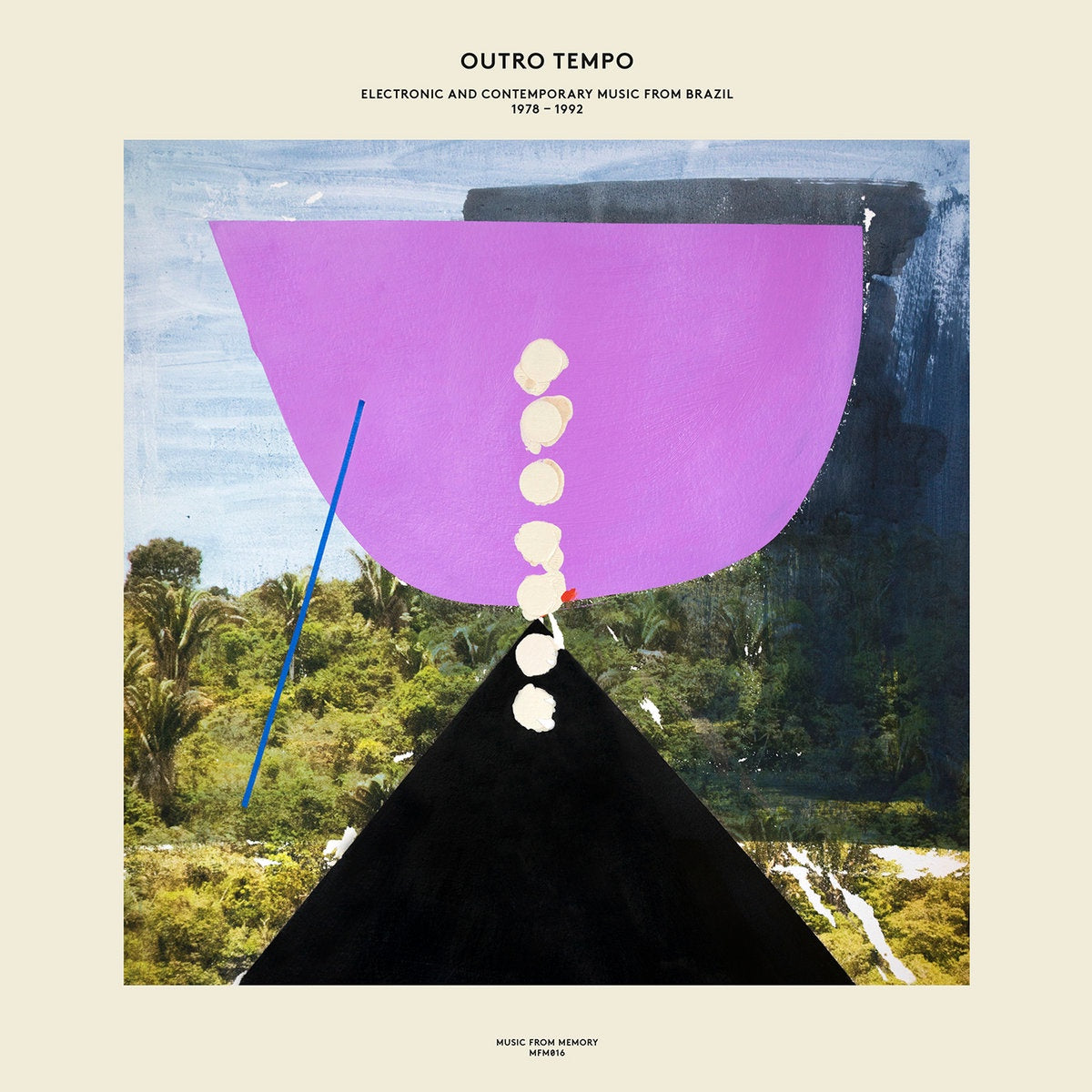
Various Outro Tempo (Electronic And Contemporary Music From Brazil 1978 to 1992)
-
Regular price
-
$60.00 SGD
-
Regular price
-
-
Sale price
-
$60.00 SGD
- Unit price
-
per
Couldn't load pickup availability
About
For their first multi-artist compilation, Music From Memory take us on a trip to the heart of the Amazon rainforest. Outro Tempo: Electronic and Contemporary Music From Brazil, 1978-1992 is a double LP that explores the outer reaches of Brazilian music, where indigenous rhythms mix with synthesizers and where MPB mingles with drum computers.
As Brazil faced the last years of its military dictatorship and transition to democracy, a generation of forward-thinking musicians developed an alternative vision of Brazilian music and culture. They embraced traditionally shunned electronic production methods and infused their music with elements of ambient, jazz-fusion, and minimalism. At the same time they referenced the musical forms and spirituality of indigenous tribes from the Amazon. The music they produced was a complex and mesmerising tapestry that vividly evoked Brazilian landscapes and simultaneously reached out to the world beyond its borders.
The product of extensive research, this compilation is a unique introduction to this visionary music and features many fresh discoveries in a country well trodden by record diggers. It gathers tracks from obscure albums that have for too long been neglected by even the most avid collectors of Brazilian music.
It includes now highly sought after music by Andréa Daltro, Maria Rita, and Fernando Falcão, as well as unknown gems like those of Cinema, Carlinhos Santos, and Anno Luz.
This is an essential release that reveals a broader spectrum of Brazilian music, striking a unique sonic signature that is full of innovation, experimentation, and beauty.
Compiled by John Gómez and featuring extensive liner notes, Outro Tempo showcases this overlooked corner in Brazil’s rich music history for the first time. — (via Label)
—
Brazil has long had beautiful, covetable records. Its tropicália and bossa nova scenes are obsessed over, and the timeless catalogs of acts like Azymuth, Caetano Veloso and Os Mutantes are valued by DJs, producers, collectors, dealers and, naturally, reissue labels. Floating Points, Gilles Peterson, Antal and Madlib are notably enthusiastic for Brazilian music. (Peterson once traded his car for a copy of João Donato's Amazons.)
Some may think there's not much else to discover in a country whose record bins have been searched so extensively, but there's always a clever digger looking where others aren't. With Outro Tempo: Electronic And Contemporary Music From Brazil 1978-1992, London-based DJ John Gómez presents a scene that explored new age in parallel to those in the US, Central America and Europe.
Should Gómez tire of finding records, he might consider a career as a private investigator. In a recent interview, he described the lengths he went to in locating the artists that appear on Outro Tempo: "I contacted a bar where I had read Carlinhos Santos used to perform in Porto Alegre; the organiser of a conference at which Priscilla Ermel had once given a paper; the producer at a theatre in Bahia where Andréa Daltro had performed in a show." He began sourcing this music after stumbling on a copy of Maria Rita's Brasileira in Japan, following a hunch that a scene of homespun electronics had existed in Brazil. He spent days digging through record stores in São Paulo. Despite the prices that vinyl from Brazil can fetch, no one was looking for pioneering electronic Brazilian records—yet. Still, Gómez was wary of Columbusing this scene. "This has been meaningful music to people in all these different contexts, for years before we 'discovered' it," Gómez told Stamp The Wax.
Outro Tempo recontextualizes this scene for the kind of music fan who, like Young Marco, could spend "a solid two years just listening to new age records." These tracks often take a well-known genre—jazz, folk, tropicália—and bend them, using primitive electronic techniques, into some alien form. On the opening track, Piry Reis' "O Sol Na Janela," he sounds like a drunken lounge singer backed by an experimental synthesizer ensemble. The electro drums on "Só Quero Um Xodó" are reminiscent of Mantronix on a Gilberto Gil hit. Luli E Lucina harmonize beautifully over "E Foi," a folk arrangement warped with effects.
The compilation's truly stunning moments apply avant-garde electronic techniques to the musical traditions of the Amazon rainforest region. Gómez notes this scene emerged during a period of creative freedom following Brazil's transition, in 1985, from dictatorship to democracy. This era also saw increased attention paid to previously nonexistent rights for the Amazon Indian population. Musicians like Priscilla Ermel traveled deep into the Amazon to study indigenous music. Ermel's Outro Tempo contributions—1989's "Gestos De Equilíbrio" and 1986's "Corpo Do Vento"—are dizzying fourth world journeys. "Gestos De Equilíbrio" segues from plucked, orientalist guitar section to evocative soundtrack-style work and a psychedelic Rhodes jam over the course of nine minutes. Tracks like these show how Brazil's new age artists worked towards a goal common among visionary artists in the field—combining the indigenous with the utterly alien. — (via Resident Advisor)+
This ambitious compilation features wild blends of electronics, jazz fusion, new age drifts, new-fangled digital drum machines, and traditional Brazilian percussion placed into new, curious sounds.
In 1985, Brazil’s repressive junta finally allowed for direct elections for a president for the first time since their military coup of 1964. For artists and musicians of all stripes, the censorship and repression experienced during that military reign came to be known as “vazio cultural” (cultural void). The most well-known example came with the 1968 arrest and subsequent exile of two stars of Tropicália, Caetano Veloso and Gilberto Gil. But for the artists who stayed in country, the regime’s censorship became increasingly Kafkaesque to navigate. Some artists resorted to recording without words so as to elude such censorship—see Milton Nascimento’s Milagre Dos Peixes—but it was only as the military’s stranglehold finally loosened that others began to rediscover their voices.
In the liner notes to Outro Tempo—a beguiling and dizzying assemblage of fourteen Brazilian experimental and fusion artists from around the time of that country’s thawing—producer John Gómez remembers happening upon Marco Bosco’s 1983 album Metalmadeira in a British thrift shop and finding a handwritten note within: “Dear Mr. Eno, I would like you to know about our work, we work with tapes and sounds of Nature.” Whether or not Mr. Eno ever happened upon this music, in the instance of taking over thirty years for this work to drift to ears, each track feels like a message in a bottle. As guitarist Nando Carneiro states in the notes, musicians during this time “had to stay caught in a cage.” Emanating from a country increasingly isolated from the rest of the world, these artists put wild blends of electronics, jazz fusion, new age drifts, new-fangled digital drum machines, and traditional Brazilian percussion into a new, curious sound.
The most stunning compositions come from Priscilla Ermel, represented by the two longest cuts on the compilation. During the ’80s, Ermel traveled into the rainforest to immerse herself in study of these vanishing indigenous forms, seeking to fuse it with her own sensibilities as a musician and composer. But rather than just conduct a simple integration of ancient and modern, she also reaches outside of her country for other timbres, suggesting a “world music” more holistic than such a tag implies.
“They are portals through which stories, people, and cultures can be revealed,” Ermel explains in the album’s liner notes about how she perceives her music. And almost every track here resonates like a secret kept silent for decades. Outro Tempo opens up a portal for us in the present moment back to a time and place where —under the suffocating weight of a totalitarian state—a few brave musicians nevertheless could hear the sounds of a brighter world. — (via Pitchfork)
Vinyl Tracklist
A1 Piry Reis - O Sol Na Janela
A2 Nando Carneiro - G.R.E.S. Luxo Artesanal / O Camponês
A3 Cinema - Sem Teto
A4 Os Mulheres Negras - Só Quero Um Xodó
A5 Fernando Falcão - Amanhecer Tabajara (À Alceu Valença)
B1 Anno Luz - Por Quê
B2 Andréa Daltro - Kiuá
B3 Os Mulheres Negras - Mãoscolorida
B4 Bené Fonteles - O M M
B5 Carlinhos Santos - Giramundo
C1 Priscilla Ermel - Gestos De Equilíbrio
C2 Carioca - Branca
C3 Marco Bosco - Sol Da Manhã
C4 Maria Rita - Cântico Brasileiro No. 3 (Kamaiurá)
D1 Marco Bosco - Madeira II (Mãe Terra)
D2 Priscilla Ermel - Corpo Do Vento
D3 Luli E Lucina - E Foi
↓
Label: Music From Memory
Format: 2 x Vinyl, LP, Compilation
Released: 2017
Genre: Electronic, Jazz, Latin, Folk, World, & Country
Style: Experimental, Ambient, Fusion, MPB
File under: Electronic // Ambient / Experimental / IDM
⦿
Share
- Regular price
- $60.00 SGD
- Regular price
-
- Sale price
- $60.00 SGD
- Unit price
- per
Couldn't load pickup availability
About
For their first multi-artist compilation, Music From Memory take us on a trip to the heart of the Amazon rainforest. Outro Tempo: Electronic and Contemporary Music From Brazil, 1978-1992 is a double LP that explores the outer reaches of Brazilian music, where indigenous rhythms mix with synthesizers and where MPB mingles with drum computers.
As Brazil faced the last years of its military dictatorship and transition to democracy, a generation of forward-thinking musicians developed an alternative vision of Brazilian music and culture. They embraced traditionally shunned electronic production methods and infused their music with elements of ambient, jazz-fusion, and minimalism. At the same time they referenced the musical forms and spirituality of indigenous tribes from the Amazon. The music they produced was a complex and mesmerising tapestry that vividly evoked Brazilian landscapes and simultaneously reached out to the world beyond its borders.
The product of extensive research, this compilation is a unique introduction to this visionary music and features many fresh discoveries in a country well trodden by record diggers. It gathers tracks from obscure albums that have for too long been neglected by even the most avid collectors of Brazilian music.
It includes now highly sought after music by Andréa Daltro, Maria Rita, and Fernando Falcão, as well as unknown gems like those of Cinema, Carlinhos Santos, and Anno Luz.
This is an essential release that reveals a broader spectrum of Brazilian music, striking a unique sonic signature that is full of innovation, experimentation, and beauty.
Compiled by John Gómez and featuring extensive liner notes, Outro Tempo showcases this overlooked corner in Brazil’s rich music history for the first time. — (via Label)
—
Brazil has long had beautiful, covetable records. Its tropicália and bossa nova scenes are obsessed over, and the timeless catalogs of acts like Azymuth, Caetano Veloso and Os Mutantes are valued by DJs, producers, collectors, dealers and, naturally, reissue labels. Floating Points, Gilles Peterson, Antal and Madlib are notably enthusiastic for Brazilian music. (Peterson once traded his car for a copy of João Donato's Amazons.)
Some may think there's not much else to discover in a country whose record bins have been searched so extensively, but there's always a clever digger looking where others aren't. With Outro Tempo: Electronic And Contemporary Music From Brazil 1978-1992, London-based DJ John Gómez presents a scene that explored new age in parallel to those in the US, Central America and Europe.
Should Gómez tire of finding records, he might consider a career as a private investigator. In a recent interview, he described the lengths he went to in locating the artists that appear on Outro Tempo: "I contacted a bar where I had read Carlinhos Santos used to perform in Porto Alegre; the organiser of a conference at which Priscilla Ermel had once given a paper; the producer at a theatre in Bahia where Andréa Daltro had performed in a show." He began sourcing this music after stumbling on a copy of Maria Rita's Brasileira in Japan, following a hunch that a scene of homespun electronics had existed in Brazil. He spent days digging through record stores in São Paulo. Despite the prices that vinyl from Brazil can fetch, no one was looking for pioneering electronic Brazilian records—yet. Still, Gómez was wary of Columbusing this scene. "This has been meaningful music to people in all these different contexts, for years before we 'discovered' it," Gómez told Stamp The Wax.
Outro Tempo recontextualizes this scene for the kind of music fan who, like Young Marco, could spend "a solid two years just listening to new age records." These tracks often take a well-known genre—jazz, folk, tropicália—and bend them, using primitive electronic techniques, into some alien form. On the opening track, Piry Reis' "O Sol Na Janela," he sounds like a drunken lounge singer backed by an experimental synthesizer ensemble. The electro drums on "Só Quero Um Xodó" are reminiscent of Mantronix on a Gilberto Gil hit. Luli E Lucina harmonize beautifully over "E Foi," a folk arrangement warped with effects.
The compilation's truly stunning moments apply avant-garde electronic techniques to the musical traditions of the Amazon rainforest region. Gómez notes this scene emerged during a period of creative freedom following Brazil's transition, in 1985, from dictatorship to democracy. This era also saw increased attention paid to previously nonexistent rights for the Amazon Indian population. Musicians like Priscilla Ermel traveled deep into the Amazon to study indigenous music. Ermel's Outro Tempo contributions—1989's "Gestos De Equilíbrio" and 1986's "Corpo Do Vento"—are dizzying fourth world journeys. "Gestos De Equilíbrio" segues from plucked, orientalist guitar section to evocative soundtrack-style work and a psychedelic Rhodes jam over the course of nine minutes. Tracks like these show how Brazil's new age artists worked towards a goal common among visionary artists in the field—combining the indigenous with the utterly alien. — (via Resident Advisor)+
This ambitious compilation features wild blends of electronics, jazz fusion, new age drifts, new-fangled digital drum machines, and traditional Brazilian percussion placed into new, curious sounds.
In 1985, Brazil’s repressive junta finally allowed for direct elections for a president for the first time since their military coup of 1964. For artists and musicians of all stripes, the censorship and repression experienced during that military reign came to be known as “vazio cultural” (cultural void). The most well-known example came with the 1968 arrest and subsequent exile of two stars of Tropicália, Caetano Veloso and Gilberto Gil. But for the artists who stayed in country, the regime’s censorship became increasingly Kafkaesque to navigate. Some artists resorted to recording without words so as to elude such censorship—see Milton Nascimento’s Milagre Dos Peixes—but it was only as the military’s stranglehold finally loosened that others began to rediscover their voices.
In the liner notes to Outro Tempo—a beguiling and dizzying assemblage of fourteen Brazilian experimental and fusion artists from around the time of that country’s thawing—producer John Gómez remembers happening upon Marco Bosco’s 1983 album Metalmadeira in a British thrift shop and finding a handwritten note within: “Dear Mr. Eno, I would like you to know about our work, we work with tapes and sounds of Nature.” Whether or not Mr. Eno ever happened upon this music, in the instance of taking over thirty years for this work to drift to ears, each track feels like a message in a bottle. As guitarist Nando Carneiro states in the notes, musicians during this time “had to stay caught in a cage.” Emanating from a country increasingly isolated from the rest of the world, these artists put wild blends of electronics, jazz fusion, new age drifts, new-fangled digital drum machines, and traditional Brazilian percussion into a new, curious sound.
The most stunning compositions come from Priscilla Ermel, represented by the two longest cuts on the compilation. During the ’80s, Ermel traveled into the rainforest to immerse herself in study of these vanishing indigenous forms, seeking to fuse it with her own sensibilities as a musician and composer. But rather than just conduct a simple integration of ancient and modern, she also reaches outside of her country for other timbres, suggesting a “world music” more holistic than such a tag implies.
“They are portals through which stories, people, and cultures can be revealed,” Ermel explains in the album’s liner notes about how she perceives her music. And almost every track here resonates like a secret kept silent for decades. Outro Tempo opens up a portal for us in the present moment back to a time and place where —under the suffocating weight of a totalitarian state—a few brave musicians nevertheless could hear the sounds of a brighter world. — (via Pitchfork)
Vinyl Tracklist
A1 Piry Reis - O Sol Na Janela
A2 Nando Carneiro - G.R.E.S. Luxo Artesanal / O Camponês
A3 Cinema - Sem Teto
A4 Os Mulheres Negras - Só Quero Um Xodó
A5 Fernando Falcão - Amanhecer Tabajara (À Alceu Valença)
B1 Anno Luz - Por Quê
B2 Andréa Daltro - Kiuá
B3 Os Mulheres Negras - Mãoscolorida
B4 Bené Fonteles - O M M
B5 Carlinhos Santos - Giramundo
C1 Priscilla Ermel - Gestos De Equilíbrio
C2 Carioca - Branca
C3 Marco Bosco - Sol Da Manhã
C4 Maria Rita - Cântico Brasileiro No. 3 (Kamaiurá)
D1 Marco Bosco - Madeira II (Mãe Terra)
D2 Priscilla Ermel - Corpo Do Vento
D3 Luli E Lucina - E Foi
↓
Label: Music From Memory
Format: 2 x Vinyl, LP, Compilation
Released: 2017
Genre: Electronic, Jazz, Latin, Folk, World, & Country
Style: Experimental, Ambient, Fusion, MPB
File under: Electronic // Ambient / Experimental / IDM
⦿
Share
- Choosing a selection results in a full page refresh.