


The Roots Things Fall Apart (20th Anniversary Deluxe Edition)
-
Regular price
-
$80.00 SGD
-
Regular price
-
-
Sale price
-
$80.00 SGD
- Unit price
-
per
Couldn't load pickup availability
About
— The Analog Vault // Essential Listening —
Things Fall Apart is where things finally came together for American hip hop group The Roots. Though respected in the alternative hip-hop scene, the band did not achieve mainstream exposure until this breakthrough album in 1999. Things Fall Apart endures as the group’s most fully realised document for their cerebral brand of rap and jazzy instrumental creativity.
Led by Black Thought’s sophisticated lyricism and Questlove’s world-class drumming - alongside MC Malik B, keyboardist Kamal Gray, turntablist Scratch, bassist Leonard Hubbard, and beatboxer Rahzel - Things Fall Apart coalesced into one of the most cohesive and fluid hip-hop records one will ever hear. Featuring collaborations with D’Angelo, Erykah Badu, Mos Def, Common, Jill Scott and Eve (among others), the collection of talent on offer here proved untouchable. — The Analog Vault
—
One of the cornerstone albums of alternative rap's second wave, Things Fall Apart was the point where the Roots' tremendous potential finally coalesced into a structured album that maintained its focus from top to bottom. If the group sacrifices a little of the unpredictability of its jam sessions, the resulting consistency more than makes up for it, since the record flows from track to track so effortlessly.
Taking its title from the Chinua Achebe novel credited with revitalizing African fiction, Things Fall Apart announces its ambition right upfront, and reinforces it in the opening sound collage. Dialogue sampled from Spike Lee's Mo' Better Blues implies a comparison to abstract modern jazz that lost its audience, and there's another quote about hip-hop records being treated as disposable, that they aren't maximized as product or as art. That's the framework in which the album operates, and while there's a definite unity counteracting the second observation, the artistic ambition actually helped gain the Roots a whole new audience ("coffeehouse chicks and white dudes," as Common puts it in the liner notes).
The backing tracks are jazzy and reflective, filled with subtly unpredictable instrumental lines, and the band also shows a strong affinity for the neo-soul movement, which they actually had a hand in kick-starting via their supporting work on Erykah Badu's Baduizm. Badu returns the favor by guesting on the album's breakthrough single, "You Got Me," an involved love story that also features a rap from Eve, co-writing from Jill Scott, and an unexpected drum'n'bass breakbeat in the outro.
Other notables include Mos Def on the playful old-school rhymefest "Double Trouble," Slum Village superproducer Jay Dee on "Dynamite!," and Philly native DJ Jazzy Jeff on "The Next Movement." But the real stars are Black Thought and Malik B, who drop such consistently nimble rhymes throughout the record that picking highlights is extremely difficult.
Along with works by Lauryn Hill, Common, and Black Star, Things Fall Apart is essential listening for anyone interested in the new breed of mainstream conscious rap. — (via AllMusic)
—
Things Fall Apart was a turning point for the Roots, the record where they figured out what kind of band they could be. Both its themes and its eclectic mix of sounds resonate in the current moment.
In 1999, the Roots were in limbo. The Philadelphia hip-hop band had released three critically acclaimed albums but were still considered something of a novelty act, featuring a big guy with a big Afro on drums (?uestlove), a sharp but unshowy MC (Black Thought), two beatboxers (Rahzel and Scratch), and a stellar live show—all anomalies in the gilded age of Puff Daddy and the million-dollar sample clearance. The Roots had by this time amassed a faithful cult following, but none of it translated to mainstream success. They were selling more records and slowly moving beyond their dedicated base of jazz and traditional rap purists, but their career wasn’t headed anywhere in particular.
Reflecting these tensions, the Roots opened their fourth studio album, Things Fall Apart, with dialogue from a scene from Spike Lee’s 1990 film, Mo’ Better Blues, in which characters Bleek Gilliam and Shadow Henderson—played by Denzel Washington and Wesley Snipes, respectively—debate the state of jazz music. Gilliam doesn’t want to sacrifice his creative vision to pander to crowds, and he thinks black people should come to his shows simply because he’s making black art. “That’s bullshit,” Henderson quips. “The people don’t come because you grandiose motherfuckers don’t play shit that they like.” The clip seemed to acknowledge the Roots’ reputation: They were too smart for their own good, too self-aware, and they were getting in their own way. It was as if, from the very beginning, the band sought to be misunderstood, to find somewhere to hide from the mainstream.
Things go in cycles, and the approach the Roots pioneered came back around. In 2015, the “next movement” the Roots mentioned on Things Fall Apart seemed to arrive. Kendrick Lamar’s To Pimp a Butterfly—a densely lyrical and allegorical exploration of Blackness and struggle, set to a live-jazz soundtrack featuring dozens of collaborators—is hard to imagine without this album in its rearview. Artists like Robert Glasper, Thundercat, Terrace Martin, and Kamasi Washington channel the same creativity as the Roots, D’Angelo, and company, banding together to push rap, jazz, soul, and more into atmospheric new places. The spirit of Things Fall Apart is in the air.
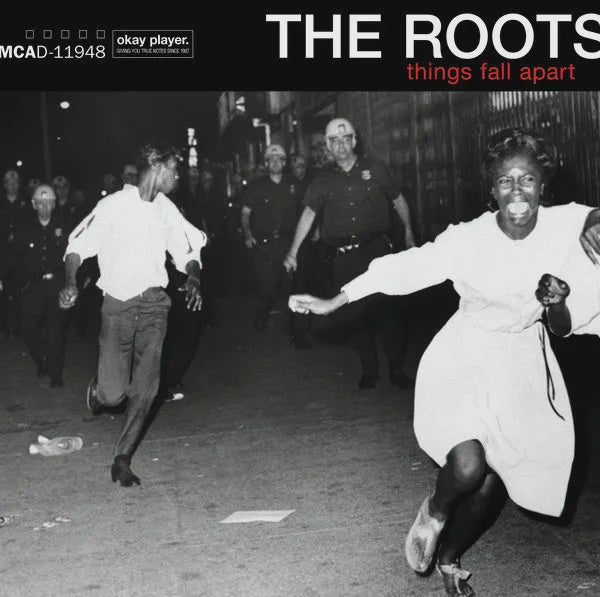
Looking back on it now, this record feels like both a love letter and a fond farewell to the Roots’ early days, acknowledging that they needed to evolve to stay relevant. And some of the album’s continued relevance is painful. Its closing poem, “The Return to Innocence Lost,” details the fate of a young man seemingly doomed to fail since birth. He dies tragically, leaving nothing but thoughts of a life that could’ve been. Nowadays, black men are dying at the hands of police with alarming frequency, and we’re left to mourn the dead in hashtags and shared articles, wondering what’s next—or who’s next—in this seemingly endless war. Things Fall Apart imparts a similar tone, even if the band didn’t address those issues directly. The black and white cover art, taken in Bed-Stuy, Brooklyn in 1965, depicts a young black woman running from a waiting police officer, her face twisted in fear. The scene is sadly familiar 50 years later. As the Roots teetered between fame and purgatory, virtue and failure, Things Fall Apart captured the intensity of a group with everything to lose and the world to gain. — (via Pitchfork)
—
Things Fall Apart is not the Roots' masterpiece, but rather the beginning of them making masterpieces. Its unforgettable cover art aside, with two terrified black people fleeing white police on foot, most of the album's depth is musical. Before Genius existed, Questlove was happy to fill the Roots' CD booklets with footnotes to help any listener place the cymbal-heavy opener "Table of Contents (Parts 1 & 2)" as a tribute to the "sloppy tambourine" of Marley Marl and "horrible mixing" of the Jungle Brothers. The drums on "Step Into the Realm" keep fading out as an homage to the breaks our heroes had to loop as kids from the ends of other songs where the only isolated drum sounds they could grab would fade out. The backing track of "Without a Doubt" is built entirely from a sample of their fellow hometown hero Schoolly-D.
Old-school rap was the foundation of Things Fall Apart, down to the back-and-forth mic-trading between Black Thought and Mos Def on "Double Trouble." But the hyper-time drum-and-bass that Questlove lays under the final chorus of "You Got Me," J Dilla's creaky deep-crate jazz on "Dynamite!" and the Jazzyfatnastees' hocketing vocals on "The Next Movement" were all expanding the sonic palates of millennial rap fans. The group embraced their progressivism visually, too, building on the subversive "What They Do" with two more Charles Stone III-directed videos: "You Got Me" remixed Radiohead's infamously open-ended "Just" clip, while the mini visual marvels of “The Next Movement,” rival anything Spike Jonze directed in the '90s.
The album cover and title of the Roots' third album were perhaps better suited to their darker later work, which became crucially political, but at least it established an urgency for the group, one they deserve to get back. Because the true theme song of Things Fall Apart is the centerpiece "Act Too (The Love of My Life)," whose titular inamorata is hip-hop itself, and that song's own music sounded like a successor to "The Cosby Show" theme, which at one time was another example of Philly pride. Making an album about how much you love what you do doesn’t sound like a radical concept, necessarily. But it’s an uplifting one, and when it busts open the doors that permit you to do so much more of it, well, that’s the beginning of a revolution, no? — (via Grammy)
—
Remastered 3LP deluxe edition
Tri-gatefold housed in a protective box
3rd LP curated by Questlove (bonus tracks & remixes)
24 Page Booklet featuring rare photos, and essays by Black Thought & Questlove, track commentaries by Questlove and lyrics
↓
Label: Okay Player
Format: 3 x Vinyl, LP, Album, Limited Edition, Reissue
Reissued: 2019 / Originally Released: 1999
Genre: Hip Hop
Style: Conscious, Rap, Jazzy Hip Hop
File under: TAV Essential Listening
File under: Hip-Hop
⦿
Share
- Regular price
- $80.00 SGD
- Regular price
-
- Sale price
- $80.00 SGD
- Unit price
- per
Couldn't load pickup availability
About
— The Analog Vault // Essential Listening —
Things Fall Apart is where things finally came together for American hip hop group The Roots. Though respected in the alternative hip-hop scene, the band did not achieve mainstream exposure until this breakthrough album in 1999. Things Fall Apart endures as the group’s most fully realised document for their cerebral brand of rap and jazzy instrumental creativity.
Led by Black Thought’s sophisticated lyricism and Questlove’s world-class drumming - alongside MC Malik B, keyboardist Kamal Gray, turntablist Scratch, bassist Leonard Hubbard, and beatboxer Rahzel - Things Fall Apart coalesced into one of the most cohesive and fluid hip-hop records one will ever hear. Featuring collaborations with D’Angelo, Erykah Badu, Mos Def, Common, Jill Scott and Eve (among others), the collection of talent on offer here proved untouchable. — The Analog Vault
—
One of the cornerstone albums of alternative rap's second wave, Things Fall Apart was the point where the Roots' tremendous potential finally coalesced into a structured album that maintained its focus from top to bottom. If the group sacrifices a little of the unpredictability of its jam sessions, the resulting consistency more than makes up for it, since the record flows from track to track so effortlessly.
Taking its title from the Chinua Achebe novel credited with revitalizing African fiction, Things Fall Apart announces its ambition right upfront, and reinforces it in the opening sound collage. Dialogue sampled from Spike Lee's Mo' Better Blues implies a comparison to abstract modern jazz that lost its audience, and there's another quote about hip-hop records being treated as disposable, that they aren't maximized as product or as art. That's the framework in which the album operates, and while there's a definite unity counteracting the second observation, the artistic ambition actually helped gain the Roots a whole new audience ("coffeehouse chicks and white dudes," as Common puts it in the liner notes).
The backing tracks are jazzy and reflective, filled with subtly unpredictable instrumental lines, and the band also shows a strong affinity for the neo-soul movement, which they actually had a hand in kick-starting via their supporting work on Erykah Badu's Baduizm. Badu returns the favor by guesting on the album's breakthrough single, "You Got Me," an involved love story that also features a rap from Eve, co-writing from Jill Scott, and an unexpected drum'n'bass breakbeat in the outro.
Other notables include Mos Def on the playful old-school rhymefest "Double Trouble," Slum Village superproducer Jay Dee on "Dynamite!," and Philly native DJ Jazzy Jeff on "The Next Movement." But the real stars are Black Thought and Malik B, who drop such consistently nimble rhymes throughout the record that picking highlights is extremely difficult.
Along with works by Lauryn Hill, Common, and Black Star, Things Fall Apart is essential listening for anyone interested in the new breed of mainstream conscious rap. — (via AllMusic)
—
Things Fall Apart was a turning point for the Roots, the record where they figured out what kind of band they could be. Both its themes and its eclectic mix of sounds resonate in the current moment.
In 1999, the Roots were in limbo. The Philadelphia hip-hop band had released three critically acclaimed albums but were still considered something of a novelty act, featuring a big guy with a big Afro on drums (?uestlove), a sharp but unshowy MC (Black Thought), two beatboxers (Rahzel and Scratch), and a stellar live show—all anomalies in the gilded age of Puff Daddy and the million-dollar sample clearance. The Roots had by this time amassed a faithful cult following, but none of it translated to mainstream success. They were selling more records and slowly moving beyond their dedicated base of jazz and traditional rap purists, but their career wasn’t headed anywhere in particular.
Reflecting these tensions, the Roots opened their fourth studio album, Things Fall Apart, with dialogue from a scene from Spike Lee’s 1990 film, Mo’ Better Blues, in which characters Bleek Gilliam and Shadow Henderson—played by Denzel Washington and Wesley Snipes, respectively—debate the state of jazz music. Gilliam doesn’t want to sacrifice his creative vision to pander to crowds, and he thinks black people should come to his shows simply because he’s making black art. “That’s bullshit,” Henderson quips. “The people don’t come because you grandiose motherfuckers don’t play shit that they like.” The clip seemed to acknowledge the Roots’ reputation: They were too smart for their own good, too self-aware, and they were getting in their own way. It was as if, from the very beginning, the band sought to be misunderstood, to find somewhere to hide from the mainstream.
Things go in cycles, and the approach the Roots pioneered came back around. In 2015, the “next movement” the Roots mentioned on Things Fall Apart seemed to arrive. Kendrick Lamar’s To Pimp a Butterfly—a densely lyrical and allegorical exploration of Blackness and struggle, set to a live-jazz soundtrack featuring dozens of collaborators—is hard to imagine without this album in its rearview. Artists like Robert Glasper, Thundercat, Terrace Martin, and Kamasi Washington channel the same creativity as the Roots, D’Angelo, and company, banding together to push rap, jazz, soul, and more into atmospheric new places. The spirit of Things Fall Apart is in the air.
Looking back on it now, this record feels like both a love letter and a fond farewell to the Roots’ early days, acknowledging that they needed to evolve to stay relevant. And some of the album’s continued relevance is painful. Its closing poem, “The Return to Innocence Lost,” details the fate of a young man seemingly doomed to fail since birth. He dies tragically, leaving nothing but thoughts of a life that could’ve been. Nowadays, black men are dying at the hands of police with alarming frequency, and we’re left to mourn the dead in hashtags and shared articles, wondering what’s next—or who’s next—in this seemingly endless war. Things Fall Apart imparts a similar tone, even if the band didn’t address those issues directly. The black and white cover art, taken in Bed-Stuy, Brooklyn in 1965, depicts a young black woman running from a waiting police officer, her face twisted in fear. The scene is sadly familiar 50 years later. As the Roots teetered between fame and purgatory, virtue and failure, Things Fall Apart captured the intensity of a group with everything to lose and the world to gain. — (via Pitchfork)
—
Things Fall Apart is not the Roots' masterpiece, but rather the beginning of them making masterpieces. Its unforgettable cover art aside, with two terrified black people fleeing white police on foot, most of the album's depth is musical. Before Genius existed, Questlove was happy to fill the Roots' CD booklets with footnotes to help any listener place the cymbal-heavy opener "Table of Contents (Parts 1 & 2)" as a tribute to the "sloppy tambourine" of Marley Marl and "horrible mixing" of the Jungle Brothers. The drums on "Step Into the Realm" keep fading out as an homage to the breaks our heroes had to loop as kids from the ends of other songs where the only isolated drum sounds they could grab would fade out. The backing track of "Without a Doubt" is built entirely from a sample of their fellow hometown hero Schoolly-D.
Old-school rap was the foundation of Things Fall Apart, down to the back-and-forth mic-trading between Black Thought and Mos Def on "Double Trouble." But the hyper-time drum-and-bass that Questlove lays under the final chorus of "You Got Me," J Dilla's creaky deep-crate jazz on "Dynamite!" and the Jazzyfatnastees' hocketing vocals on "The Next Movement" were all expanding the sonic palates of millennial rap fans. The group embraced their progressivism visually, too, building on the subversive "What They Do" with two more Charles Stone III-directed videos: "You Got Me" remixed Radiohead's infamously open-ended "Just" clip, while the mini visual marvels of “The Next Movement,” rival anything Spike Jonze directed in the '90s.
The album cover and title of the Roots' third album were perhaps better suited to their darker later work, which became crucially political, but at least it established an urgency for the group, one they deserve to get back. Because the true theme song of Things Fall Apart is the centerpiece "Act Too (The Love of My Life)," whose titular inamorata is hip-hop itself, and that song's own music sounded like a successor to "The Cosby Show" theme, which at one time was another example of Philly pride. Making an album about how much you love what you do doesn’t sound like a radical concept, necessarily. But it’s an uplifting one, and when it busts open the doors that permit you to do so much more of it, well, that’s the beginning of a revolution, no? — (via Grammy)
—
Remastered 3LP deluxe edition
Tri-gatefold housed in a protective box
3rd LP curated by Questlove (bonus tracks & remixes)
24 Page Booklet featuring rare photos, and essays by Black Thought & Questlove, track commentaries by Questlove and lyrics
↓
Label: Okay Player
Format: 3 x Vinyl, LP, Album, Limited Edition, Reissue
Reissued: 2019 / Originally Released: 1999
Genre: Hip Hop
Style: Conscious, Rap, Jazzy Hip Hop
File under: TAV Essential Listening
File under: Hip-Hop
⦿
Share
- Choosing a selection results in a full page refresh.