


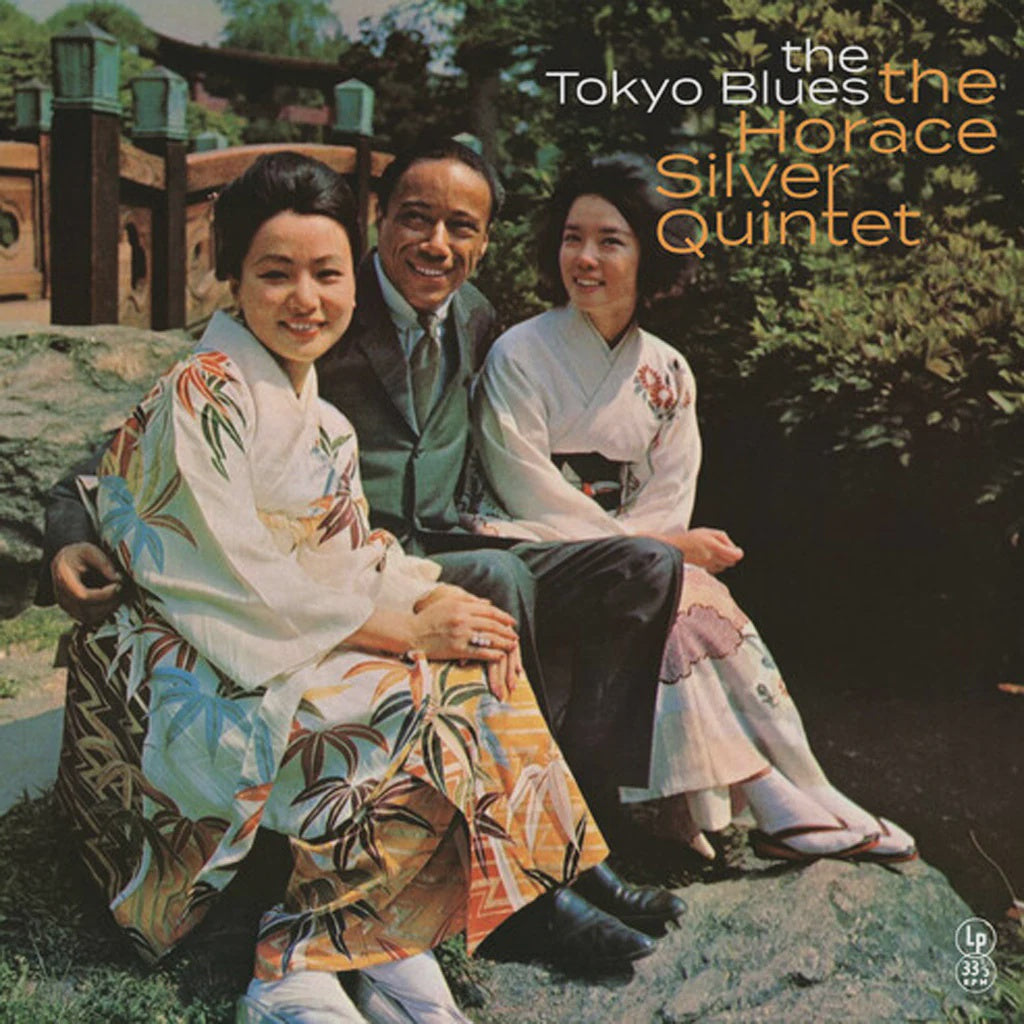
The Horace Silver Quintet The Tokyo Blues (Blue Note Tone Poet series)
Blue Note Records (Tone Poet series)
-
Regular price
-
$65.00 SGD
-
Regular price
-
-
Sale price
-
$65.00 SGD
- Unit price
-
per
Couldn't load pickup availability
About
— The Analog Vault // Essential Listening —
Following a series of concert dates in Tokyo late in 1961 with his quintet, Horace Silver returned to the U.S. with his head full of the Japanese melodies he had heard during his visit, and using those as a springboard, he wrote four new pieces, which he then recorded at sessions held on July 13 and 14, 1962, along with a version of Ronnell Bright's little known ballad "Cherry Blossom." One would naturally assume the resulting LP would have a Japanese feel, but that really isn't the case. Using Latin rhythms and the blues as a base, Silver's Tokyo-influenced compositions fit right in with the subtle cross-cultural but very American hard bop he'd been doing all along. Using his usual quintet (Blue Mitchell on trumpet, Junior Cook on tenor sax, Gene Taylor on bass) with drummer Joe Harris (he is listed as John Harris, Jr. for this set) filling in for an ailing Roy Brooks), Silver's compositions have a light, airy feel, with plenty of space, and no one used that space better at these sessions than Cook, whose tenor sax lines are simply wonderful, adding a sturdy, reliable brightness.
The centerpieces are the two straight blues, "Sayonara Blues" and "The Tokyo Blues," both of which have a delightfully natural flow, and the building, patient take on Bright's "Cherry Blossom," which Silver takes pains to make sure sounds like a ballad and not a barely restrained minor-key romp. The bottom line is that The Tokyo Blues emerges as a fairly typical Silver set from the era and not as a grandiose fusion experiment welding hard bop to Japanese melodies. That might have been interesting, certainly, but Silver obviously assimilated things down to a deeper level before he wrote these pieces, and they feel like a natural extension of his work rather than an experimental detour. — via (Steve Leggett // AllMusic)
—
Horace Silver’s 1962 tour of Japan had a profound impact on the pianist who returned to the U.S. and dedicated his subsequent album The Tokyo Blues to his fervent Japanese fans. Along with his quintet featuring trumpeter Blue Mitchell, tenor saxophonist Junior Cook, bassist Gene Taylor, and drummer John Harris Jr., Silver delivered an inspired 5-song set including his alluring originals “The Tokyo Blues,” “Too Much Sake,” “Sayonara Blues,” and “Ah! So,” as well as Ronnell Bright’s lovely ballad “Cherry Blossom.” Silver had noticed a love of Latin music among the Japanese jazz fans he met and in his compositions he sought to “combine the Japanese feeling in the melodies with the Latin feeling in the rhythms.” — (via Label)
—
A Blue Note postcard from Japan, written in groove and grace.
Some albums feel like travelogues pressed to vinyl, and The Tokyo Blues is exactly that: a record that carries you halfway across the world without leaving your seat. Released in 1962 on Blue Note, it was Horace Silver’s imaginative way of marking his visit to Japan — not with souvenirs or snapshots, but with sound. The pianist, already one of hard bop’s great architects, gathered his quintet and translated impressions of another culture into jazz idiom. The result is one of those Blue Note gems that is both deeply American and quietly global, a conversation across oceans.
The first thing you hear is the unmistakable Silver touch at the piano. His playing has always been rhythmic, earthy, infused with gospel cadences and blues inflections, and here it meets a Japanese palette of suggestion. But make no mistake: this is not pastiche. Silver doesn’t attempt to mimic; he reflects. The “Tokyo” in the title isn’t exotic scenery but inspiration, a reminder that jazz itself thrives on encounter.
The band is first-rate. Blue Mitchell’s trumpet is lyrical and warm, Junior Cook’s tenor saxophone is muscular yet supple, Gene Taylor keeps the bass buoyant, and John Harris Jr. drives the rhythm with drums that are light on their feet but steady at the core. Together they embody what makes a Silver quintet swing so distinctly: that tight balance between structure and looseness, melody and improvisation, church and club.
Take the opening track, “Too Much Sake.” Already the title carries humour and experience. The tune rolls in with a loping groove, Mitchell and Cook stating a theme that feels both bluesy and gently tipsy, as if swaying down a Tokyo street after a generous pour. Silver’s solo is sparkling, not in a showy sense but with the clarity of a storyteller who knows how to phrase. Every note falls into place as though it were preordained, yet it swings with casual joy.
The title track, “The Tokyo Blues,” is where Silver’s reflective side emerges. It is slower, more deliberate, infused with a mood that feels respectful rather than brash. Silver lingers on the piano, letting chords breathe, while the horns answer with a kind of dignity. It’s a blues, yes, but one that stretches into something contemplative. You can almost imagine Silver sitting at a piano in a quiet hotel lobby in Shinjuku, playing not for an audience but for the room itself.
Then there is “Sayonara Blues,” which has a farewell grace about it. The horns harmonise with wistful warmth, and Silver’s comping is understated, almost courtly. The rhythm section plays with restraint, giving space for the melody to resonate. It’s music that gestures outward, like a bow of thanks.
But Silver doesn’t let the album drift into sentimentality. “Cherry Blossom” picks up the tempo, bright and fresh, horns darting like petals in the wind. The rhythm section finds a groove that feels celebratory, and the solos dance. It’s Silver at his best: turning a simple idea into a structure where each player can shine without breaking the unity.
Finally, “Ah! So” closes the album with a wink. The tune is catchy, playful, and almost tongue-in-cheek. Silver knew how to end a session not with a grand finale but with a smile, something that left listeners wanting to drop the needle again.
On vinyl, the Rudy Van Gelder engineering is luminous. The horns have body and burnish, Silver’s piano is crisp and percussive, the bass resonant, and the cymbals shimmer without sharpness. It is a record made to be played loud enough to feel the groove, but never so loud as to overwhelm the subtlety. In a listening bar setting, it’s a perfect mid-evening record: it keeps conversation buoyant, the room alert, and the mood swinging without demanding centre stage.
What makes The Tokyo Blues particularly special in the Tracks & Tales context is its cultural stance. In 1962, global jazz was still in its infancy. Musicians were beginning to tour widely, to absorb and reflect on other cultures. Silver wasn’t trying to “represent” Japan; he was acknowledging it, folding impressions into his already distinctive style. That humility, that willingness to listen as well as play, makes the record resonate even now.
The album endures because it balances identity and openness. It is undeniably Horace Silver — gospel-rooted, blues-inflected, rhythmically alive — but it is also open to the world, curious, respectful. In that sense, it models exactly what listening bars aspire to: a space where influences meet, where sound becomes a medium of connection.
To play The Tokyo Blues today is to hear not just great jazz but a gesture of friendship across distance. It’s an album that says: here is where I come from, and here is what I heard in you. That’s why, decades later, it still swings, still moves, still speaks.
Lower the needle, let the horns call out, and follow Silver as he takes you down a Tokyo street where the blues and the blossom share the same breeze. — (via Rafi Mercer // Track & Tales)
—
About the Blue Note Tone Poet Series:
The Tone Poet Audiophile Vinyl Reissue Series was born out of Blue Note President Don Was’ admiration for the exceptional audiophile Blue Note LP reissues presented by Music Matters. Was brought Joe Harley, a.k.a. the “Tone Poet,” on board to curate and supervise a series of reissues from the Blue Note family of labels.
Extreme attention to detail has been paid to getting these right in every conceivable way, from the jacket graphics and printing quality to superior LP mastering (direct from the master tapes) by Kevin Gray to superb 180g audiophile LP pressings by Record Technology Inc. Every aspect of these Tone Poet releases is done to the highest possible standard. It means that you will never find a superior version. This is IT.
This stereo Tone Poet Vinyl Edition was produced by Joe Harley, mastered by Kevin Gray (Cohearent Audio) from the original analog master tapes, pressed on 180g vinyl at Record Technology Inc. (RTI), and packaged in a deluxe gatefold tip-on jacket.
Vinyl Tracklist
A1 Too Much Sake
A2 Sayanora Blues
B1 The Tokyo Blues
B2 Cherry Blossom
B3 Ah! So
↓
Label: Blue Note
Format: Vinyl, LP, Album, Reissue, Stereo, Gatefold, 180 Gram
Reissued: 2025 / Originally Released: 1962
Genre: Jazz
Style: Hard Bop
File under: TAV Essential Listening
File under: Jazz // Blue Note Tone Poet
⦿
Share
Blue Note Records (Tone Poet series)
- Regular price
- $65.00 SGD
- Regular price
-
- Sale price
- $65.00 SGD
- Unit price
- per
Couldn't load pickup availability
About
— The Analog Vault // Essential Listening —
Following a series of concert dates in Tokyo late in 1961 with his quintet, Horace Silver returned to the U.S. with his head full of the Japanese melodies he had heard during his visit, and using those as a springboard, he wrote four new pieces, which he then recorded at sessions held on July 13 and 14, 1962, along with a version of Ronnell Bright's little known ballad "Cherry Blossom." One would naturally assume the resulting LP would have a Japanese feel, but that really isn't the case. Using Latin rhythms and the blues as a base, Silver's Tokyo-influenced compositions fit right in with the subtle cross-cultural but very American hard bop he'd been doing all along. Using his usual quintet (Blue Mitchell on trumpet, Junior Cook on tenor sax, Gene Taylor on bass) with drummer Joe Harris (he is listed as John Harris, Jr. for this set) filling in for an ailing Roy Brooks), Silver's compositions have a light, airy feel, with plenty of space, and no one used that space better at these sessions than Cook, whose tenor sax lines are simply wonderful, adding a sturdy, reliable brightness.
The centerpieces are the two straight blues, "Sayonara Blues" and "The Tokyo Blues," both of which have a delightfully natural flow, and the building, patient take on Bright's "Cherry Blossom," which Silver takes pains to make sure sounds like a ballad and not a barely restrained minor-key romp. The bottom line is that The Tokyo Blues emerges as a fairly typical Silver set from the era and not as a grandiose fusion experiment welding hard bop to Japanese melodies. That might have been interesting, certainly, but Silver obviously assimilated things down to a deeper level before he wrote these pieces, and they feel like a natural extension of his work rather than an experimental detour. — via (Steve Leggett // AllMusic)
—
Horace Silver’s 1962 tour of Japan had a profound impact on the pianist who returned to the U.S. and dedicated his subsequent album The Tokyo Blues to his fervent Japanese fans. Along with his quintet featuring trumpeter Blue Mitchell, tenor saxophonist Junior Cook, bassist Gene Taylor, and drummer John Harris Jr., Silver delivered an inspired 5-song set including his alluring originals “The Tokyo Blues,” “Too Much Sake,” “Sayonara Blues,” and “Ah! So,” as well as Ronnell Bright’s lovely ballad “Cherry Blossom.” Silver had noticed a love of Latin music among the Japanese jazz fans he met and in his compositions he sought to “combine the Japanese feeling in the melodies with the Latin feeling in the rhythms.” — (via Label)
—
A Blue Note postcard from Japan, written in groove and grace.
Some albums feel like travelogues pressed to vinyl, and The Tokyo Blues is exactly that: a record that carries you halfway across the world without leaving your seat. Released in 1962 on Blue Note, it was Horace Silver’s imaginative way of marking his visit to Japan — not with souvenirs or snapshots, but with sound. The pianist, already one of hard bop’s great architects, gathered his quintet and translated impressions of another culture into jazz idiom. The result is one of those Blue Note gems that is both deeply American and quietly global, a conversation across oceans.
The first thing you hear is the unmistakable Silver touch at the piano. His playing has always been rhythmic, earthy, infused with gospel cadences and blues inflections, and here it meets a Japanese palette of suggestion. But make no mistake: this is not pastiche. Silver doesn’t attempt to mimic; he reflects. The “Tokyo” in the title isn’t exotic scenery but inspiration, a reminder that jazz itself thrives on encounter.
The band is first-rate. Blue Mitchell’s trumpet is lyrical and warm, Junior Cook’s tenor saxophone is muscular yet supple, Gene Taylor keeps the bass buoyant, and John Harris Jr. drives the rhythm with drums that are light on their feet but steady at the core. Together they embody what makes a Silver quintet swing so distinctly: that tight balance between structure and looseness, melody and improvisation, church and club.
Take the opening track, “Too Much Sake.” Already the title carries humour and experience. The tune rolls in with a loping groove, Mitchell and Cook stating a theme that feels both bluesy and gently tipsy, as if swaying down a Tokyo street after a generous pour. Silver’s solo is sparkling, not in a showy sense but with the clarity of a storyteller who knows how to phrase. Every note falls into place as though it were preordained, yet it swings with casual joy.
The title track, “The Tokyo Blues,” is where Silver’s reflective side emerges. It is slower, more deliberate, infused with a mood that feels respectful rather than brash. Silver lingers on the piano, letting chords breathe, while the horns answer with a kind of dignity. It’s a blues, yes, but one that stretches into something contemplative. You can almost imagine Silver sitting at a piano in a quiet hotel lobby in Shinjuku, playing not for an audience but for the room itself.
Then there is “Sayonara Blues,” which has a farewell grace about it. The horns harmonise with wistful warmth, and Silver’s comping is understated, almost courtly. The rhythm section plays with restraint, giving space for the melody to resonate. It’s music that gestures outward, like a bow of thanks.
But Silver doesn’t let the album drift into sentimentality. “Cherry Blossom” picks up the tempo, bright and fresh, horns darting like petals in the wind. The rhythm section finds a groove that feels celebratory, and the solos dance. It’s Silver at his best: turning a simple idea into a structure where each player can shine without breaking the unity.
Finally, “Ah! So” closes the album with a wink. The tune is catchy, playful, and almost tongue-in-cheek. Silver knew how to end a session not with a grand finale but with a smile, something that left listeners wanting to drop the needle again.
On vinyl, the Rudy Van Gelder engineering is luminous. The horns have body and burnish, Silver’s piano is crisp and percussive, the bass resonant, and the cymbals shimmer without sharpness. It is a record made to be played loud enough to feel the groove, but never so loud as to overwhelm the subtlety. In a listening bar setting, it’s a perfect mid-evening record: it keeps conversation buoyant, the room alert, and the mood swinging without demanding centre stage.
What makes The Tokyo Blues particularly special in the Tracks & Tales context is its cultural stance. In 1962, global jazz was still in its infancy. Musicians were beginning to tour widely, to absorb and reflect on other cultures. Silver wasn’t trying to “represent” Japan; he was acknowledging it, folding impressions into his already distinctive style. That humility, that willingness to listen as well as play, makes the record resonate even now.
The album endures because it balances identity and openness. It is undeniably Horace Silver — gospel-rooted, blues-inflected, rhythmically alive — but it is also open to the world, curious, respectful. In that sense, it models exactly what listening bars aspire to: a space where influences meet, where sound becomes a medium of connection.
To play The Tokyo Blues today is to hear not just great jazz but a gesture of friendship across distance. It’s an album that says: here is where I come from, and here is what I heard in you. That’s why, decades later, it still swings, still moves, still speaks.
Lower the needle, let the horns call out, and follow Silver as he takes you down a Tokyo street where the blues and the blossom share the same breeze. — (via Rafi Mercer // Track & Tales)
—
About the Blue Note Tone Poet Series:
The Tone Poet Audiophile Vinyl Reissue Series was born out of Blue Note President Don Was’ admiration for the exceptional audiophile Blue Note LP reissues presented by Music Matters. Was brought Joe Harley, a.k.a. the “Tone Poet,” on board to curate and supervise a series of reissues from the Blue Note family of labels.
Extreme attention to detail has been paid to getting these right in every conceivable way, from the jacket graphics and printing quality to superior LP mastering (direct from the master tapes) by Kevin Gray to superb 180g audiophile LP pressings by Record Technology Inc. Every aspect of these Tone Poet releases is done to the highest possible standard. It means that you will never find a superior version. This is IT.
This stereo Tone Poet Vinyl Edition was produced by Joe Harley, mastered by Kevin Gray (Cohearent Audio) from the original analog master tapes, pressed on 180g vinyl at Record Technology Inc. (RTI), and packaged in a deluxe gatefold tip-on jacket.
Vinyl Tracklist
A1 Too Much Sake
A2 Sayanora Blues
B1 The Tokyo Blues
B2 Cherry Blossom
B3 Ah! So
↓
Label: Blue Note
Format: Vinyl, LP, Album, Reissue, Stereo, Gatefold, 180 Gram
Reissued: 2025 / Originally Released: 1962
Genre: Jazz
Style: Hard Bop
File under: TAV Essential Listening
File under: Jazz // Blue Note Tone Poet
⦿
Share
- Choosing a selection results in a full page refresh.