


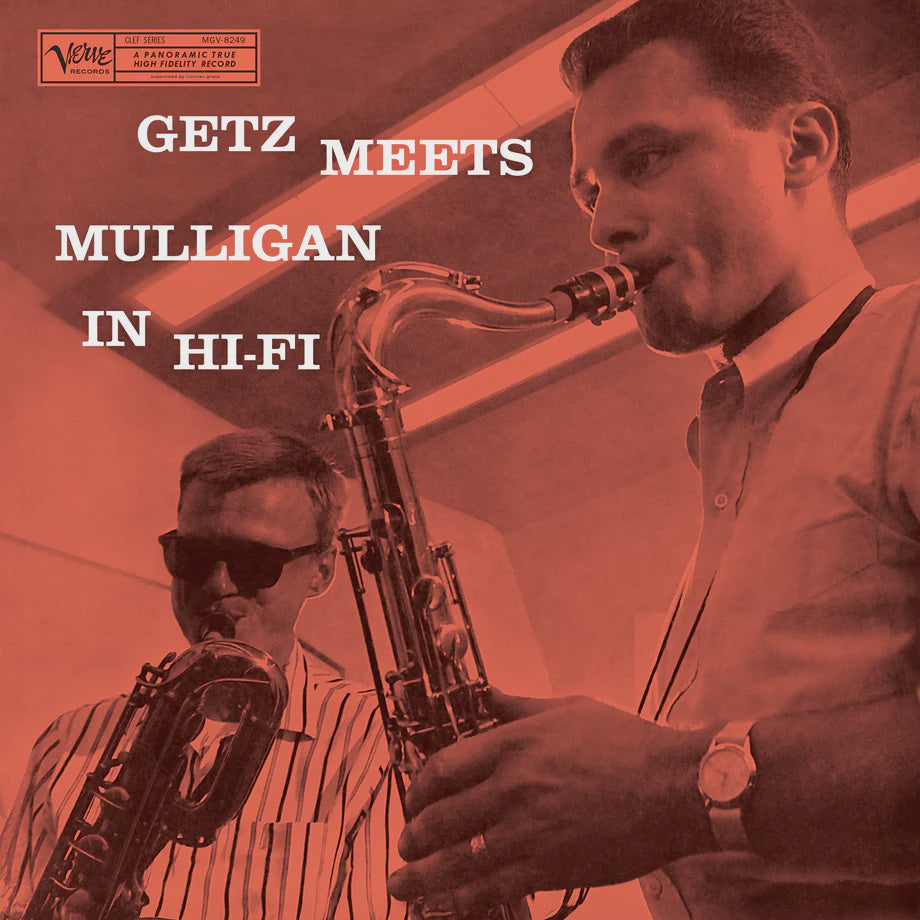
Stan Getz, Gerry Mulligan Getz Meets Mulligan In HiFi (Acoustic Sounds Series)
Verve (Acoustic Sounds Series)
-
Regular price
-
$65.00 SGD
-
Regular price
-
-
Sale price
-
$65.00 SGD
- Unit price
-
per
Couldn't load pickup availability
About
Under the guidance of Norman Granz, Stan Getz and Gerry Mulligan collaborate for the first time as the primary horns on Getz Meets Mulligan in Hi-Fi. Recorded in 1957, this record offers the unique opportunity to listen to the two jazz stars trade instruments on the first three tracks (‘Let's Fall in Love’, ‘Anything Goes’, and ‘Too Close for Comfort’) with Getz on baritone sax and Mulligan on tenor. The music gels with the help of a world-class rhythm section featuring Lou Levy on piano, Ray Brown on bass, and Stan Levey on drums. While a massive musical success, the duo never recorded again in this quintet format, making this record a rarity. Verve’s Acoustic Sounds Series features transfers from analog tapes and remastered 180-gram vinyl in deluxe gatefold packaging. — (via Label)
—
With two of the finest performers on their instruments accompanied by a stellar rhythm section this really could have been a great collaboration. Somebody (producer Norman Granz perhaps) decided it would be a good idea for Stan Getz and Gerry Mulligan to swop horns on Let’s Fall In Love, Anything Goes and Too Close For Comfort. Years later Mulligan told me that it certainly was not his decision and he also said he didn’t like the sound he achieved on Stan’s tenor.
Anything Goes once confused Ronnie Ross in a 1958 Downbeat blindfold test because he did not have a clue who was playing. This really was a wasted opportunity rather like recording Johnny Hodges on tenor with Lester Young on alto – what would be the point? That said there is still much to enjoy here with both men on top form, producing music of lasting value when not handicapped by an unnecessary gimmick.
The relaxed "That Old Feeling" is book-ended by eight bars of exchanges leading to Getz’s delightful paraphrase of the melody accompanied by sympathetic backgrounds from Mulligan. There is some extrovert, hard-swinging blowing from both men on This Can’t Be Love, uninhibited by the tempo which storms along at over 70 bpm.
The temperature cools several notches for Mulligan’s A Ballad which is given a sympathetic reading with both horns at their most lyrical. They really should have recorded more together. Their only other studio date was Jazz Giants ’58 with Harry Edison, Oscar Peterson’s trio and Louis Bellson. It’s well worth tracking down. — (via Jazz Journal)
—
There's a cross-dressing quality about the first three tracks on Getz Meets Mulligan in Hi-Fi. You hear the baritone and tenor saxophones but things seem a little inside out. The baritone has Stan Getz's mildness and the tenor sounds more like Mulligan's bouncing attack. In fact, Verve producer Norman Granz recorded just such a switch, which at first might seem pointless but it kind of grows on you. Getz plays the baritone saxophone and Mulligan plays the tenor on the three tracks. Both are lacking slightly, since the baritone doesn't sound nearly as commanding and the tenor doesn't sound as airy or as sweet. But somehow it works as a novelty on Let's Fall in Love, Anything Goes and Too Close for Comfort, forcing you to hear the instruments differently. Or rather, you wind up listening for the Getz feel on the baritone and the Mulligan feel on the tenor.
By the fourth track —That Old Feeling— Getz and Mulligan are on their signature horns, with Getz roosted on the high end of the tenor's register and soaring off the top while Mulligan bops along with barking-seal accents on the baritone. That's when the pairing of these two giants gels. And how could it not. If they were playing wooden recorders they'd sound great. After Lester Young, they were among the smoothest, most inventive saxophone swingers in the 1950s.
Recorded in October 1957, the album must have been recorded simultaneously in mono and stereo, a format that wasn't widespread yet. The mono hi-fi version was released in November '57 but the stereo version didn't come out until 1960, when more jazz record-buyers owned systems with two separate speakers that maximized the wider sound. The mono version of 1957 appeared at the peak of the high-fidelity craze and just before stereophonic sound caught on.
As for the three tracks with Getz and Mulligan, Granz pointed his finger at Mulligan for the saxophone swap. In his notes, Granz wrote: “Mulligan suggested at one juncture that they trade horns, so you find that on side one of the album that Getz plays baritone and Mulligan plays tenor; and on the other side they reversed the procedure so that each played his primary instrument, Stan the tenor and Gerry the baritone. The session, by the way, produced a second album, which will be released shortly after this one, so there will be something for fans to look forward to as further minutes of this history meeting." — (via All About Jazz)
↓
Label: Verve Records
Format: Vinyl, LP, Album, Reissue, Mono, Gatefold, 180g
Reissued: 2025 / Originally Released: 1957
Genre: Jazz
Style: Bop, Hard Bop
File under: Audiophile Jazz
⦿
Share
Verve (Acoustic Sounds Series)
- Regular price
- $65.00 SGD
- Regular price
-
- Sale price
- $65.00 SGD
- Unit price
- per
Couldn't load pickup availability
About
Under the guidance of Norman Granz, Stan Getz and Gerry Mulligan collaborate for the first time as the primary horns on Getz Meets Mulligan in Hi-Fi. Recorded in 1957, this record offers the unique opportunity to listen to the two jazz stars trade instruments on the first three tracks (‘Let's Fall in Love’, ‘Anything Goes’, and ‘Too Close for Comfort’) with Getz on baritone sax and Mulligan on tenor. The music gels with the help of a world-class rhythm section featuring Lou Levy on piano, Ray Brown on bass, and Stan Levey on drums. While a massive musical success, the duo never recorded again in this quintet format, making this record a rarity. Verve’s Acoustic Sounds Series features transfers from analog tapes and remastered 180-gram vinyl in deluxe gatefold packaging. — (via Label)
—
With two of the finest performers on their instruments accompanied by a stellar rhythm section this really could have been a great collaboration. Somebody (producer Norman Granz perhaps) decided it would be a good idea for Stan Getz and Gerry Mulligan to swop horns on Let’s Fall In Love, Anything Goes and Too Close For Comfort. Years later Mulligan told me that it certainly was not his decision and he also said he didn’t like the sound he achieved on Stan’s tenor.
Anything Goes once confused Ronnie Ross in a 1958 Downbeat blindfold test because he did not have a clue who was playing. This really was a wasted opportunity rather like recording Johnny Hodges on tenor with Lester Young on alto – what would be the point? That said there is still much to enjoy here with both men on top form, producing music of lasting value when not handicapped by an unnecessary gimmick.
The relaxed "That Old Feeling" is book-ended by eight bars of exchanges leading to Getz’s delightful paraphrase of the melody accompanied by sympathetic backgrounds from Mulligan. There is some extrovert, hard-swinging blowing from both men on This Can’t Be Love, uninhibited by the tempo which storms along at over 70 bpm.
The temperature cools several notches for Mulligan’s A Ballad which is given a sympathetic reading with both horns at their most lyrical. They really should have recorded more together. Their only other studio date was Jazz Giants ’58 with Harry Edison, Oscar Peterson’s trio and Louis Bellson. It’s well worth tracking down. — (via Jazz Journal)
—
There's a cross-dressing quality about the first three tracks on Getz Meets Mulligan in Hi-Fi. You hear the baritone and tenor saxophones but things seem a little inside out. The baritone has Stan Getz's mildness and the tenor sounds more like Mulligan's bouncing attack. In fact, Verve producer Norman Granz recorded just such a switch, which at first might seem pointless but it kind of grows on you. Getz plays the baritone saxophone and Mulligan plays the tenor on the three tracks. Both are lacking slightly, since the baritone doesn't sound nearly as commanding and the tenor doesn't sound as airy or as sweet. But somehow it works as a novelty on Let's Fall in Love, Anything Goes and Too Close for Comfort, forcing you to hear the instruments differently. Or rather, you wind up listening for the Getz feel on the baritone and the Mulligan feel on the tenor.
By the fourth track —That Old Feeling— Getz and Mulligan are on their signature horns, with Getz roosted on the high end of the tenor's register and soaring off the top while Mulligan bops along with barking-seal accents on the baritone. That's when the pairing of these two giants gels. And how could it not. If they were playing wooden recorders they'd sound great. After Lester Young, they were among the smoothest, most inventive saxophone swingers in the 1950s.
Recorded in October 1957, the album must have been recorded simultaneously in mono and stereo, a format that wasn't widespread yet. The mono hi-fi version was released in November '57 but the stereo version didn't come out until 1960, when more jazz record-buyers owned systems with two separate speakers that maximized the wider sound. The mono version of 1957 appeared at the peak of the high-fidelity craze and just before stereophonic sound caught on.
As for the three tracks with Getz and Mulligan, Granz pointed his finger at Mulligan for the saxophone swap. In his notes, Granz wrote: “Mulligan suggested at one juncture that they trade horns, so you find that on side one of the album that Getz plays baritone and Mulligan plays tenor; and on the other side they reversed the procedure so that each played his primary instrument, Stan the tenor and Gerry the baritone. The session, by the way, produced a second album, which will be released shortly after this one, so there will be something for fans to look forward to as further minutes of this history meeting." — (via All About Jazz)
↓
Label: Verve Records
Format: Vinyl, LP, Album, Reissue, Mono, Gatefold, 180g
Reissued: 2025 / Originally Released: 1957
Genre: Jazz
Style: Bop, Hard Bop
File under: Audiophile Jazz
⦿
Share
- Choosing a selection results in a full page refresh.