


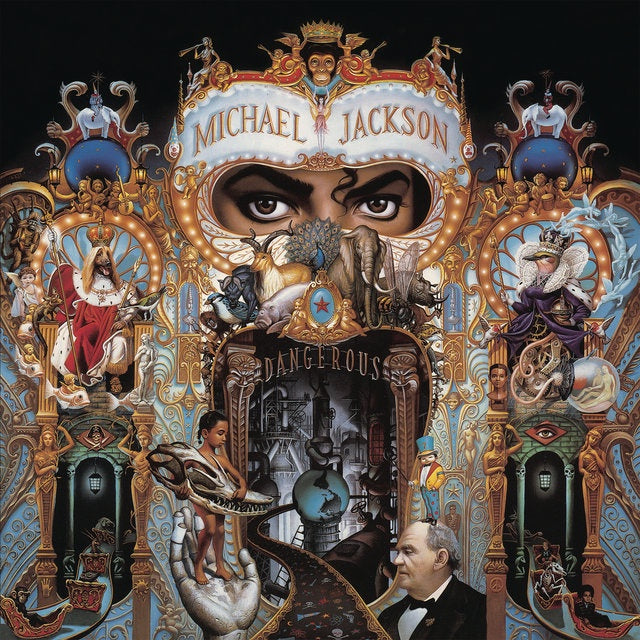
Michael Jackson Dangerous
-
Regular price
-
$60.00 SGD
-
Regular price
-
-
Sale price
-
$60.00 SGD
- Unit price
-
per
Couldn't load pickup availability
About
From 1972 to 2001, the American singer Michael Jackson released ten studio albums. Dangerous is the eighth studio album by American recording artist Michael Jackson, originally released in 1991 by Epic Records.
Dangerous took over a year in production, and was produced by Jackson with additional production from his friends Bill Bottrell and Teddy Riley. Jackson wrote twelve of the fourteen songs on the album. Lyrical themes expressed on the album included racism, poverty, romance, the welfare of children and the world and self-improvement, topics Jackson had covered before.
Dangerous peaked at number one in nine countries, while charting at the top ten in four other territories. Dangerous received several Grammy nominations, winning only one for Best Engineered Album (Non Classical) by Bruce Swedien and Riley. The album also received three nominations at the American Music Awards of 1993 ultimately winning two awards, mainly: Favorite Soul/R&B Single for the single "Remember the Time" and Favorite Pop/Rock Album for the album itself.
Dangerous has sold 32 million copies worldwide, 7 million albums were shipped in the United States alone, and has been cited as one of the best-selling albums of all time. The album produced four top ten singles on the Billboard Hot 100, including the number-one hit 'Black or White'.
Similar to the musician's previous material, the album's music features elements of R&B, pop and rock while also incorporating a newer genre, new jack swing, after the inclusion of producer Teddy Riley to the project in a bid to present Jackson to a younger urban audience. According to Chicago Tribune journalist Kelley L. Carter, it is the most successful new jack swing album of all time. — (via Discogs)
—
Despite the success of Bad, it was hard not to view it as a bit of a letdown, since it presented a cleaner, colder, calculated version of Thriller - something that delivered what it should on the surface, but wound up offering less in the long run. So, it was time for a change-up, something even a superstar as huge as Michael Jackson realized, so he left Quincy Jones behind, hired Guy mastermind Teddy Riley as the main producer, and worked with a variety of other producers, arrangers, and writers, most notably Bruce Swedien and Bill Bottrell. The end result of this is a much sharper, harder, riskier album than Bad, one that has its eyes on the street, even if its heart gets middle-class soft on "Heal the World."
The shift in direction and change of collaborators has liberated Jackson, and he's written a set of songs that is considerably stronger than Bad, often approaching the consistency of Off the Wall and Thriller. If it is hardly as effervescent or joyous as either of those records, chalk it up to his suffocating stardom, which results in a set of songs without much real emotional center, either in their substance or performance. But, there's a lot to be said for professional craftsmanship at its peak, and Dangerous has plenty of that, not just on such fine singles as "In the Closet," "Remember the Time," or the blistering "Jam," but on album tracks like "Why You Wanna Trip on Me." No, it's not perfect — it has a terrible cover, a couple of slow spots, and suffers from CD-era ailments of the early '90s, such as its overly long running time and its deadening Q Sound production, which sounds like somebody forgot to take the Surround Sound button off. Even so, Dangerous captures Jackson at a near-peak, delivering an album that would have ruled the pop charts surely and smoothly if it had arrived just a year earlier. But it didn't — it arrived along with grunge, which changed the rules of the game nearly as much as Thriller itself. Consequently, it's the rare multi-platinum, number one album that qualifies as a nearly forgotten, underappreciated record. — (via All Music)
—
At the time of Dangerous, Michael Jackson's universal popularity was on par with pizza and the polio vaccine. It was the last time that Michael Jackson was Michael Jackson.
Released only five months before the LA Riots, the Rodney King beating and murder of Latasha Harlins almost certainly factored into Jackson’s increasingly political slant. “Black or White” articulated a utopian vision of a post-racial future while acknowledging the sins of contemporary bigotry. He demands equality, shouting that he “ain’t second to none.” He growls, “I ain’t scared of no sheets” (presumably Klansmen). Its hook offers his dream of a color-blind society, echoing Martin Luther King.
The lone #1 single from the 32-million selling Dangerous, “Black or White” spent seven weeks atop the Billboard charts. Directed by John Landis (“Thriller,” National Lampoon’s Animal House) the first quarter of its video reveals Jackson’s mischievous child-like streak, with Culkin towing out Spinal Tap-sized speakers, amplifying the volume to “ARE YOU NUTS!?!,” and shredding so hard that George Wendt gets ejected into the stratosphere screaming “Da Bears.”
It blends into his idealistic visionary side that wanted to heal the world through philanthropy and moonwalking. There is pop locking with Balinese dancers, rain dances with Native Americans, folk dances in front of the Kremlin, and the serenade of a Hindu goddess on a freeway. This is the magical Michael Jackson of our early memories—the man with the graceful dance moves and lithe falsetto that seemed celestially ordained (masking a notoriously intense perfectionist streak). Faces of all races harmoniously morph into one another, the most cutting edge FX that 1991 had to offer.
My favorite song on Dangerous is “Remember the Time.” Like so many others on this album, it’s inextricable from its video, which also received the MJ treatment: simultaneous premieres on MTV, Fox and BET in February of 1992. Directed by John Singleton, it stars Eddie Murphy, Iman, the Pharcyde, Magic Johnson, Tiny Lister, and some adorable striped tabbies. It’s probably the only song from Dangerous that can still go off in any club on any given night.
In an interview given shortly after the release of Dangerous, Jackson said that his goal was to do “an album that was like Tchaikovsky’s ‘Nutcracker Suite.’ In a thousand years from now, people would still be listening to it…. Something that would live forever.” He’s been gone for over half a decade, but I still think about this quote every time I walk past that sound stage—considering the possibilities that Michael Jackson unlocked in every song, the infinite magic that he could create out of an empty room, the orphic visions of one of our final myths. — (via Pitchfork)
—
↓
Label: Epic / Legacy
Format: 2 x Vinyl, LP, Album, Reissue, 180 Gram
Reissued: 2020 / Original: 1991
Genre: Funk / Soul, Pop, Rock
Style: Contemporary R&B, Pop Rap, Pop Rock, Disco, New Jack Swing, Male Vocals
File under: Funk / Soul
⦿
Share
- Regular price
- $60.00 SGD
- Regular price
-
- Sale price
- $60.00 SGD
- Unit price
- per
Couldn't load pickup availability
About
From 1972 to 2001, the American singer Michael Jackson released ten studio albums. Dangerous is the eighth studio album by American recording artist Michael Jackson, originally released in 1991 by Epic Records.
Dangerous took over a year in production, and was produced by Jackson with additional production from his friends Bill Bottrell and Teddy Riley. Jackson wrote twelve of the fourteen songs on the album. Lyrical themes expressed on the album included racism, poverty, romance, the welfare of children and the world and self-improvement, topics Jackson had covered before.
Dangerous peaked at number one in nine countries, while charting at the top ten in four other territories. Dangerous received several Grammy nominations, winning only one for Best Engineered Album (Non Classical) by Bruce Swedien and Riley. The album also received three nominations at the American Music Awards of 1993 ultimately winning two awards, mainly: Favorite Soul/R&B Single for the single "Remember the Time" and Favorite Pop/Rock Album for the album itself.
Dangerous has sold 32 million copies worldwide, 7 million albums were shipped in the United States alone, and has been cited as one of the best-selling albums of all time. The album produced four top ten singles on the Billboard Hot 100, including the number-one hit 'Black or White'.
Similar to the musician's previous material, the album's music features elements of R&B, pop and rock while also incorporating a newer genre, new jack swing, after the inclusion of producer Teddy Riley to the project in a bid to present Jackson to a younger urban audience. According to Chicago Tribune journalist Kelley L. Carter, it is the most successful new jack swing album of all time. — (via Discogs)
—
Despite the success of Bad, it was hard not to view it as a bit of a letdown, since it presented a cleaner, colder, calculated version of Thriller - something that delivered what it should on the surface, but wound up offering less in the long run. So, it was time for a change-up, something even a superstar as huge as Michael Jackson realized, so he left Quincy Jones behind, hired Guy mastermind Teddy Riley as the main producer, and worked with a variety of other producers, arrangers, and writers, most notably Bruce Swedien and Bill Bottrell. The end result of this is a much sharper, harder, riskier album than Bad, one that has its eyes on the street, even if its heart gets middle-class soft on "Heal the World."
The shift in direction and change of collaborators has liberated Jackson, and he's written a set of songs that is considerably stronger than Bad, often approaching the consistency of Off the Wall and Thriller. If it is hardly as effervescent or joyous as either of those records, chalk it up to his suffocating stardom, which results in a set of songs without much real emotional center, either in their substance or performance. But, there's a lot to be said for professional craftsmanship at its peak, and Dangerous has plenty of that, not just on such fine singles as "In the Closet," "Remember the Time," or the blistering "Jam," but on album tracks like "Why You Wanna Trip on Me." No, it's not perfect — it has a terrible cover, a couple of slow spots, and suffers from CD-era ailments of the early '90s, such as its overly long running time and its deadening Q Sound production, which sounds like somebody forgot to take the Surround Sound button off. Even so, Dangerous captures Jackson at a near-peak, delivering an album that would have ruled the pop charts surely and smoothly if it had arrived just a year earlier. But it didn't — it arrived along with grunge, which changed the rules of the game nearly as much as Thriller itself. Consequently, it's the rare multi-platinum, number one album that qualifies as a nearly forgotten, underappreciated record. — (via All Music)
—
At the time of Dangerous, Michael Jackson's universal popularity was on par with pizza and the polio vaccine. It was the last time that Michael Jackson was Michael Jackson.
Released only five months before the LA Riots, the Rodney King beating and murder of Latasha Harlins almost certainly factored into Jackson’s increasingly political slant. “Black or White” articulated a utopian vision of a post-racial future while acknowledging the sins of contemporary bigotry. He demands equality, shouting that he “ain’t second to none.” He growls, “I ain’t scared of no sheets” (presumably Klansmen). Its hook offers his dream of a color-blind society, echoing Martin Luther King.
The lone #1 single from the 32-million selling Dangerous, “Black or White” spent seven weeks atop the Billboard charts. Directed by John Landis (“Thriller,” National Lampoon’s Animal House) the first quarter of its video reveals Jackson’s mischievous child-like streak, with Culkin towing out Spinal Tap-sized speakers, amplifying the volume to “ARE YOU NUTS!?!,” and shredding so hard that George Wendt gets ejected into the stratosphere screaming “Da Bears.”
It blends into his idealistic visionary side that wanted to heal the world through philanthropy and moonwalking. There is pop locking with Balinese dancers, rain dances with Native Americans, folk dances in front of the Kremlin, and the serenade of a Hindu goddess on a freeway. This is the magical Michael Jackson of our early memories—the man with the graceful dance moves and lithe falsetto that seemed celestially ordained (masking a notoriously intense perfectionist streak). Faces of all races harmoniously morph into one another, the most cutting edge FX that 1991 had to offer.
My favorite song on Dangerous is “Remember the Time.” Like so many others on this album, it’s inextricable from its video, which also received the MJ treatment: simultaneous premieres on MTV, Fox and BET in February of 1992. Directed by John Singleton, it stars Eddie Murphy, Iman, the Pharcyde, Magic Johnson, Tiny Lister, and some adorable striped tabbies. It’s probably the only song from Dangerous that can still go off in any club on any given night.
In an interview given shortly after the release of Dangerous, Jackson said that his goal was to do “an album that was like Tchaikovsky’s ‘Nutcracker Suite.’ In a thousand years from now, people would still be listening to it…. Something that would live forever.” He’s been gone for over half a decade, but I still think about this quote every time I walk past that sound stage—considering the possibilities that Michael Jackson unlocked in every song, the infinite magic that he could create out of an empty room, the orphic visions of one of our final myths. — (via Pitchfork)
—
↓
Label: Epic / Legacy
Format: 2 x Vinyl, LP, Album, Reissue, 180 Gram
Reissued: 2020 / Original: 1991
Genre: Funk / Soul, Pop, Rock
Style: Contemporary R&B, Pop Rap, Pop Rock, Disco, New Jack Swing, Male Vocals
File under: Funk / Soul
⦿
Share
- Choosing a selection results in a full page refresh.