


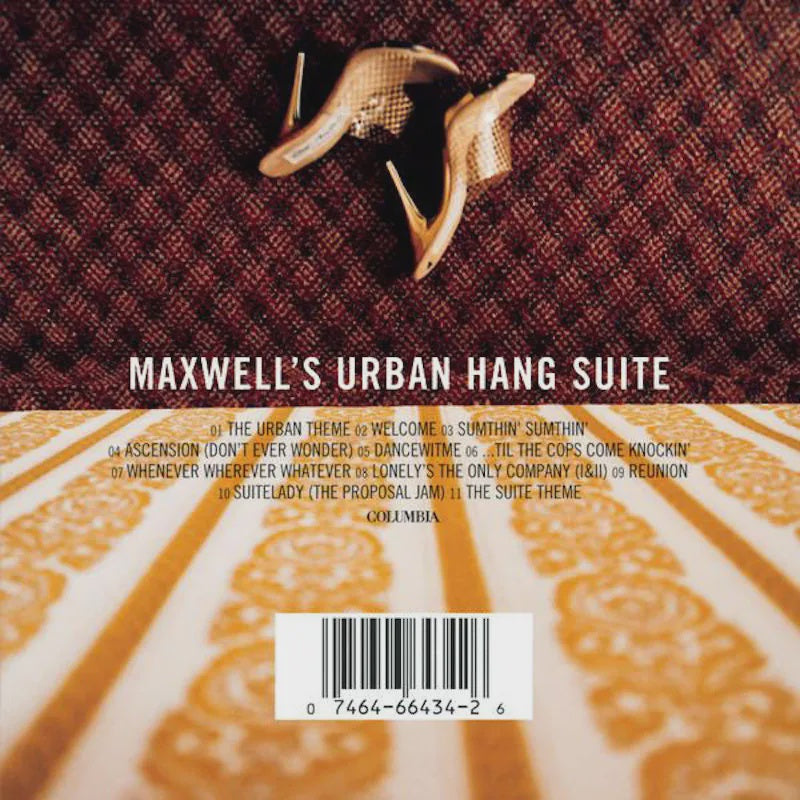
Maxwell Maxwell's Urban Hang Suite (30th anniversary edition)
-
Regular price
-
$65.00 SGD
-
Regular price
-
-
Sale price
-
$65.00 SGD
- Unit price
-
per
Couldn't load pickup availability
About
— The Analog Vault // Essential Listening —
Originally released in 1996 on Columbia Records, Maxwell’s Urban Hang Suite became one of the defining albums of the neo-soul movement. Blending classic soul arrangements with contemporary R&B production, Maxwell crafted a lush, sensual sound inspired by artists like Marvin Gaye and Prince. Songs such as “Ascension (Don’t Ever Wonder),” “Whenever Wherever Whatever,” and “Sumthin’ Sumthin’” showcase his smooth vocal phrasing over warm bass lines and live instrumentation. The album unfolds like a cohesive evening soundtrack, moving through moods of romance, introspection, and groove. Maxwell’s Urban Hang Suite helped reintroduce vintage soul aesthetics to 1990s audiences while establishing Maxwell as a leading voice of the genre.
—
— 2LP, Remastered and pressed on classic black vinyl
— Includes an 8‑page booklet of rare photos
—
Maxwell's debut offers up a sophisticated and stylized take on late-'60s and early-'70 soul. Sam Cooke, Marvin Gaye, Al Green, and the like are subtly referenced over the course of these 11 tracks of wide-screen soul. Mixing sensual funk with ballad sincerity, Maxwell coolly sings through highlights like "Welcome," "...Til the Cops Come Knockin'," and "Ascension (Don't Ever Wonder)." The atmospheric, cool-breeze soundscape comes courtesy of Maxwell and Sade cohort Stuart Mathewman. More expansive and airy sounding than the deep groove and gospel sides by fellow retro-soulster D'Angelo, Urban Hang Suite is destined to become a classic contemporary R&B album. — (via AllMusic)
—
In the late summer of 1996, Harlem was a loopy place to live—a mix of everyday strivers, storefront church-folk, street preachers, and bugged-out crackheads, buttressed by sneaker shops, streetwear emporiums (like Dr. Jays), soul-food joints, and no-nonsense African hair-braiding centers. Strolling down Lenox Avenue on a Sunday afternoon, I’d tuned my Walkman radio to DJ Hal Jackson’s legendary Sunday Morning Classics broadcast on WBLS: a slow-burn funk groove with an extended intro, hula-hooping bass, creamy electric keys, and mellifluous vocalizing stopped me dead in my tracks. “Ascension (Don’t Ever Wonder),” the second single from Maxwell’s debut Maxwell’s Urban Hang Suite, sounded more like the feel-good black cookout R&B associated with ’70s acts like Frankie Beverly & Maze than the machine-programmed, sample-heavy hip-hop and hip-hop soul dominating airwaves at the time.
Urban Hang Suite’s starry-eyed romantic story is supposedly based on a real-life experience. Maxwell even dedicates the liner notes to his “musze,” confessing, “I could never have done this without you.” But Maxwell never initially made public any other details about his “musze” (whom he reportedly met while working at Coffee Shop); in fact, he kept matters so under wraps that, at the time of the album’s release, gossip floated the songs were actually about his relationship with a man. “Music is my life,” he’d tell journalist Cheo Coker, “but as a profession, I don't want it to interfere with the daily routine of being a human being. Hopefully, people will respect that.” He might have been right: Maxwell’s insistence on privacy added to the album’s alluring mystique—who needs details when the musical sexiness is so off the charts?
The album isn’t merely about bedroom carnality; it aspired to the status of a spiritual, existential “Black Love” album. If you’ve ever thumbed through the pages of Essence, read works by writers Maulana Karenga or Lerone Bennett Jr., or even spent 10 minutes at any corner in the ‘hood selling black-themed books, you know about black love: the idea that intra-racial kinship between members of the opposite sex can offer relief, if not therapeutic recovery, from oppressive racism. Black love emerges as a balm that offers members of the community the chance to become healed and unbroken from systemic trauma. — (via Pitchfork)
—
Recorded in 1994, but released two years later, Maxwell's Urban Hang Suite still sounds as if it was made yesterday. It is a heartfelt, soulful album that praises monogamous love. Released at the height of hip-hop’s popularity, it was a novel idea, and one that slowly and surely caught on.
Although the name of the genre was coined a couple of years later, the album can be seen as the birth of Neo-Soul. Like his peers – most notably D'Angelo – Maxwell's songwriting can be seen as a direct homage to the work of Stevie Wonder and Curtis Mayfield.
From the scratched vinyl introduction to the loose, late night soul of The Urban Theme, the album is sophisticated, accessible R&B. Ascension (Don't Ever Wonder) was the rightful hit single and the nagging funk of Dancewitme demonstrates the album is not all about the bedroom. The spirit of Prince hovers in the mix as well, especially on Lonely's The Only Company (I &II). — (via BBC Music)
—
↓
Label: Columbia / Legacy
Format: 2 x Vinyl, LP, Album, Reissue, Remastered, 30th Anniversary
Reissued: 2026 / Originally Released: 1996
Genre: Funk / Soul
Style: Neo Soul, Contemporary R&B, Male Vocals
File under: TAV Essential Listening
File under: Funk / Soul
⦿
Share
- Regular price
- $65.00 SGD
- Regular price
-
- Sale price
- $65.00 SGD
- Unit price
- per
Couldn't load pickup availability
About
— The Analog Vault // Essential Listening —
Originally released in 1996 on Columbia Records, Maxwell’s Urban Hang Suite became one of the defining albums of the neo-soul movement. Blending classic soul arrangements with contemporary R&B production, Maxwell crafted a lush, sensual sound inspired by artists like Marvin Gaye and Prince. Songs such as “Ascension (Don’t Ever Wonder),” “Whenever Wherever Whatever,” and “Sumthin’ Sumthin’” showcase his smooth vocal phrasing over warm bass lines and live instrumentation. The album unfolds like a cohesive evening soundtrack, moving through moods of romance, introspection, and groove. Maxwell’s Urban Hang Suite helped reintroduce vintage soul aesthetics to 1990s audiences while establishing Maxwell as a leading voice of the genre.
—
— 2LP, Remastered and pressed on classic black vinyl
— Includes an 8‑page booklet of rare photos
—
Maxwell's debut offers up a sophisticated and stylized take on late-'60s and early-'70 soul. Sam Cooke, Marvin Gaye, Al Green, and the like are subtly referenced over the course of these 11 tracks of wide-screen soul. Mixing sensual funk with ballad sincerity, Maxwell coolly sings through highlights like "Welcome," "...Til the Cops Come Knockin'," and "Ascension (Don't Ever Wonder)." The atmospheric, cool-breeze soundscape comes courtesy of Maxwell and Sade cohort Stuart Mathewman. More expansive and airy sounding than the deep groove and gospel sides by fellow retro-soulster D'Angelo, Urban Hang Suite is destined to become a classic contemporary R&B album. — (via AllMusic)
—
In the late summer of 1996, Harlem was a loopy place to live—a mix of everyday strivers, storefront church-folk, street preachers, and bugged-out crackheads, buttressed by sneaker shops, streetwear emporiums (like Dr. Jays), soul-food joints, and no-nonsense African hair-braiding centers. Strolling down Lenox Avenue on a Sunday afternoon, I’d tuned my Walkman radio to DJ Hal Jackson’s legendary Sunday Morning Classics broadcast on WBLS: a slow-burn funk groove with an extended intro, hula-hooping bass, creamy electric keys, and mellifluous vocalizing stopped me dead in my tracks. “Ascension (Don’t Ever Wonder),” the second single from Maxwell’s debut Maxwell’s Urban Hang Suite, sounded more like the feel-good black cookout R&B associated with ’70s acts like Frankie Beverly & Maze than the machine-programmed, sample-heavy hip-hop and hip-hop soul dominating airwaves at the time.
Urban Hang Suite’s starry-eyed romantic story is supposedly based on a real-life experience. Maxwell even dedicates the liner notes to his “musze,” confessing, “I could never have done this without you.” But Maxwell never initially made public any other details about his “musze” (whom he reportedly met while working at Coffee Shop); in fact, he kept matters so under wraps that, at the time of the album’s release, gossip floated the songs were actually about his relationship with a man. “Music is my life,” he’d tell journalist Cheo Coker, “but as a profession, I don't want it to interfere with the daily routine of being a human being. Hopefully, people will respect that.” He might have been right: Maxwell’s insistence on privacy added to the album’s alluring mystique—who needs details when the musical sexiness is so off the charts?
The album isn’t merely about bedroom carnality; it aspired to the status of a spiritual, existential “Black Love” album. If you’ve ever thumbed through the pages of Essence, read works by writers Maulana Karenga or Lerone Bennett Jr., or even spent 10 minutes at any corner in the ‘hood selling black-themed books, you know about black love: the idea that intra-racial kinship between members of the opposite sex can offer relief, if not therapeutic recovery, from oppressive racism. Black love emerges as a balm that offers members of the community the chance to become healed and unbroken from systemic trauma. — (via Pitchfork)
—
Recorded in 1994, but released two years later, Maxwell's Urban Hang Suite still sounds as if it was made yesterday. It is a heartfelt, soulful album that praises monogamous love. Released at the height of hip-hop’s popularity, it was a novel idea, and one that slowly and surely caught on.
Although the name of the genre was coined a couple of years later, the album can be seen as the birth of Neo-Soul. Like his peers – most notably D'Angelo – Maxwell's songwriting can be seen as a direct homage to the work of Stevie Wonder and Curtis Mayfield.
From the scratched vinyl introduction to the loose, late night soul of The Urban Theme, the album is sophisticated, accessible R&B. Ascension (Don't Ever Wonder) was the rightful hit single and the nagging funk of Dancewitme demonstrates the album is not all about the bedroom. The spirit of Prince hovers in the mix as well, especially on Lonely's The Only Company (I &II). — (via BBC Music)
—
↓
Label: Columbia / Legacy
Format: 2 x Vinyl, LP, Album, Reissue, Remastered, 30th Anniversary
Reissued: 2026 / Originally Released: 1996
Genre: Funk / Soul
Style: Neo Soul, Contemporary R&B, Male Vocals
File under: TAV Essential Listening
File under: Funk / Soul
⦿
Share
- Choosing a selection results in a full page refresh.