


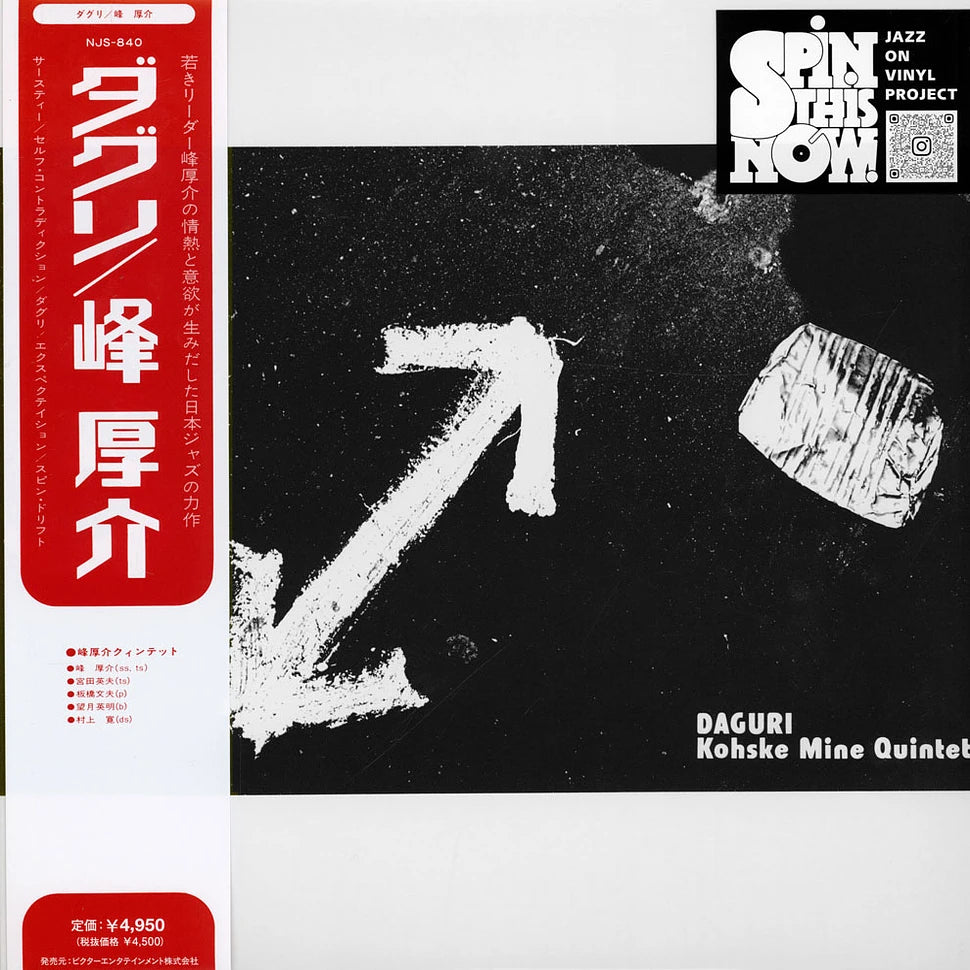
Kohske Mine Quintet Daguri ダグリ (Spin This Now Reissue)
-
Regular price
-
$65.00 SGD
-
Regular price
-
-
Sale price
-
$65.00 SGD
- Unit price
-
per
Couldn't load pickup availability
About
Reissued on black vinyl via SPIN THIS NOW series
With full original reproduction artwork, including obi strip and insert
"SPIN THIS NOW" is a reissue project that brings together Japanese jazz works that we believe are especially relevant in today's world.
The "Japanese jazz" that this project focuses on is not simply jazz played by Japanese people, but rather a collection of precious recordings of Japanese players who performed with a quality comparable to that of jazz in its country of origin during the Showa era from the 1950s to the 1980s. In addition to their outstanding performance techniques, their uniquely Japanese themes and melodies have been highly praised worldwide, and in recent years, their popularity and attention from overseas have been increasing even further through social media and subscription services.
—
This album, recorded by Atsushi Mine, who rose to prominence in the Masaharu Kikuchi Group, features his own regular group. The group, comprised of up-and-coming musicians including Fumio Itabashi, delivers a powerful and vibrant performance, possessing a force and intensity that seems to herald the dawn of a new era. Mine, influenced by Coltrane during this period, displays both flashes of brilliance and grandeur in his playing, delivering soaring melodies like "Thirsty" and "Daguri" with overwhelming expressiveness. Combining dynamism, lyricism, and exoticism, this album is a worthy representative work of Mine's career. — (via Label)
On Daguri, Kosuke Mine Quintet channel early‑70s Coltrane fire into a distinctly Japanese voice, fusing spiritual intensity, modal lyricism and subtle exotic color into a taut, forward‑rushing statement that stands among Mine’s finest recordings. Recorded in 1973, Daguri captures Kosuke Mine at the point where hard‑won experience meets the thrill of discovery. Having earned wide recognition through his work with the Masabumi Kikuchi Group, Mine entered the studio with his regular ensemble, a band whose internal chemistry was already finely tuned. Among them was a young Fumio Itabashi, soon to become one of the most distinctive pianists in Japanese jazz. The result is an album that feels both grounded and newly lit from within: weighty in tone, yet vibrant and alert, with a coherence that suggests not just a strong session but the outline of a new era.
The performances carry an unmistakable charge. This was a period in which John Coltrane’s legacy still cast a long, restless shadow, and Mine’s tenor and soprano lines bristle with that influence without ever collapsing into imitation. His sound here has breadth and grain, moving easily from incantatory cries to carefully chiselled phrases. On pieces such as “Thirsty” and the title track “Daguri,” he stretches long, ascending melodies over insistent rhythmic foundations, giving the music a sense of scale that feels almost architectural. There is an underlying spiritual intensity, but it is articulated with a clarity and focus that keep every chorus purposeful.
The band around him amplifies these qualities. Itabashi’s piano tacks between driving, percussive comping and more lyrical, harmonically searching passages, constantly feeding and reframing Mine’s improvisations. The rhythm section supplies both heft and forward motion, locking into grooves that are propulsive without heaviness, allowing the horns to ride on top with maximum expressive freedom. Throughout, there is a productive tension between dynamism and space: dense, surging passages open suddenly onto more open, meditative sections, as if the music were breathing.
One of Daguri’s defining traits is the way it folds lyricism and exotic colour into that Coltrane‑shaped framework. Melodic themes often carry an unusual contour, drawing on scales and intervals that give the tunes a subtly non‑Western inflection without tipping into pastiche. This “exoticism” is never decorative; it feels like an expansion of the harmonic palette, a way of claiming a distinctive territory within the broader spiritual and modal jazz language of the time. The horn voicings, the choice of motifs, the way solos arc and resolve all contribute to a mood that is simultaneously intense and song‑like.
Crucially, all the material on Daguri is composed by Kosuke Mine himself. That fact underlines how fully formed his voice already was in 1973, not only as an improviser but as an architect of musical worlds. Each piece has its own internal logic and atmosphere, yet the album plays as a unified suite, with recurring contrasts of light and shadow, agitation and calm, fire and poise. Taken as a whole, it exemplifies the blend of momentum, lyricism and exploratory edge that makes this recording widely regarded as one of Mine’s masterpieces: a document of a musician absorbing powerful influences and, in the same breath, stepping decisively into his own. — (via Soundohm)
Vinyl Tracklist
A1 Thirsty サースティ
A2 Self-Contradiction セルフ・コントラディクション
A3 Daguri ダグリ
B1 Expectation エクスペクテイション
B2 Spin Drift スピン・ドリフト
↓
Label: Victor
Format: Vinyl, LP, Album, Limited Edition, Reissue
Reissued: 2026 / Originally Released: 1973
Genre: Jazz
Style: Modal, Post Bop
File under: Japanese Jazz
⦿
Share
- Regular price
- $65.00 SGD
- Regular price
-
- Sale price
- $65.00 SGD
- Unit price
- per
Couldn't load pickup availability
About
Reissued on black vinyl via SPIN THIS NOW series
With full original reproduction artwork, including obi strip and insert
"SPIN THIS NOW" is a reissue project that brings together Japanese jazz works that we believe are especially relevant in today's world.
The "Japanese jazz" that this project focuses on is not simply jazz played by Japanese people, but rather a collection of precious recordings of Japanese players who performed with a quality comparable to that of jazz in its country of origin during the Showa era from the 1950s to the 1980s. In addition to their outstanding performance techniques, their uniquely Japanese themes and melodies have been highly praised worldwide, and in recent years, their popularity and attention from overseas have been increasing even further through social media and subscription services.
—
This album, recorded by Atsushi Mine, who rose to prominence in the Masaharu Kikuchi Group, features his own regular group. The group, comprised of up-and-coming musicians including Fumio Itabashi, delivers a powerful and vibrant performance, possessing a force and intensity that seems to herald the dawn of a new era. Mine, influenced by Coltrane during this period, displays both flashes of brilliance and grandeur in his playing, delivering soaring melodies like "Thirsty" and "Daguri" with overwhelming expressiveness. Combining dynamism, lyricism, and exoticism, this album is a worthy representative work of Mine's career. — (via Label)
On Daguri, Kosuke Mine Quintet channel early‑70s Coltrane fire into a distinctly Japanese voice, fusing spiritual intensity, modal lyricism and subtle exotic color into a taut, forward‑rushing statement that stands among Mine’s finest recordings. Recorded in 1973, Daguri captures Kosuke Mine at the point where hard‑won experience meets the thrill of discovery. Having earned wide recognition through his work with the Masabumi Kikuchi Group, Mine entered the studio with his regular ensemble, a band whose internal chemistry was already finely tuned. Among them was a young Fumio Itabashi, soon to become one of the most distinctive pianists in Japanese jazz. The result is an album that feels both grounded and newly lit from within: weighty in tone, yet vibrant and alert, with a coherence that suggests not just a strong session but the outline of a new era.
The performances carry an unmistakable charge. This was a period in which John Coltrane’s legacy still cast a long, restless shadow, and Mine’s tenor and soprano lines bristle with that influence without ever collapsing into imitation. His sound here has breadth and grain, moving easily from incantatory cries to carefully chiselled phrases. On pieces such as “Thirsty” and the title track “Daguri,” he stretches long, ascending melodies over insistent rhythmic foundations, giving the music a sense of scale that feels almost architectural. There is an underlying spiritual intensity, but it is articulated with a clarity and focus that keep every chorus purposeful.
The band around him amplifies these qualities. Itabashi’s piano tacks between driving, percussive comping and more lyrical, harmonically searching passages, constantly feeding and reframing Mine’s improvisations. The rhythm section supplies both heft and forward motion, locking into grooves that are propulsive without heaviness, allowing the horns to ride on top with maximum expressive freedom. Throughout, there is a productive tension between dynamism and space: dense, surging passages open suddenly onto more open, meditative sections, as if the music were breathing.
One of Daguri’s defining traits is the way it folds lyricism and exotic colour into that Coltrane‑shaped framework. Melodic themes often carry an unusual contour, drawing on scales and intervals that give the tunes a subtly non‑Western inflection without tipping into pastiche. This “exoticism” is never decorative; it feels like an expansion of the harmonic palette, a way of claiming a distinctive territory within the broader spiritual and modal jazz language of the time. The horn voicings, the choice of motifs, the way solos arc and resolve all contribute to a mood that is simultaneously intense and song‑like.
Crucially, all the material on Daguri is composed by Kosuke Mine himself. That fact underlines how fully formed his voice already was in 1973, not only as an improviser but as an architect of musical worlds. Each piece has its own internal logic and atmosphere, yet the album plays as a unified suite, with recurring contrasts of light and shadow, agitation and calm, fire and poise. Taken as a whole, it exemplifies the blend of momentum, lyricism and exploratory edge that makes this recording widely regarded as one of Mine’s masterpieces: a document of a musician absorbing powerful influences and, in the same breath, stepping decisively into his own. — (via Soundohm)
Vinyl Tracklist
A1 Thirsty サースティ
A2 Self-Contradiction セルフ・コントラディクション
A3 Daguri ダグリ
B1 Expectation エクスペクテイション
B2 Spin Drift スピン・ドリフト
↓
Label: Victor
Format: Vinyl, LP, Album, Limited Edition, Reissue
Reissued: 2026 / Originally Released: 1973
Genre: Jazz
Style: Modal, Post Bop
File under: Japanese Jazz
⦿
Share
- Choosing a selection results in a full page refresh.