


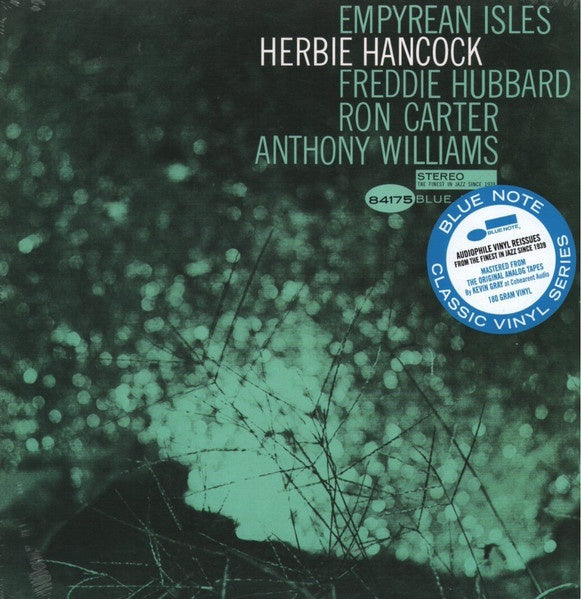
Herbie Hancock Empyrean Isles (Classic Vinyl Series)
-
Regular price
-
$48.00 SGD
-
Regular price
-
-
Sale price
-
$48.00 SGD
- Unit price
-
per
Couldn't load pickup availability
About
Herbie Hancock debuted on Blue Note in 1962 and quickly established himself as both a remarkable pianist and a brilliant composer with three excellent albums - Takin’ Off, My Point Of View, and Inventions & Dimensions - before making what is widely considered to be his first masterpiece: Empyrean Isles.
Recorded in 1964, the album seemed to distill the full breadth of Hancock’s artistry into a sweeping 35-minute musical journey. Joining Hancock on the voyage were three of his closest collaborators: trumpeter Freddie Hubbard and Hancock’s Miles Davis Quintet bandmates Ron Carter on bass and Tony Williams on drums. Each of the four distinctive original pieces Hancock composed for the date occupies its own unique space. The quartet launches into the album opener “One Finger Snap” which consists of a single opening line that leads directly into blistering improvisations by Hubbard and Hancock. The first side concludes with the beguiling “Oliloquy Valley” which conjures a mysterious and mystical vibe. The flipside leads off with one of Hancock’s most enduring themes, “Cantaloupe Island,” with its undulating groove and unforgettable melody, before moving into a more exploratory realm with “The Egg,” an expansive 14-minute epic that flirts with the avant-garde and gives ample space for the musicians to let their imaginations run wild.
This Blue Note Classic Vinyl Edition is stereo, all-analog, mastered by Kevin Gray from the original master tapes, and pressed on 180g vinyl at Optimal. — (via Label)
My Point of View and Inventions and Dimensions found Herbie Hancock exploring the fringes of hard bop, working with a big band and a Latin-flavored percussion section, respectively. On Empyrean Isles, he returns to hard bop, but the results are anything but conventional. Working with cornetist Freddie Hubbard, bassist Ron Carter, and drummer Tony Williams - a trio just as young and adventurous as he was - Hancock pushes at the borders of hard bop, finding a brilliantly evocative balance between traditional bop, soul-injected grooves, and experimental, post-modal jazz.
Hancock's four original concepts are loosely based on the myths of the Empyrean Isles, and they are designed to push the limits of the band and of hard bop. Even "Cantaloupe Island," well-known for its funky piano riff, takes chances and doesn't just ride the groove. "The Egg," with its minimal melody and extended solo improvisations, is the riskiest number on the record, but it works because each musician spins inventive, challenging solos that defy convention. In comparison, "One Finger Snap" and "Oliloqui Valley" adhere to hard bop conventions, but each song finds the quartet vigorously searching for new sonic territory with convincing fire. That passion informs all of Empyrean Isles, a record that officially established Hancock as a major artist in his own right. — (via AllMusic)
As a member of Miles Davis' second quintet during the 1960s, pianist Herbie Hancock rarely performed live under his own leadership, but he did take the time to record. Hancock's 1964 effort, Empyrean Isles, remains one of the most diverse and often challenging records of the pianist's tenure with Blue Note Records. It's a rare jazz record that offers both a hugely popular hit, as well as an outré masterwork of rhythmic repetition and angular melodies.
Empyrean Isles is best know for the hit "Cantaloupe Island," ... The real meat of Empyrean Isles—its adventurous heart—lies with "The Egg," A thirteen-minute exploration of the limits of beat repetition that includes some of Hubbard's most restless trumpet playing. He strains his horn against the locked rhythm, looking for a way out that never comes. It's a fascinating juxtaposition of improvisation over rigid reiteration. — (via All About Jazz)
This is a quartet album for trumpet and rhythm section. In this circumstance, a problem was created for the composer-arranger, in that the lack of another instrument supporting the lower, richer register, such as a tenor saxophone, might result in a shallow sound.
With this problem in mind, Herbie Hancock, who composed and arranged all the tunes, wrote them to sound more like improvisations than ensemble melodies, so that the warmth and fullness of a supporting instrument would not be missed. Free sketches were written in such a way that each instrument is allowed great flexibility of interpretation. In many cases, no melodic line was laid out over the chords nor atonal clusters written, so that the trumpeter could supply any melody he wished.
“The Egg,” the most exemplary composition in the album, has only a short trumpet melody written out over a repeating figure in the rhythm section. This sets the mood and builds up tension; after that, the musicians’ ears do the rest! (— Original Album Liner Notes)
↓
Label :Blue Note
Series: Blue Note Classic Vinyl Series
Format: Vinyl, LP, Album, Reissue, Stereo, 180g
Reissued:2023 / Original release: 1964
Genre: Jazz
Style: Post Bop, Modal
File under: Jazz // Blue Note Records
⦿
Share
- Regular price
- $48.00 SGD
- Regular price
-
- Sale price
- $48.00 SGD
- Unit price
- per
Couldn't load pickup availability
About
Herbie Hancock debuted on Blue Note in 1962 and quickly established himself as both a remarkable pianist and a brilliant composer with three excellent albums - Takin’ Off, My Point Of View, and Inventions & Dimensions - before making what is widely considered to be his first masterpiece: Empyrean Isles.
Recorded in 1964, the album seemed to distill the full breadth of Hancock’s artistry into a sweeping 35-minute musical journey. Joining Hancock on the voyage were three of his closest collaborators: trumpeter Freddie Hubbard and Hancock’s Miles Davis Quintet bandmates Ron Carter on bass and Tony Williams on drums. Each of the four distinctive original pieces Hancock composed for the date occupies its own unique space. The quartet launches into the album opener “One Finger Snap” which consists of a single opening line that leads directly into blistering improvisations by Hubbard and Hancock. The first side concludes with the beguiling “Oliloquy Valley” which conjures a mysterious and mystical vibe. The flipside leads off with one of Hancock’s most enduring themes, “Cantaloupe Island,” with its undulating groove and unforgettable melody, before moving into a more exploratory realm with “The Egg,” an expansive 14-minute epic that flirts with the avant-garde and gives ample space for the musicians to let their imaginations run wild.
This Blue Note Classic Vinyl Edition is stereo, all-analog, mastered by Kevin Gray from the original master tapes, and pressed on 180g vinyl at Optimal. — (via Label)
My Point of View and Inventions and Dimensions found Herbie Hancock exploring the fringes of hard bop, working with a big band and a Latin-flavored percussion section, respectively. On Empyrean Isles, he returns to hard bop, but the results are anything but conventional. Working with cornetist Freddie Hubbard, bassist Ron Carter, and drummer Tony Williams - a trio just as young and adventurous as he was - Hancock pushes at the borders of hard bop, finding a brilliantly evocative balance between traditional bop, soul-injected grooves, and experimental, post-modal jazz.
Hancock's four original concepts are loosely based on the myths of the Empyrean Isles, and they are designed to push the limits of the band and of hard bop. Even "Cantaloupe Island," well-known for its funky piano riff, takes chances and doesn't just ride the groove. "The Egg," with its minimal melody and extended solo improvisations, is the riskiest number on the record, but it works because each musician spins inventive, challenging solos that defy convention. In comparison, "One Finger Snap" and "Oliloqui Valley" adhere to hard bop conventions, but each song finds the quartet vigorously searching for new sonic territory with convincing fire. That passion informs all of Empyrean Isles, a record that officially established Hancock as a major artist in his own right. — (via AllMusic)
As a member of Miles Davis' second quintet during the 1960s, pianist Herbie Hancock rarely performed live under his own leadership, but he did take the time to record. Hancock's 1964 effort, Empyrean Isles, remains one of the most diverse and often challenging records of the pianist's tenure with Blue Note Records. It's a rare jazz record that offers both a hugely popular hit, as well as an outré masterwork of rhythmic repetition and angular melodies.
Empyrean Isles is best know for the hit "Cantaloupe Island," ... The real meat of Empyrean Isles—its adventurous heart—lies with "The Egg," A thirteen-minute exploration of the limits of beat repetition that includes some of Hubbard's most restless trumpet playing. He strains his horn against the locked rhythm, looking for a way out that never comes. It's a fascinating juxtaposition of improvisation over rigid reiteration. — (via All About Jazz)
This is a quartet album for trumpet and rhythm section. In this circumstance, a problem was created for the composer-arranger, in that the lack of another instrument supporting the lower, richer register, such as a tenor saxophone, might result in a shallow sound.
With this problem in mind, Herbie Hancock, who composed and arranged all the tunes, wrote them to sound more like improvisations than ensemble melodies, so that the warmth and fullness of a supporting instrument would not be missed. Free sketches were written in such a way that each instrument is allowed great flexibility of interpretation. In many cases, no melodic line was laid out over the chords nor atonal clusters written, so that the trumpeter could supply any melody he wished.
“The Egg,” the most exemplary composition in the album, has only a short trumpet melody written out over a repeating figure in the rhythm section. This sets the mood and builds up tension; after that, the musicians’ ears do the rest! (— Original Album Liner Notes)
↓
Label :Blue Note
Series: Blue Note Classic Vinyl Series
Format: Vinyl, LP, Album, Reissue, Stereo, 180g
Reissued:2023 / Original release: 1964
Genre: Jazz
Style: Post Bop, Modal
File under: Jazz // Blue Note Records
⦿
Share
- Choosing a selection results in a full page refresh.