


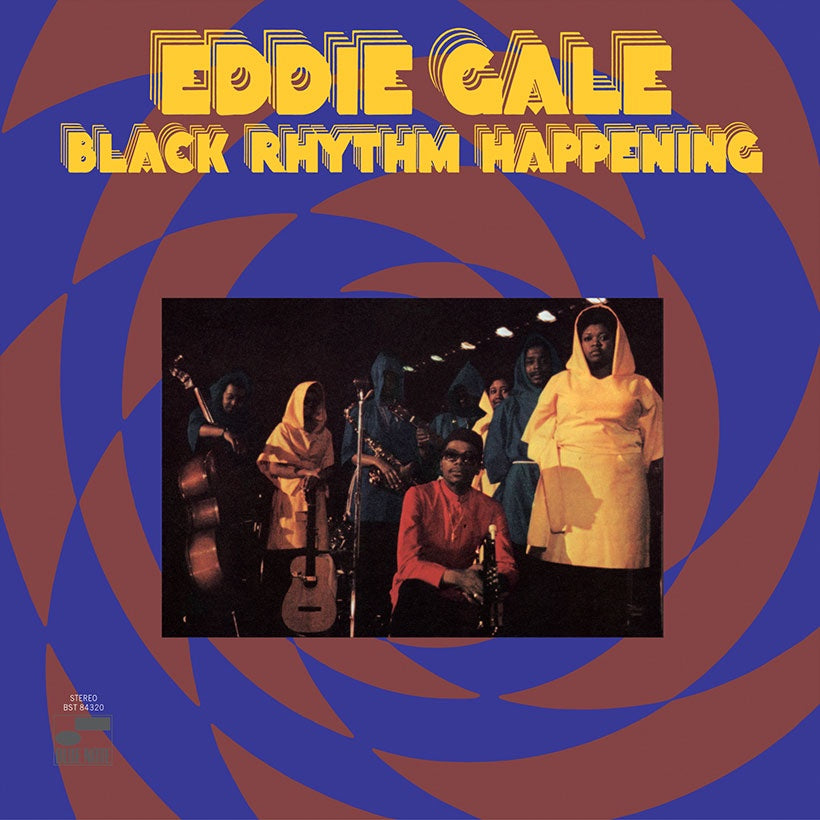
Eddie Gale Black Rhythm Happening (Blue Note Classic Vinyl Series)
-
Regular price
-
$60.00 SGD
-
Regular price
-
-
Sale price
-
$60.00 SGD
- Unit price
-
per
Couldn't load pickup availability
About
— Reissued as part of the Blue Note Classic Vinyl Series.
— Pressed on 180g heavyweight vinyl.
— Cut from the original master tapes by Kevin Gray at Cohearent Audio.
—
Following his striking 1968 debut Ghetto Music, the radical trumpeter and composer Eddie Gale presented an extension of that vision continuing to seek truth and justice through his music on his magnificent 2nd Blue Note album Black Rhythm Happening, recorded in 1969. Joining the Noble Gale Musicians (Gale, saxophonist/flutist Russell Lyle, and bassists Judah Samuel and Henry Pearson) and Noble Gale Singers (including Joann Gale Stevens and Fulumi Prince) are guest musicians including alto saxophonist Jimmy Lyons and drummer Elvin Jones. The album presents eight evocative originals from the emphatic title track with its declarative refrain to the tenacious resolve and austere beauty of the extraordinary “Song Of Will.”
This Blue Note Classic Vinyl Edition is stereo, all-analog, mastered by Kevin Gray from the original master tapes, and pressed on 180g vinyl at Optimal. — (via Label)
—
Love it or hate it, trumpeter Eddie Gale's second Blue Note outing as a leader is one of the most adventurous recordings to come out of the 1960s. Black Rhythm Happening picks up where Ghetto Music left off, in that it takes the soul and free jazz elements of his debut and adds to them the sound of the church in all its guises — from joyous call and response celebration on the title track (and album opener), to the mournful funeral sounds of "Song of Will," to the determined Afro-Latin-style chanting on "Mexico Thing" that brings the pre-Thomas Dorsey gospel to the revolutionary song style prevalent in Zapata's Mexico — all thanks to the Eddie Gale Singers. Elsewhere, wild smatterings of hard and post-bop ("Ghetto Love Night") and angular modal music ("Ghetto Summertime," featuring Elvin Jones on drums and Joann Stevens-Gale on guitar), turn the jazz paradigm of the era inside out, simultaneously admitting everything in a coherent, wonderfully ambitious whole. There is no doubt that Archie Shepp listened to both Ghetto Music and Black Rhythm Happening before setting out to assemble his Attica Blues project.
The album closes with "Look at Teyonda," a sprawling exercise in the deep melding of African and Latin folk musics with the folk-blues, flamenco, and jazz rhythms. Funky horns (courtesy of Gale, Russell Lyle, and Roland Alexander) moan toward Fulumi Prince's startlingly beautiful vocal. Stevens-Gale's guitar whispers the tune into the field before the saxophones and brass come to get it, and when they do, long open lines are offered slowly and deliberately, as Jones' shimmering ride cymbals triple-time the beat into something wholly Other. Black Rhythm Happening is a timeless, breathtaking recording, one that sounds as forward-thinking and militant in the 21st century as it did in 1969. — (via AllMusic)
—
Gale’s second album is more or less the logical continuity of Ghetto Music, in both sonics and musicians taking part into it (more or less unchanged), despite a somewhat different format (four of the eight tracks around or below three minutes). Recorded and released the following year, still on Blue Note, Black Rhythm Happening does feature some guests, the better-known being Elvin Jones and the Noble singers are under the leadership of Fulumi Prince, this time.
Despite plenty of qualities of its own, BRH fails to match its predecessor’s success, partly because the surprise is now gone, but the shorter tracks are often not bringing the same flavour that the longer ones did in GM. Nevertheless, Gale’s second solo album is still an excellent disc, but sadly it would be his last for the next 30 years, and from what I heard his three “recent” albums don’t hold the same sense of urgency that these two did. — (via Jazz Music Archives)
↓
Label: Blue Note Records
Format: Vinyl, LP, Album, Reissue, Repress, 180 gr
Reissued: 2026 / Originally Released: 1969
Genre: Jazz
Style: Free Jazz, Soul-Jazz
File under: Blue Note
⦿
Share
- Regular price
- $60.00 SGD
- Regular price
-
- Sale price
- $60.00 SGD
- Unit price
- per
Couldn't load pickup availability
About
— Reissued as part of the Blue Note Classic Vinyl Series.
— Pressed on 180g heavyweight vinyl.
— Cut from the original master tapes by Kevin Gray at Cohearent Audio.
—
Following his striking 1968 debut Ghetto Music, the radical trumpeter and composer Eddie Gale presented an extension of that vision continuing to seek truth and justice through his music on his magnificent 2nd Blue Note album Black Rhythm Happening, recorded in 1969. Joining the Noble Gale Musicians (Gale, saxophonist/flutist Russell Lyle, and bassists Judah Samuel and Henry Pearson) and Noble Gale Singers (including Joann Gale Stevens and Fulumi Prince) are guest musicians including alto saxophonist Jimmy Lyons and drummer Elvin Jones. The album presents eight evocative originals from the emphatic title track with its declarative refrain to the tenacious resolve and austere beauty of the extraordinary “Song Of Will.”
This Blue Note Classic Vinyl Edition is stereo, all-analog, mastered by Kevin Gray from the original master tapes, and pressed on 180g vinyl at Optimal. — (via Label)
—
Love it or hate it, trumpeter Eddie Gale's second Blue Note outing as a leader is one of the most adventurous recordings to come out of the 1960s. Black Rhythm Happening picks up where Ghetto Music left off, in that it takes the soul and free jazz elements of his debut and adds to them the sound of the church in all its guises — from joyous call and response celebration on the title track (and album opener), to the mournful funeral sounds of "Song of Will," to the determined Afro-Latin-style chanting on "Mexico Thing" that brings the pre-Thomas Dorsey gospel to the revolutionary song style prevalent in Zapata's Mexico — all thanks to the Eddie Gale Singers. Elsewhere, wild smatterings of hard and post-bop ("Ghetto Love Night") and angular modal music ("Ghetto Summertime," featuring Elvin Jones on drums and Joann Stevens-Gale on guitar), turn the jazz paradigm of the era inside out, simultaneously admitting everything in a coherent, wonderfully ambitious whole. There is no doubt that Archie Shepp listened to both Ghetto Music and Black Rhythm Happening before setting out to assemble his Attica Blues project.
The album closes with "Look at Teyonda," a sprawling exercise in the deep melding of African and Latin folk musics with the folk-blues, flamenco, and jazz rhythms. Funky horns (courtesy of Gale, Russell Lyle, and Roland Alexander) moan toward Fulumi Prince's startlingly beautiful vocal. Stevens-Gale's guitar whispers the tune into the field before the saxophones and brass come to get it, and when they do, long open lines are offered slowly and deliberately, as Jones' shimmering ride cymbals triple-time the beat into something wholly Other. Black Rhythm Happening is a timeless, breathtaking recording, one that sounds as forward-thinking and militant in the 21st century as it did in 1969. — (via AllMusic)
—
Gale’s second album is more or less the logical continuity of Ghetto Music, in both sonics and musicians taking part into it (more or less unchanged), despite a somewhat different format (four of the eight tracks around or below three minutes). Recorded and released the following year, still on Blue Note, Black Rhythm Happening does feature some guests, the better-known being Elvin Jones and the Noble singers are under the leadership of Fulumi Prince, this time.
Despite plenty of qualities of its own, BRH fails to match its predecessor’s success, partly because the surprise is now gone, but the shorter tracks are often not bringing the same flavour that the longer ones did in GM. Nevertheless, Gale’s second solo album is still an excellent disc, but sadly it would be his last for the next 30 years, and from what I heard his three “recent” albums don’t hold the same sense of urgency that these two did. — (via Jazz Music Archives)
↓
Label: Blue Note Records
Format: Vinyl, LP, Album, Reissue, Repress, 180 gr
Reissued: 2026 / Originally Released: 1969
Genre: Jazz
Style: Free Jazz, Soul-Jazz
File under: Blue Note
⦿
Share
- Choosing a selection results in a full page refresh.