


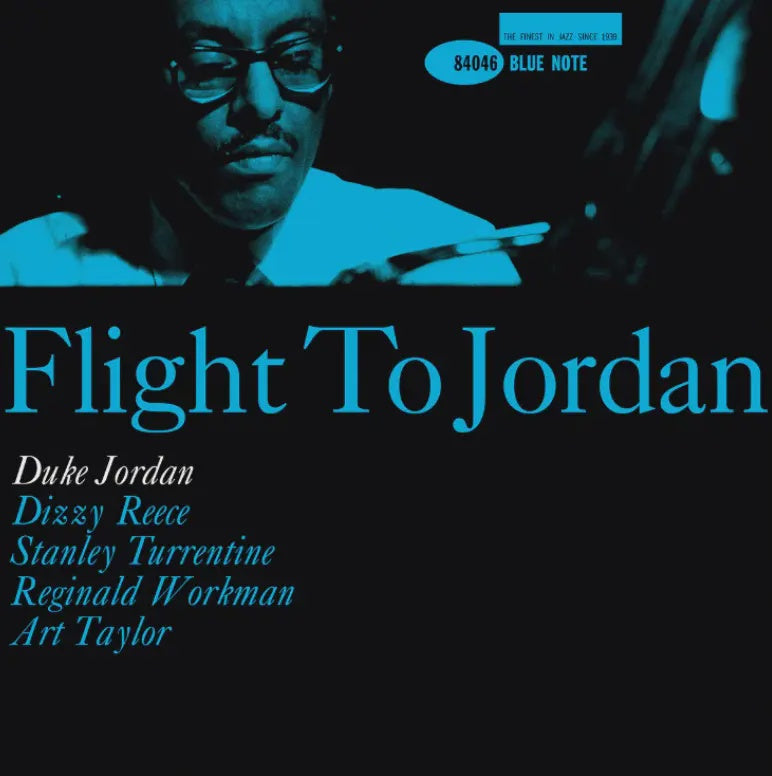
Duke Jordan Flight To Jordan (Blue Note Tone Poet series)
Blue Note Records (Tone Poet series)
-
Regular price
-
$65.00 SGD
-
Regular price
-
-
Sale price
-
$65.00 SGD
- Unit price
-
per
Couldn't load pickup availability
About
Brooklyn-born pianist Duke Jordan was on the front lines of the bebop revolution as a member of Charlie Parker’s quintet in the late-1940s which also featured a young Miles Davis on trumpet. In 1960, Jordan recorded his sole Blue Note album as a leader, Flight To Jordan, an exemplar hard bop date featuring a top-shelf quintet with Dizzy Reece on trumpet, Stanley Turrentine on tenor saxophone, Reggie Workman on bass, and Art Taylor on drums. The set presented six fine Jordan original compositions including the minor mode title track, the elegant ballad “Starbrite,” the church-inspired “Deacon Joe,” and the Latin-tinged “Si-Joya. — (via Label)
—
1961 was a prolific one for Blue Note with Art Blakey & The Jazz Messengers’ A Night in Tunisia, Hank Mobley’s Roll Call, and Dexter Gordon’s Doin’ Alright – just three of the hard bop albums recorded at Van Gelder Studio. Also released that year, was a similarly powerful yet strangely overlooked hard bop album that became something of holy grail for collectors.
Subsequently regarded by many critics as one the great Blue Note hard bop albums, Duke Jordan’s Flight To Jordan should have seen the pianist move through the golden era of the label with a string of albums like his aforementioned peers. Instead, what followed was 10 years of silence.
That Duke Jordan didn’t go on to become one of Blue Note’s famous pianists and composers is especially surprising when you consider his career before his label debut as a leader. Amongst the archive of William P. Gottlieb there’s an evocative black and white photograph of Jordan seated beside Miles Davis with the Charlie Parker Quintet at the Three Deuces on Manhattan’s 52nd Steet in 1947.
The Brooklyn raised Jordan had been taken on by Parker when he heard the pianist in a trio led by guitarist Teddy Walters. One of the great early bebop pianists, Jordan featured on Parker’s albums in various formats for Dial Records and Savoy, while also playing regularly with trumpeter Roy Eldridge. Jordan also appeared on records for the Prestige label with the Gene Ammons / Sonny Stitt Quintet and on early 1950s recordings with Stan Getz.
Then there were the albums under his own name, beginning with two trio sessions from 1954 for the French label Vogue. A year later he joined engineer Rudy Van Gelder at his first studio in Hackensack, New Jersey, to record two albums for Don Schlitten’s Signal label, Jazz Laboratory Series Vol. 1 and a Trio/Quintet featuring Percy Heath on bass and Art Blakey on drums fresh from his first albums for Blue Note with the Jazz Messengers.
The connections formed in the mid to late ‘50s led naturally to Jordan’s Blue Note debut as a sideman with Tina Brooks on the tenor saxophonist’s True Blue. The album was recorded on June 25, 1960, just two months before Jordan took his own Quintet into Van Gelder Studio, Englewood Cliffs, New Jersey for his one and only album as a leader for Blue Note.
His band for this session were Blue Note stalwarts Stanley Turrentine on tenor and Reggie Workman on bass, with Jamaican Dizzy Reece on trumpet and Art Taylor on drums – another player who only recorded one album for Blue Note A.T.’s Delight. Flight to Jordan was presented in one of the most beautiful Reid Miles Blue Note covers of the early 1960s with Francis Wolff’s photography capturing the coolness of the pianist in his prime.
Consisting of six of Jordan’s own compositions, the album’s opening title track was first recorded by him in 1955 on a Quintet album for Savoy. It was written a year after his best known original “Jordu”, that became a standard after the Max Roach-Clifford Brown Quintet recorded it in 1954. Themed melodically around the spiritual “Joshua Fit the Battle of Jericho”, it shows why Jordan was considered one of the most melodic pianists of the era.
Dizzy Reece and Stanley Turrentine proved to be a formidable front line, bringing a soulful groove to Jordan’s faster paced compositions like “Diamond Stud” with Reggie Workman and Art Taylor providing a solid foundation. The original liner notes provide an insight into another swinging number “Squawkin’” composed after an encounter in Jordan’s neighbourhood. “I saw a scene on the street in Brooklyn, a cab-driver and some other cats squawking away, and I thought of writing a theme to express the mood,” Jordan told Blue Note’s regular writer Leonard Feather.
Both as a player and composer Jordan could be equally tender and pensive as heard on “Starbrite” and “Deacon Joe”. The mournful ballad “Starbrite” illustrates Jordan’s imagination and guidance as a bandleader. “I noticed that Dizzy (Reece) has a fine, big sound on slow tunes, so l wrote this with him in mind,” he told Leonard Feather.
Two more recordings in 1962 followed, Duke Jordan And Sadik Hakim East And West Of Jazz for Charlie Parker Records and Les Liaisons Dangereuses a soundtrack to a French film for the Egmont label. But then nothing more for the rest of the sixties. Why Duke Jordan went from a sharp Blue Note artist in his prime to driving a taxi around New York for a living is one of those jazz mysteries we’ll never uncover.
It would be more than 10 years before Jordan returned on vinyl. Opening with Jackie McLean’s “Live At Montmartre’ recorded at Jazzhaus Montmartre in Copenhagen, Nils Winther’s Danish label SteepleChase became an important European home for American jazz artists. Amongst fellow pianists Kenny Drew and Horace Parlan, was Duke Jordan whose 1974 album Flight To Denmark was the first of many albums he recorded for SteepleChase in Copenhagen. He would call the city his home from 1978 until he passed away in 2006.
His only Blue Note album was one of the most eagerly awaited Tone Poet releases with prices for original copies now reaching into four figures. — (via Everything Jazz)
—
If this isn't a perfect hard bop record, it comes awfully close. And coming from an artist who is virtually forgotten, it's all the sweeter.
Duke Jordan was an A-list pianist who was there at the birth of bebop. He was part of Charlie Parker's classic quintet in 1947. So why don't we know his name the way we know Thelonious Monk's or Bud Powell's?
My guess is Jordan just didn't have the personality to be a headliner. But that's just a guess, and it's based partly on this wonderful 1960 album—his only one as a leader for Blue Note.
On Flight to Jordan, the pianist shines in three ways.
First and foremost, Jordan is a magnificent composer. He wrote all six tunes on the original album. .. All are spot on. There are four hard bop workouts that stand up to any The Jazz Messengers track of the era. There is also one achingly beautiful ballad, one magnificent slow, draggy blues and one standard. For the writing alone, Jordan earns my admiration.
Second, he's clearly a terrific leader. How do I know? He lets the two horns—tenor Stanley Turrentine and trumpeter Dizzy Reece—steal the spotlight on almost every tune. They are a formidable front line. If you didn't know it was Jordan's album, you'd think it was a hornman leading the crew. They are that dominant. Jordan must have had supreme confidence in his own ego to arrange the tunes like that.
Finally, Jordan is a fine pianist—nimble and melodic. I particularly love his soft, bluesy lines on "Deacon Joe," his exquisite solo on the ballad "Star Brite" and the gentleness of the closing piano trio on "I Should Care." Yes, it's a bop record, but it's the slow stuff that really separates Flight to Jordan from standard Blue Note fare. — (via All About Jazz)
Vinyl Tracklist
A1 Flight To Jordan In Memory Of
A2 Starbrite
A3 Squawkin'
B1 Deacon Joe
B2 Split Quick
B3 Si-Joya
↓
Label: Blue Note
Format: Vinyl, LP, Album, Reissue, Stereo, Gatefold, 180g
Reissued: 2025 / Originally Released: 1961
Genre: Jazz
Style: Hard Bop
File under: Blue Note Tone Poet
⦿
Share
Blue Note Records (Tone Poet series)
- Regular price
- $65.00 SGD
- Regular price
-
- Sale price
- $65.00 SGD
- Unit price
- per
Couldn't load pickup availability
About
Brooklyn-born pianist Duke Jordan was on the front lines of the bebop revolution as a member of Charlie Parker’s quintet in the late-1940s which also featured a young Miles Davis on trumpet. In 1960, Jordan recorded his sole Blue Note album as a leader, Flight To Jordan, an exemplar hard bop date featuring a top-shelf quintet with Dizzy Reece on trumpet, Stanley Turrentine on tenor saxophone, Reggie Workman on bass, and Art Taylor on drums. The set presented six fine Jordan original compositions including the minor mode title track, the elegant ballad “Starbrite,” the church-inspired “Deacon Joe,” and the Latin-tinged “Si-Joya. — (via Label)
—
1961 was a prolific one for Blue Note with Art Blakey & The Jazz Messengers’ A Night in Tunisia, Hank Mobley’s Roll Call, and Dexter Gordon’s Doin’ Alright – just three of the hard bop albums recorded at Van Gelder Studio. Also released that year, was a similarly powerful yet strangely overlooked hard bop album that became something of holy grail for collectors.
Subsequently regarded by many critics as one the great Blue Note hard bop albums, Duke Jordan’s Flight To Jordan should have seen the pianist move through the golden era of the label with a string of albums like his aforementioned peers. Instead, what followed was 10 years of silence.
That Duke Jordan didn’t go on to become one of Blue Note’s famous pianists and composers is especially surprising when you consider his career before his label debut as a leader. Amongst the archive of William P. Gottlieb there’s an evocative black and white photograph of Jordan seated beside Miles Davis with the Charlie Parker Quintet at the Three Deuces on Manhattan’s 52nd Steet in 1947.
The Brooklyn raised Jordan had been taken on by Parker when he heard the pianist in a trio led by guitarist Teddy Walters. One of the great early bebop pianists, Jordan featured on Parker’s albums in various formats for Dial Records and Savoy, while also playing regularly with trumpeter Roy Eldridge. Jordan also appeared on records for the Prestige label with the Gene Ammons / Sonny Stitt Quintet and on early 1950s recordings with Stan Getz.
Then there were the albums under his own name, beginning with two trio sessions from 1954 for the French label Vogue. A year later he joined engineer Rudy Van Gelder at his first studio in Hackensack, New Jersey, to record two albums for Don Schlitten’s Signal label, Jazz Laboratory Series Vol. 1 and a Trio/Quintet featuring Percy Heath on bass and Art Blakey on drums fresh from his first albums for Blue Note with the Jazz Messengers.
The connections formed in the mid to late ‘50s led naturally to Jordan’s Blue Note debut as a sideman with Tina Brooks on the tenor saxophonist’s True Blue. The album was recorded on June 25, 1960, just two months before Jordan took his own Quintet into Van Gelder Studio, Englewood Cliffs, New Jersey for his one and only album as a leader for Blue Note.
His band for this session were Blue Note stalwarts Stanley Turrentine on tenor and Reggie Workman on bass, with Jamaican Dizzy Reece on trumpet and Art Taylor on drums – another player who only recorded one album for Blue Note A.T.’s Delight. Flight to Jordan was presented in one of the most beautiful Reid Miles Blue Note covers of the early 1960s with Francis Wolff’s photography capturing the coolness of the pianist in his prime.
Consisting of six of Jordan’s own compositions, the album’s opening title track was first recorded by him in 1955 on a Quintet album for Savoy. It was written a year after his best known original “Jordu”, that became a standard after the Max Roach-Clifford Brown Quintet recorded it in 1954. Themed melodically around the spiritual “Joshua Fit the Battle of Jericho”, it shows why Jordan was considered one of the most melodic pianists of the era.
Dizzy Reece and Stanley Turrentine proved to be a formidable front line, bringing a soulful groove to Jordan’s faster paced compositions like “Diamond Stud” with Reggie Workman and Art Taylor providing a solid foundation. The original liner notes provide an insight into another swinging number “Squawkin’” composed after an encounter in Jordan’s neighbourhood. “I saw a scene on the street in Brooklyn, a cab-driver and some other cats squawking away, and I thought of writing a theme to express the mood,” Jordan told Blue Note’s regular writer Leonard Feather.
Both as a player and composer Jordan could be equally tender and pensive as heard on “Starbrite” and “Deacon Joe”. The mournful ballad “Starbrite” illustrates Jordan’s imagination and guidance as a bandleader. “I noticed that Dizzy (Reece) has a fine, big sound on slow tunes, so l wrote this with him in mind,” he told Leonard Feather.
Two more recordings in 1962 followed, Duke Jordan And Sadik Hakim East And West Of Jazz for Charlie Parker Records and Les Liaisons Dangereuses a soundtrack to a French film for the Egmont label. But then nothing more for the rest of the sixties. Why Duke Jordan went from a sharp Blue Note artist in his prime to driving a taxi around New York for a living is one of those jazz mysteries we’ll never uncover.
It would be more than 10 years before Jordan returned on vinyl. Opening with Jackie McLean’s “Live At Montmartre’ recorded at Jazzhaus Montmartre in Copenhagen, Nils Winther’s Danish label SteepleChase became an important European home for American jazz artists. Amongst fellow pianists Kenny Drew and Horace Parlan, was Duke Jordan whose 1974 album Flight To Denmark was the first of many albums he recorded for SteepleChase in Copenhagen. He would call the city his home from 1978 until he passed away in 2006.
His only Blue Note album was one of the most eagerly awaited Tone Poet releases with prices for original copies now reaching into four figures. — (via Everything Jazz)
—
If this isn't a perfect hard bop record, it comes awfully close. And coming from an artist who is virtually forgotten, it's all the sweeter.
Duke Jordan was an A-list pianist who was there at the birth of bebop. He was part of Charlie Parker's classic quintet in 1947. So why don't we know his name the way we know Thelonious Monk's or Bud Powell's?
My guess is Jordan just didn't have the personality to be a headliner. But that's just a guess, and it's based partly on this wonderful 1960 album—his only one as a leader for Blue Note.
On Flight to Jordan, the pianist shines in three ways.
First and foremost, Jordan is a magnificent composer. He wrote all six tunes on the original album. .. All are spot on. There are four hard bop workouts that stand up to any The Jazz Messengers track of the era. There is also one achingly beautiful ballad, one magnificent slow, draggy blues and one standard. For the writing alone, Jordan earns my admiration.
Second, he's clearly a terrific leader. How do I know? He lets the two horns—tenor Stanley Turrentine and trumpeter Dizzy Reece—steal the spotlight on almost every tune. They are a formidable front line. If you didn't know it was Jordan's album, you'd think it was a hornman leading the crew. They are that dominant. Jordan must have had supreme confidence in his own ego to arrange the tunes like that.
Finally, Jordan is a fine pianist—nimble and melodic. I particularly love his soft, bluesy lines on "Deacon Joe," his exquisite solo on the ballad "Star Brite" and the gentleness of the closing piano trio on "I Should Care." Yes, it's a bop record, but it's the slow stuff that really separates Flight to Jordan from standard Blue Note fare. — (via All About Jazz)
Vinyl Tracklist
A1 Flight To Jordan In Memory Of
A2 Starbrite
A3 Squawkin'
B1 Deacon Joe
B2 Split Quick
B3 Si-Joya
↓
Label: Blue Note
Format: Vinyl, LP, Album, Reissue, Stereo, Gatefold, 180g
Reissued: 2025 / Originally Released: 1961
Genre: Jazz
Style: Hard Bop
File under: Blue Note Tone Poet
⦿
Share
- Choosing a selection results in a full page refresh.