


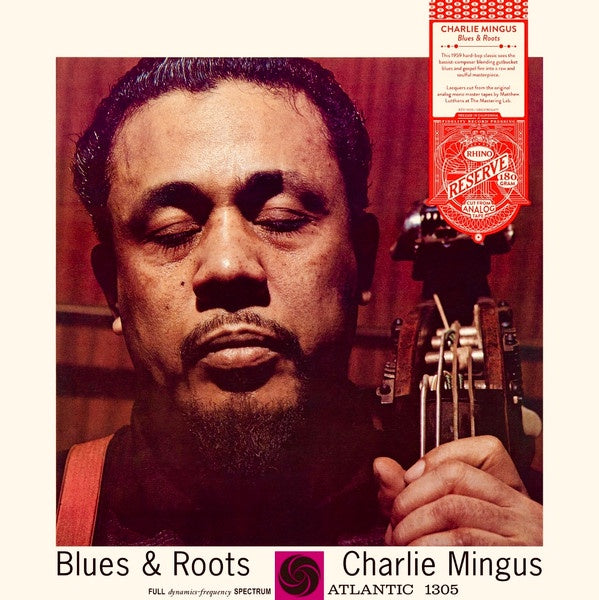
Charlie Mingus Blues & Roots
-
Regular price
-
$60.00 SGD
-
Regular price
-
-
Sale price
-
$60.00 SGD
- Unit price
-
per
Couldn't load pickup availability
About
In response to critical carping that his ambitious, evocative music somehow didn't swing enough, Charles Mingus returned to the earthiest and earliest sources of black musical expression, namely the blues, gospel, and old-time New Orleans jazz. The resulting LP, Blues and Roots, isn't quite as wildly eclectic as usual, but it ranks as arguably Mingus' most joyously swinging outing. Working with simple forms, Mingus boosts the complexity of the music by assembling a nine-piece outfit and arranging multiple lines to be played simultaneously — somewhat akin to the Dixieland ensembles of old, but with an acutely modern flavor. Anyone who had heard "Haitian Fight Song" shouldn't have been surprised that such an album was well within Mingus' range, but jazz's self-appointed guardians have long greeted innovation with reactionary distaste.
After Blues and Roots, there could be no question of Mingus' firm grounding in the basics, nor of his deeply felt affinity with them. Whether the music is explicitly gospel-based — like the groundbreaking classic "Wednesday Night Prayer Meeting" — or not, the whole album is performed with a churchy fervor that rips through both the exuberant swingers and the aching, mournful slow blues. Still, it's the blues that most prominently inform the feeling of the album, aside from the aforementioned "Wednesday Night Prayer Meeting" and the Jelly Roll Morton tribute "My Jelly Roll Soul." The recording session was reportedly very disorganized, but perhaps that actually helped give the performances the proper feel, since they wound up so loose and free-swinging.
With a lineup including John Handy and Jackie McLean on alto, Booker Ervin on tenor, frequent anchor Pepper Adams on baritone, and Jimmy Knepper and Willie Dennis on trombones, among others, Blues and Roots isn't hurting for fiery soloists, and they help make the album perhaps the most soulful in Mingus' discography. — (via AllMusic)
—
Blues & Roots is a singular entry in Mingus’ body of work, a show of myopic focus on swing, with no tangents into the avant-garde or classical that had made his past records thrash and foam with personality and range (The violent ambience of Pithecanthropus Erectus or the future experimental, almost ballet-like affectations of his masterpiece Black Saint and the Sinner Lady). Yet for all its supposed primitivism in aesthetic form, Blues feels as vital and important as any of his best; six shots of a heady, unyielding brew.
Once “Wednesday Night Prayer Meeting” gets into gear, it is all Mingus, his bass clattering forward as the rest of the musicians rally to keep the swirl going uninterrupted. Horace Parlan’s piano adds tiers and variations into the driving frame, as the wind section takes the piece into the stratosphere.
“Tensions” spends every second of its buildup living up to the name, the brass roiling and pulsating in anticipation, as the echoey bass stirs the piece into resolution.
Blues & Roots crashes through the listener the way breakers do in rough weather, instinctual and beautiful and spilling over with measured substance. Mingus’ eventual demise from ALS is as tragic and as it is morbidly fascinating – a man whose life was built on virtuosic fingers rendered stiff and obsolete. What he left behind endures. There’s plenty that’s been said about what makes a genius – patience, madness, love, God, Nature, passion, opium, death. What seems less abstract is that ***ing poetry, that sheer beauty that sits so high, the thin air kills. — (via Sputnik Music)
—
— 180g Mono pressing, cut from analog tape
— Part of the Rhino Reserve series
↓
Label: Rhino Records
Format: Vinyl, LP, Album, Reissue, Mono, 180g
Reissued: 2026 / Originally Released: 1960
Genre: Jazz
Style: Post Bop, Hard Bop
File under: Audiophile Jazz
⦿
Share
- Regular price
- $60.00 SGD
- Regular price
-
- Sale price
- $60.00 SGD
- Unit price
- per
Couldn't load pickup availability
About
In response to critical carping that his ambitious, evocative music somehow didn't swing enough, Charles Mingus returned to the earthiest and earliest sources of black musical expression, namely the blues, gospel, and old-time New Orleans jazz. The resulting LP, Blues and Roots, isn't quite as wildly eclectic as usual, but it ranks as arguably Mingus' most joyously swinging outing. Working with simple forms, Mingus boosts the complexity of the music by assembling a nine-piece outfit and arranging multiple lines to be played simultaneously — somewhat akin to the Dixieland ensembles of old, but with an acutely modern flavor. Anyone who had heard "Haitian Fight Song" shouldn't have been surprised that such an album was well within Mingus' range, but jazz's self-appointed guardians have long greeted innovation with reactionary distaste.
After Blues and Roots, there could be no question of Mingus' firm grounding in the basics, nor of his deeply felt affinity with them. Whether the music is explicitly gospel-based — like the groundbreaking classic "Wednesday Night Prayer Meeting" — or not, the whole album is performed with a churchy fervor that rips through both the exuberant swingers and the aching, mournful slow blues. Still, it's the blues that most prominently inform the feeling of the album, aside from the aforementioned "Wednesday Night Prayer Meeting" and the Jelly Roll Morton tribute "My Jelly Roll Soul." The recording session was reportedly very disorganized, but perhaps that actually helped give the performances the proper feel, since they wound up so loose and free-swinging.
With a lineup including John Handy and Jackie McLean on alto, Booker Ervin on tenor, frequent anchor Pepper Adams on baritone, and Jimmy Knepper and Willie Dennis on trombones, among others, Blues and Roots isn't hurting for fiery soloists, and they help make the album perhaps the most soulful in Mingus' discography. — (via AllMusic)
—
Blues & Roots is a singular entry in Mingus’ body of work, a show of myopic focus on swing, with no tangents into the avant-garde or classical that had made his past records thrash and foam with personality and range (The violent ambience of Pithecanthropus Erectus or the future experimental, almost ballet-like affectations of his masterpiece Black Saint and the Sinner Lady). Yet for all its supposed primitivism in aesthetic form, Blues feels as vital and important as any of his best; six shots of a heady, unyielding brew.
Once “Wednesday Night Prayer Meeting” gets into gear, it is all Mingus, his bass clattering forward as the rest of the musicians rally to keep the swirl going uninterrupted. Horace Parlan’s piano adds tiers and variations into the driving frame, as the wind section takes the piece into the stratosphere.
“Tensions” spends every second of its buildup living up to the name, the brass roiling and pulsating in anticipation, as the echoey bass stirs the piece into resolution.
Blues & Roots crashes through the listener the way breakers do in rough weather, instinctual and beautiful and spilling over with measured substance. Mingus’ eventual demise from ALS is as tragic and as it is morbidly fascinating – a man whose life was built on virtuosic fingers rendered stiff and obsolete. What he left behind endures. There’s plenty that’s been said about what makes a genius – patience, madness, love, God, Nature, passion, opium, death. What seems less abstract is that ***ing poetry, that sheer beauty that sits so high, the thin air kills. — (via Sputnik Music)
—
— 180g Mono pressing, cut from analog tape
— Part of the Rhino Reserve series
↓
Label: Rhino Records
Format: Vinyl, LP, Album, Reissue, Mono, 180g
Reissued: 2026 / Originally Released: 1960
Genre: Jazz
Style: Post Bop, Hard Bop
File under: Audiophile Jazz
⦿
Share
- Choosing a selection results in a full page refresh.