


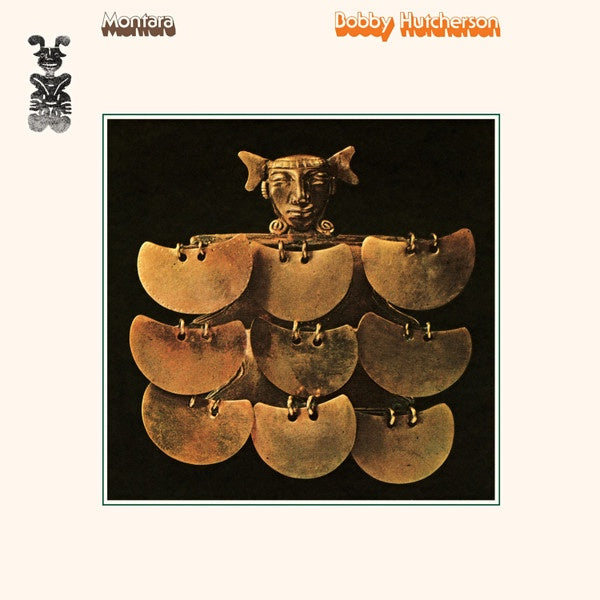
Bobby Hutcherson Montara (Blue Note Tone Poet series)
Blue Note Records (Tone Poet series)
-
Regular price
-
$70.00 SGD
-
Regular price
-
-
Sale price
-
$70.00 SGD
- Unit price
-
per
Couldn't load pickup availability
About
— The Analog Vault // Essential Listening —
With the possible exception of Grover Washington's Feels So Good, no other album captured the spirit of jazz in 1975 like Bobby Hutcherson's Montara. Recorded in his hometown of L.A., Montara is the very sound of groove jazz coming out of fusion, and Latin jazz's tough salsa rhythms coming home to roost in something more warm and effluvial that would meet the populace where it was changing and mellowing out rather than making it sit up and take notice.
That said, Montara is, like the Washington record, a masterpiece of the genre even though it isn't celebrated in the same way. Featuring a stellar cast of musicians - among them Willie Bobo, Blue Mitchell, Bobby Matos, Ernie Watts, Harvey Mason, Plas Johnson, Fred Jackson, Larry Nash, and Chuck Domanico - Montara is a portrait of Hutcherson's complex gift of subtlety and virtuosity.
Whether it's the funky Weather Report dance of "Camel Rise," with Nash's electric piano and the horns weaving around one another in a soulful samba melody, the sweet soulful groove of the title track, where Hutcherson's solo lilts to the point of actually singing, the killer Cuban salsa of "La Malanga," done in complete minor-key frenzy (all the while without losing the easy, slippery grace of soul-jazz), the shimmering echoplexed electric piano and vibes interplay on "Love Song," or the steaming, burning gasoline orgy of Hutcherson's read of Santana's "Oye Como Va," with a killer flute line by Watts winding its way through a knotty bassline and multi-part percussion, the effect is the same: blissed-out moving and grooving for a summer day.
Hutcherson's chameleon-like ability to shape-shift is truly remarkable as a sideman and especially as a leader. He never overplays, his charts are tight, and he always creates a band vibe. Almost all of his solo recordings reflect the strengths of the ensemble rather than his strengths as a soloist. Montara is one of the great feel-good jazz albums of the 1970s, one of the great Latin jazz albums of the 1970s, and one of the great groove jazz records. Seek it out without hesitation. — (via AllMusic)
—
A high-water mark of Bobby Hutcherson’s remarkably creative and diverse 1970s Blue Note output, Montara is a feel-good album that found the great vibraphonist conjuring up an intoxicating hybrid of Latin jazz and fusion grooves. Recorded in Hutcherson’s hometown of Los Angeles, the album featured a talented cast of musicians including Willie Bobo, Blue Mitchell, Bobby Matos, Ernie Watts, Harvey Mason, Plas Johnson, Fred Jackson, Larry Nash, and Chuck Domanico. Hutcherson’s stunning virtuosity and nuanced musicality is on full display across this set that moves between the percolating rhythms of “La Malanga,” “Yuyo,” and “Oye Como Va” and the rich harmonies and alluring textures of “Montara,” “Love Song,” and “Little Angel.”
About the Blue Note Tone Poet Series:
The Tone Poet Audiophile Vinyl Reissue Series was born out of Blue Note President Don Was’ admiration for the exceptional audiophile Blue Note LP reissues presented by Music Matters. Was brought Joe Harley, a.k.a. the “Tone Poet,” on board to curate and supervise a series of reissues from the Blue Note family of labels.
Extreme attention to detail has been paid to getting these right in every conceivable way, from the jacket graphics and printing quality to superior LP mastering (direct from the master tapes) by Kevin Gray to superb 180g audiophile LP pressings by Record Technology Inc. Every aspect of these Tone Poet releases is done to the highest possible standard. It means that you will never find a superior version. This is IT.
This stereo Tone Poet Vinyl Edition was produced by Joe Harley, mastered by Kevin Gray (Cohearent Audio) from the original analog master tapes, pressed on 180g vinyl at Record Technology Inc. (RTI), and packaged in a deluxe tip-on jacket. — (via Label)
—
Bobby Hutcherson might be best-known for his albums in the post-bop and avant-garde jazz realm, but the vibraphonist always had a Latin tinge to his music. This came to a head on his 1975 album Montara, recorded with the cream of L.A.’s Latin percussionists and heavily sampled by hip-hop producers.
Released in late 1975, Bobby Hutcherson’s Montara joined an incredible list of forward-thinking albums for Blue Note in that year including Donald Byrd’s Spaces and Places, Bobbi Humphrey’s Fancy Dancer, Ronnie Foster’s Cheshire Cat, Eddie Henderson’s Sunburst and Chico Hamilton’s Peregrinations.
Montara was the first Blue Note album produced by Dale Oehler who had previously worked as arranger on Marvin Gaye’s Trouble Man before moving into jazz as conductor and arranger on Freddie Hubbard’s 1974 album High Energy. It would be one of four Hutcherson albums Oehler produced for Blue Note alongside those of Marlena Shaw and Brazilian musician Moacir Santos. But the direction Hutcherson took on Montara was very much down to its Executive Producer, George Butler, who gets a special thanks on the back of the album for the “creative ideas [that] sparked the album”.
Arriving at Blue Note in 1971, Butler had steered Blue Note into jazz-funk and fusion with pivotal albums recorded with the Mizell Brothers, including Donald Byrd’s Black Byrd and Bobbi Humphrey’s Blacks and Blues. These albums, and the aforementioned ones from 1975 that Butler worked on as Executive Producer, took Blue Note forward with music for the feet as much as the head. Montara joined them as one of the great Latin Jazz records of the mid-1970s.
After his post-bop, modal and avant-garde albums of the 1960s, Bobby Hutcherson had entered the 1970s with a roar on the political charged psychedelic jazz album Now. It was recorded with saxophonist Harold Land as was the fusion-leaning follow-up “San Francisco”. From the modal jazz of Cirrus (1971) to the jazz-funk of Natural Illusions (1973), Hutcherson continued to jump between styles while expanding the language of the vibraphone in jazz. But he was still to fully explore his Latin tendencies.
Recorded on August 12-14, 1975 at The Record Plant, in his home city of Los Angeles, Montara found Hutcherson alternating between vibraphone and marimba, as he had done periodically since Dialogue in 1965. For the sessions he called on heavyweight players from the L.A. scene including trumpeter Blue Mitchell, electric pianist Larry Nash, bassist Chuck Domanico, saxophonist/flautist Ernie Watts, drummer Harvey Mason and a serious percussion section of Willie Bobo, Bobby Matos, Ralph MacDonald, and Victor Pantoja.
Fellow Blue Note vibist Stefon Harris referred to Hutcherson as “by far the most harmonically advanced person to ever play the vibraphone.” The invention and fluidity Hutcherson had previously brought to post-bop and modal jazz were on full display on his most Latin-influenced album.
The album opens with the haunting and hypnotic “Camel Rise” composed by pianist George Gables and first recorded by Freddie Hubbard on his jazz-funk/fusion album from 1974, “High Energy”. It’s followed by an equally atmospheric Hutcherson composition, the title track “Montara”. Versioned by Madlib on his Shades of Blue album from 2003, it features Hutcherson on beautifully melodic form on vibes and marimba augmented by the swirling Rhodes of Larry Nash.
This mellow opening is blown sky high by “(Se Acabo) La Malanga” a storming piece of Latin Jazz written by Cuban percussionist Rudy Calzado for the recently departed Eddie Palmieri on his 1975 album “Superimposition” for Fania Records. Supported by his serious horn and percussion sections Hutcherson drops one of his heaviest ever solos. Things are brought back down by the meditative “Little Angel” composed by Colombian pianist Edy Martínez for Mongo Santamaria on his 1972 album “Up From The Roots”.
Then comes the other Hutcherson composition, “Yuyo”, a seriously heavy slab of Latin Jazz that could have come from the Fania Records catalogue. The album closes with a version of Tito Puente’s “Oye Como Va” made famous by Santana but Hutcherson certainly has a claim on the best ever cover. — (via Andy Thomas // Everything Jazz)
↓
Label: Blue Note
Series: Blue Note Tone Poet Series
Format: Vinyl, LP, Album, Reissue, Stereo, 180 Gram
Reissued: 2025 / Original: 1975
Genre: Jazz
Style: Fusion, Latin Jazz
File under: TAV Essential Listening
File under: Jazz // Blue Note Tone Poet Series
⦿
Share
Blue Note Records (Tone Poet series)
- Regular price
- $70.00 SGD
- Regular price
-
- Sale price
- $70.00 SGD
- Unit price
- per
Couldn't load pickup availability
About
— The Analog Vault // Essential Listening —
With the possible exception of Grover Washington's Feels So Good, no other album captured the spirit of jazz in 1975 like Bobby Hutcherson's Montara. Recorded in his hometown of L.A., Montara is the very sound of groove jazz coming out of fusion, and Latin jazz's tough salsa rhythms coming home to roost in something more warm and effluvial that would meet the populace where it was changing and mellowing out rather than making it sit up and take notice.
That said, Montara is, like the Washington record, a masterpiece of the genre even though it isn't celebrated in the same way. Featuring a stellar cast of musicians - among them Willie Bobo, Blue Mitchell, Bobby Matos, Ernie Watts, Harvey Mason, Plas Johnson, Fred Jackson, Larry Nash, and Chuck Domanico - Montara is a portrait of Hutcherson's complex gift of subtlety and virtuosity.
Whether it's the funky Weather Report dance of "Camel Rise," with Nash's electric piano and the horns weaving around one another in a soulful samba melody, the sweet soulful groove of the title track, where Hutcherson's solo lilts to the point of actually singing, the killer Cuban salsa of "La Malanga," done in complete minor-key frenzy (all the while without losing the easy, slippery grace of soul-jazz), the shimmering echoplexed electric piano and vibes interplay on "Love Song," or the steaming, burning gasoline orgy of Hutcherson's read of Santana's "Oye Como Va," with a killer flute line by Watts winding its way through a knotty bassline and multi-part percussion, the effect is the same: blissed-out moving and grooving for a summer day.
Hutcherson's chameleon-like ability to shape-shift is truly remarkable as a sideman and especially as a leader. He never overplays, his charts are tight, and he always creates a band vibe. Almost all of his solo recordings reflect the strengths of the ensemble rather than his strengths as a soloist. Montara is one of the great feel-good jazz albums of the 1970s, one of the great Latin jazz albums of the 1970s, and one of the great groove jazz records. Seek it out without hesitation. — (via AllMusic)
—
A high-water mark of Bobby Hutcherson’s remarkably creative and diverse 1970s Blue Note output, Montara is a feel-good album that found the great vibraphonist conjuring up an intoxicating hybrid of Latin jazz and fusion grooves. Recorded in Hutcherson’s hometown of Los Angeles, the album featured a talented cast of musicians including Willie Bobo, Blue Mitchell, Bobby Matos, Ernie Watts, Harvey Mason, Plas Johnson, Fred Jackson, Larry Nash, and Chuck Domanico. Hutcherson’s stunning virtuosity and nuanced musicality is on full display across this set that moves between the percolating rhythms of “La Malanga,” “Yuyo,” and “Oye Como Va” and the rich harmonies and alluring textures of “Montara,” “Love Song,” and “Little Angel.”
About the Blue Note Tone Poet Series:
The Tone Poet Audiophile Vinyl Reissue Series was born out of Blue Note President Don Was’ admiration for the exceptional audiophile Blue Note LP reissues presented by Music Matters. Was brought Joe Harley, a.k.a. the “Tone Poet,” on board to curate and supervise a series of reissues from the Blue Note family of labels.
Extreme attention to detail has been paid to getting these right in every conceivable way, from the jacket graphics and printing quality to superior LP mastering (direct from the master tapes) by Kevin Gray to superb 180g audiophile LP pressings by Record Technology Inc. Every aspect of these Tone Poet releases is done to the highest possible standard. It means that you will never find a superior version. This is IT.
This stereo Tone Poet Vinyl Edition was produced by Joe Harley, mastered by Kevin Gray (Cohearent Audio) from the original analog master tapes, pressed on 180g vinyl at Record Technology Inc. (RTI), and packaged in a deluxe tip-on jacket. — (via Label)
—
Bobby Hutcherson might be best-known for his albums in the post-bop and avant-garde jazz realm, but the vibraphonist always had a Latin tinge to his music. This came to a head on his 1975 album Montara, recorded with the cream of L.A.’s Latin percussionists and heavily sampled by hip-hop producers.
Released in late 1975, Bobby Hutcherson’s Montara joined an incredible list of forward-thinking albums for Blue Note in that year including Donald Byrd’s Spaces and Places, Bobbi Humphrey’s Fancy Dancer, Ronnie Foster’s Cheshire Cat, Eddie Henderson’s Sunburst and Chico Hamilton’s Peregrinations.
Montara was the first Blue Note album produced by Dale Oehler who had previously worked as arranger on Marvin Gaye’s Trouble Man before moving into jazz as conductor and arranger on Freddie Hubbard’s 1974 album High Energy. It would be one of four Hutcherson albums Oehler produced for Blue Note alongside those of Marlena Shaw and Brazilian musician Moacir Santos. But the direction Hutcherson took on Montara was very much down to its Executive Producer, George Butler, who gets a special thanks on the back of the album for the “creative ideas [that] sparked the album”.
Arriving at Blue Note in 1971, Butler had steered Blue Note into jazz-funk and fusion with pivotal albums recorded with the Mizell Brothers, including Donald Byrd’s Black Byrd and Bobbi Humphrey’s Blacks and Blues. These albums, and the aforementioned ones from 1975 that Butler worked on as Executive Producer, took Blue Note forward with music for the feet as much as the head. Montara joined them as one of the great Latin Jazz records of the mid-1970s.
After his post-bop, modal and avant-garde albums of the 1960s, Bobby Hutcherson had entered the 1970s with a roar on the political charged psychedelic jazz album Now. It was recorded with saxophonist Harold Land as was the fusion-leaning follow-up “San Francisco”. From the modal jazz of Cirrus (1971) to the jazz-funk of Natural Illusions (1973), Hutcherson continued to jump between styles while expanding the language of the vibraphone in jazz. But he was still to fully explore his Latin tendencies.
Recorded on August 12-14, 1975 at The Record Plant, in his home city of Los Angeles, Montara found Hutcherson alternating between vibraphone and marimba, as he had done periodically since Dialogue in 1965. For the sessions he called on heavyweight players from the L.A. scene including trumpeter Blue Mitchell, electric pianist Larry Nash, bassist Chuck Domanico, saxophonist/flautist Ernie Watts, drummer Harvey Mason and a serious percussion section of Willie Bobo, Bobby Matos, Ralph MacDonald, and Victor Pantoja.
Fellow Blue Note vibist Stefon Harris referred to Hutcherson as “by far the most harmonically advanced person to ever play the vibraphone.” The invention and fluidity Hutcherson had previously brought to post-bop and modal jazz were on full display on his most Latin-influenced album.
The album opens with the haunting and hypnotic “Camel Rise” composed by pianist George Gables and first recorded by Freddie Hubbard on his jazz-funk/fusion album from 1974, “High Energy”. It’s followed by an equally atmospheric Hutcherson composition, the title track “Montara”. Versioned by Madlib on his Shades of Blue album from 2003, it features Hutcherson on beautifully melodic form on vibes and marimba augmented by the swirling Rhodes of Larry Nash.
This mellow opening is blown sky high by “(Se Acabo) La Malanga” a storming piece of Latin Jazz written by Cuban percussionist Rudy Calzado for the recently departed Eddie Palmieri on his 1975 album “Superimposition” for Fania Records. Supported by his serious horn and percussion sections Hutcherson drops one of his heaviest ever solos. Things are brought back down by the meditative “Little Angel” composed by Colombian pianist Edy Martínez for Mongo Santamaria on his 1972 album “Up From The Roots”.
Then comes the other Hutcherson composition, “Yuyo”, a seriously heavy slab of Latin Jazz that could have come from the Fania Records catalogue. The album closes with a version of Tito Puente’s “Oye Como Va” made famous by Santana but Hutcherson certainly has a claim on the best ever cover. — (via Andy Thomas // Everything Jazz)
↓
Label: Blue Note
Series: Blue Note Tone Poet Series
Format: Vinyl, LP, Album, Reissue, Stereo, 180 Gram
Reissued: 2025 / Original: 1975
Genre: Jazz
Style: Fusion, Latin Jazz
File under: TAV Essential Listening
File under: Jazz // Blue Note Tone Poet Series
⦿
Share
- Choosing a selection results in a full page refresh.