


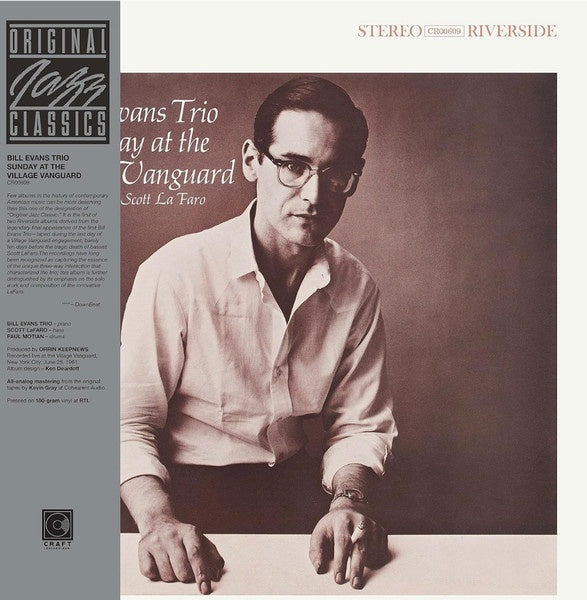
Bill Evans Trio Sunday At The Village Vanguard (Craft reissue)
Craft Recordings / Riverside Records
-
Regular price
-
$70.00 SGD
-
Regular price
-
-
Sale price
-
$70.00 SGD
- Unit price
-
per
Couldn't load pickup availability
About
— The Analog Vault // Essential Listening —
Few live jazz recordings capture intimacy as vividly as Sunday at the Village Vanguard. Recorded on 25th June 1961 and released by Riverside Records later that year, the album documents Bill Evans’ trio with bassist Scott LaFaro and drummer Paul Motian at the height of their telepathic interplay. Rather than treating bass and drums as accompaniment, Evans encouraged equal dialogue, allowing LaFaro’s melodic bass lines and Motian’s subtle rhythmic accents to shape the music’s flow.
Performances like “Gloria’s Step,” “Alice in Wonderland,” and “My Man’s Gone Now” unfold with quiet spontaneity, revealing a trio listening as intensely as they play. Tragically, LaFaro died just days after the session, giving the recording an added poignancy. Sunday at the Village Vanguard remains one of jazz’s most revered live documents. — The Analog Vault
—
Widely regarded as one of the greatest live jazz recordings of all time, Sunday At The Village Vanguard from the Bill Evans Trio, captures a remarkable performance by pianist Bill Evans, bassist Scott LaFaro, and drummer Paul Motian at the Village Vanguard jazz club in New York City on June 25, 1961. The album features a selection of jazz standards and original compositions, showcasing the exceptional musicianship and improvisational prowess of the trio. The interplay between Evans, LaFaro, and Motian is extraordinary, with each musician seamlessly complementing and responding to one another.
The record showed how Evans had refined an approach to solo improvisation in which the pulse was not as obvious as it had been in swing and bop approaches. And his extraordinarily high standards required that each improvised melodic idea be extensively developed, resulting in more continuity and pacing than was common to any previous modern style. — (via Acoustic Sounds)
—
Sunday at the Village Vanguard is the initial volume of a mammoth recording session by the Bill Evans Trio, from June 25, 1961 at New York's Village Vanguard documenting Evans' first trio with bassist Scott LaFaro and drummer Paul Motian. Its companion volume is Waltz for Debby. This trio is still widely regarded as his finest, largely because of the symbiotic interplay between its members.
Tragically, LaFaro was killed in an automobile accident ten days after this session was recorded, and Evans assembled the two packages a few months afterward. While Waltz for Debby - in retrospect - is seemingly a showcase for Evans' brilliant, subtle, and wide-ranging pianism, this volume becomes an homage, largely, to the genius and contribution of LaFaro. That said, however, this were never the point.
According to Motian, when Evans built this trio based on live gigs at the Basin Street East, the intention was always to develop a complete interactive trio experience. At the time, this was an unheard of notion, since piano trios were largely designed to showcase the prowess of the front line soloist with rhythmic accompaniment.
Here, one need listen no further than the elegant and haunting, graceful modal reading of "My Man's Gone Now" from Porgy & Bess to know that there is something completely balanced and indescribably beautiful in their approach. Motian's brushes whisper along the ride cymbals and both Evans and LaFaro enter into a dialogue that emerges from a darkly hued minor mode, into the melody and somehow beyond it, into a form of seamless dialogic improvisation to know that in the act of one musician slipping over and under another - as happens with all three in an aural basket weave - is something utterly new and different, often imitated but never replicated.
But in a sense it happens before this, on LaFaro's "Gloria's Step," which opens the recording. His thematic statement includes the briefest intro, hesitant and spacious before he and pianist enter into a harmonic and contrapuntal conversation underscored by the hushed dynamics of Motian's snare, and the lightning-fast interlocutions of single string and chorded playing of LaFaro.
The shapshifting reading of Miles Davis' "Solar," is a place where angularity, counterpoint, and early modalism all come together in a knotty and insistent, yet utterly seamless blend of post-bop aesthetics and expanded harmonic intercourse with Motian, whose work, while indispensable in the balance of the trio, comes more into play here, and is more assertive with his half-time accents to frame the counterpoint playing of Evans and LaFaro.
This is a great place to begin with Evans. — (via AllMusic)
—
One of the most influential artists in the history of jazz, Bill Evans (1929–1980) was known for his conversational interplay within his trios, his lyrical compositions and his matchless approach to the piano. In 1959, after a year with Miles Davis’ sextet, Evans embarked on a new chapter with bassist Scott LaFaro and drummer Paul Motian—a unit that would redefine the notion of the piano trio.
Over the next two years, the group recorded four foundational titles together, beginning with Portrait in Jazz and Explorations. Their final two albums, 1961’s Sunday at the Village Vanguard and 1962’s Waltz for Debby were both captured live on June 25, 1961, at New York City’s legendary Village Vanguard club. Tragically, that would be the last time that the trio would play together, as LaFaro was killed in a car accident days later.
Sunday at the Village Vanguard was intended to be a tribute to LaFaro’s talents—bookended by two of the bassist’s compositions (“Gloria’s Step” and “Jade Visions”) and showcasing his best solos from that summer day. What resulted is arguably one of the greatest live jazz recordings of all time. The trio’s exquisite unity is on display throughout the album, which also includes several crowd-pleasing standards (Cole Porter’s “All of You,” George Gershwin’s “My Man’s Gone Now” and Sammy Fain’s theme to Alice in Wonderland) plus a rendition of Miles Davis’ “Solar.” — (via Label)
—
The first of two albums recorded at the legendary final appearance of the Bill Evans Trio at the Village Vanguard, these recordings have long been recognized as capturing the unique interaction that characterized the trio of Evans, LaFaro and Motian.
This new edition of Sunday At The Village Vanguard is released as part of the OJC Series and is pressed on 180-gram vinyl at RTI with all-analog mastering from the original tapes by Kevin Gray at Cohearent Audio. It is presented in a Tip-On Jacket.
Since its inception in 1982, Fantasy's Original Jazz Classics® (OJC) series quickly established a reputation as the go-to imprint for collectible jazz reissues. OJC served as a home for the label's impressive jazz catalog — which had grown to include thousands of celebrated titles from Prestige, Galaxy, Milestone, Riverside, Debut, Contemporary, Jazzland, and Pablo. Drawing on this vast wealth of material, Original Jazz Classics released more than 850 titles.
Its goal was simple: to reissue influential jazz albums with the utmost care and reverence for the originals - from the cover art and liner notes to the audio recordings themselves. Given Craft Recordings' shared passion for meticulous preservation and quality, it is a natural step to relaunch Original Jazz Classics as part of the Craft family.
Vinyl tracklist:
A1 Gloria's Step // Written by Scott LaFaro
A2 My Man's Gone Now // Written by George & Ira Gershwin
A3 Solar // Written by Miles Davis
B1 Alice In Wonderland // Written by Bob Hilliard, Sammy Fain
B3 Jade Visions // Written by Scott LaFaro
↓
Label: Craft Recordings, Riverside Records
Series: Original Jazz Classics
Format: Vinyl, LP, Album, Reissue, Stereo, 180g
Reissued: 2023 / Original: 1961
Genre: Jazz
Style: Live, Modal, Post Bop
File under: TAV Essential Listening
File under: Jazz // Audiophile Jazz
⦿
Share
Craft Recordings / Riverside Records
- Regular price
- $70.00 SGD
- Regular price
-
- Sale price
- $70.00 SGD
- Unit price
- per
Couldn't load pickup availability
About
— The Analog Vault // Essential Listening —
Few live jazz recordings capture intimacy as vividly as Sunday at the Village Vanguard. Recorded on 25th June 1961 and released by Riverside Records later that year, the album documents Bill Evans’ trio with bassist Scott LaFaro and drummer Paul Motian at the height of their telepathic interplay. Rather than treating bass and drums as accompaniment, Evans encouraged equal dialogue, allowing LaFaro’s melodic bass lines and Motian’s subtle rhythmic accents to shape the music’s flow.
Performances like “Gloria’s Step,” “Alice in Wonderland,” and “My Man’s Gone Now” unfold with quiet spontaneity, revealing a trio listening as intensely as they play. Tragically, LaFaro died just days after the session, giving the recording an added poignancy. Sunday at the Village Vanguard remains one of jazz’s most revered live documents. — The Analog Vault
—
Widely regarded as one of the greatest live jazz recordings of all time, Sunday At The Village Vanguard from the Bill Evans Trio, captures a remarkable performance by pianist Bill Evans, bassist Scott LaFaro, and drummer Paul Motian at the Village Vanguard jazz club in New York City on June 25, 1961. The album features a selection of jazz standards and original compositions, showcasing the exceptional musicianship and improvisational prowess of the trio. The interplay between Evans, LaFaro, and Motian is extraordinary, with each musician seamlessly complementing and responding to one another.
The record showed how Evans had refined an approach to solo improvisation in which the pulse was not as obvious as it had been in swing and bop approaches. And his extraordinarily high standards required that each improvised melodic idea be extensively developed, resulting in more continuity and pacing than was common to any previous modern style. — (via Acoustic Sounds)
—
Sunday at the Village Vanguard is the initial volume of a mammoth recording session by the Bill Evans Trio, from June 25, 1961 at New York's Village Vanguard documenting Evans' first trio with bassist Scott LaFaro and drummer Paul Motian. Its companion volume is Waltz for Debby. This trio is still widely regarded as his finest, largely because of the symbiotic interplay between its members.
Tragically, LaFaro was killed in an automobile accident ten days after this session was recorded, and Evans assembled the two packages a few months afterward. While Waltz for Debby - in retrospect - is seemingly a showcase for Evans' brilliant, subtle, and wide-ranging pianism, this volume becomes an homage, largely, to the genius and contribution of LaFaro. That said, however, this were never the point.
According to Motian, when Evans built this trio based on live gigs at the Basin Street East, the intention was always to develop a complete interactive trio experience. At the time, this was an unheard of notion, since piano trios were largely designed to showcase the prowess of the front line soloist with rhythmic accompaniment.
Here, one need listen no further than the elegant and haunting, graceful modal reading of "My Man's Gone Now" from Porgy & Bess to know that there is something completely balanced and indescribably beautiful in their approach. Motian's brushes whisper along the ride cymbals and both Evans and LaFaro enter into a dialogue that emerges from a darkly hued minor mode, into the melody and somehow beyond it, into a form of seamless dialogic improvisation to know that in the act of one musician slipping over and under another - as happens with all three in an aural basket weave - is something utterly new and different, often imitated but never replicated.
But in a sense it happens before this, on LaFaro's "Gloria's Step," which opens the recording. His thematic statement includes the briefest intro, hesitant and spacious before he and pianist enter into a harmonic and contrapuntal conversation underscored by the hushed dynamics of Motian's snare, and the lightning-fast interlocutions of single string and chorded playing of LaFaro.
The shapshifting reading of Miles Davis' "Solar," is a place where angularity, counterpoint, and early modalism all come together in a knotty and insistent, yet utterly seamless blend of post-bop aesthetics and expanded harmonic intercourse with Motian, whose work, while indispensable in the balance of the trio, comes more into play here, and is more assertive with his half-time accents to frame the counterpoint playing of Evans and LaFaro.
This is a great place to begin with Evans. — (via AllMusic)
—
One of the most influential artists in the history of jazz, Bill Evans (1929–1980) was known for his conversational interplay within his trios, his lyrical compositions and his matchless approach to the piano. In 1959, after a year with Miles Davis’ sextet, Evans embarked on a new chapter with bassist Scott LaFaro and drummer Paul Motian—a unit that would redefine the notion of the piano trio.
Over the next two years, the group recorded four foundational titles together, beginning with Portrait in Jazz and Explorations. Their final two albums, 1961’s Sunday at the Village Vanguard and 1962’s Waltz for Debby were both captured live on June 25, 1961, at New York City’s legendary Village Vanguard club. Tragically, that would be the last time that the trio would play together, as LaFaro was killed in a car accident days later.
Sunday at the Village Vanguard was intended to be a tribute to LaFaro’s talents—bookended by two of the bassist’s compositions (“Gloria’s Step” and “Jade Visions”) and showcasing his best solos from that summer day. What resulted is arguably one of the greatest live jazz recordings of all time. The trio’s exquisite unity is on display throughout the album, which also includes several crowd-pleasing standards (Cole Porter’s “All of You,” George Gershwin’s “My Man’s Gone Now” and Sammy Fain’s theme to Alice in Wonderland) plus a rendition of Miles Davis’ “Solar.” — (via Label)
—
The first of two albums recorded at the legendary final appearance of the Bill Evans Trio at the Village Vanguard, these recordings have long been recognized as capturing the unique interaction that characterized the trio of Evans, LaFaro and Motian.
This new edition of Sunday At The Village Vanguard is released as part of the OJC Series and is pressed on 180-gram vinyl at RTI with all-analog mastering from the original tapes by Kevin Gray at Cohearent Audio. It is presented in a Tip-On Jacket.
Since its inception in 1982, Fantasy's Original Jazz Classics® (OJC) series quickly established a reputation as the go-to imprint for collectible jazz reissues. OJC served as a home for the label's impressive jazz catalog — which had grown to include thousands of celebrated titles from Prestige, Galaxy, Milestone, Riverside, Debut, Contemporary, Jazzland, and Pablo. Drawing on this vast wealth of material, Original Jazz Classics released more than 850 titles.
Its goal was simple: to reissue influential jazz albums with the utmost care and reverence for the originals - from the cover art and liner notes to the audio recordings themselves. Given Craft Recordings' shared passion for meticulous preservation and quality, it is a natural step to relaunch Original Jazz Classics as part of the Craft family.
Vinyl tracklist:
A1 Gloria's Step // Written by Scott LaFaro
A2 My Man's Gone Now // Written by George & Ira Gershwin
A3 Solar // Written by Miles Davis
B1 Alice In Wonderland // Written by Bob Hilliard, Sammy Fain
B3 Jade Visions // Written by Scott LaFaro
↓
Label: Craft Recordings, Riverside Records
Series: Original Jazz Classics
Format: Vinyl, LP, Album, Reissue, Stereo, 180g
Reissued: 2023 / Original: 1961
Genre: Jazz
Style: Live, Modal, Post Bop
File under: TAV Essential Listening
File under: Jazz // Audiophile Jazz
⦿
Share
- Choosing a selection results in a full page refresh.