


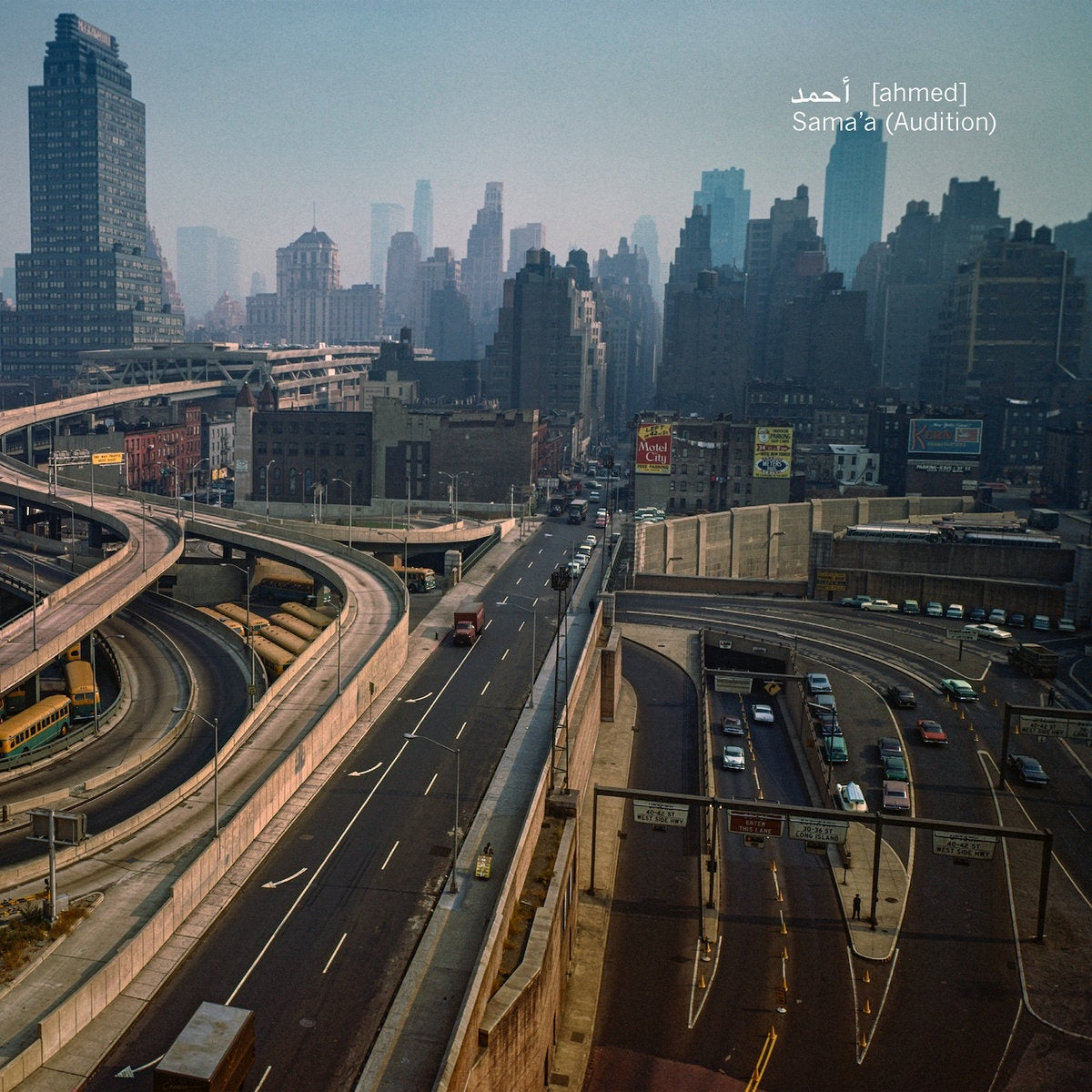
Ahmed أحمد Sama'a (Audition)
-
Regular price
-
$60.00 SGD
-
Regular price
-
-
Sale price
-
$60.00 SGD
- Unit price
-
per
Couldn't load pickup availability
About
2LP in gatefold sleeve with liners by Fred Moten and designed by Maja Larrson
Recorded and mixed by Benedic Lamdin on February 28th, 2025 Fish Factory Studios, London
Mastering and lacquers cut by Andreas LUPO Lubich
—
Known for their exhilarating live-to-record albums such as last year's critically acclaimed Wood Blues and Giant Beauty, سماع Sama'a (Audition) is the first of two releases that will surface after [Ahmed]’s first studio recording sessions at North London’s The Fish Factory in early 2025.
Since 2014, [Ahmed] أحمد have excavated and re-imagined the music of Ahmed Abdul-Malik, in an ever ongoing search for future music. Over a decade on, the group were given the opportunity to set up in the studio for the first time and, with the aid of meticulous engineer Benedic Lamdin, سماع Sama'a (Audition) is the quartet's most detailed work to date.
Fastidious fans may recognise the album's tracklisting as that of Ahmed Abdul-Malik’s Jazz Sahara. After his success collaborating with the pianists Thelonious Monk and Randy Weston, Jazz Sahara was the first record Abdul-Malik made as a leader and was released in 1958. It used the flame of late Fifties jazz to light the wick of North African folk music and acted as a reminder of the Arabic origins of jazz, creating a distinct, unique sound that was far beyond its time.
In Malik’s Jazz Sahara, there is no piano. The ongoing work of each member of [Ahmed] then is to think differently, to wonder how the music will work and to take a risk on trying it out - an extraordinarily compelling feat of imagination. Using group improvisation strategies and recording in single takes, سماع [Sama'a] (Audition) tackled the full suite of Jazz Sahara in just one session, with ‘Ya Annas [Oh, People’] and ‘Isma'a [Listen’] being previously unrecorded. 'Farah 'Alaiyna’, also released on 2019’s Super Majnoon, sounds unrecognisable - the slow, heady stomp and repeated phrasing of 2019’s embryonic [Ahmed] having been blast furnaced and sped up four-fold. The result is four kaleidoscopic, relative miniatures that move, unfold and re-imagine at a very different scale and proportion than [Ahmed]’s previous records. It’s a dizzying, euphoric music and an extraordinary record of a group moving through space-time like no other. — (via Label)
—
In just under a decade, أحمد [Ahmed] has built a formidable discography on a modest mission: to reimagine bassist and oudist Ahmed Abdul-Malik’s pioneering fusions of New York jazz with music from across the Arabic-speaking world. This premise fails to capture the radical force of what the band has accomplished. Listening to an Abdul-Malik recording before an [Ahmed] rendition of the same composition feels like witnessing an explosion: The melodic and modal material of the original is broken up into an inventory of motifs that are then iterated upon in a far more frenetic and open jazz idiom than that pursued in Abdul-Malik’s own work.
In form, [Ahmed]’s music owes its core to a free jazz tradition inherited from Cecil Taylor and Albert Ayler and developed thereafter in a transatlantic context as free improvisation, a scene best documented by the FMP/Free Music Production label. The band’s working method reflects this as well. Up until now, all their releases have been live recordings of sets played with no rehearsal prior to the members’ arrival at the venue. What sets their approach apart from most free jazz and improv is a rhythmic propulsion defined by relentless barreling forward, and tight, interlocking repetitions—a foundation that reinforces rather than diminishes the music’s chaotic intensity. Pat Thomas attacks the piano in percussive tone clusters while drummer Antonin Gerbal and bassist Joel Grip always anchor the madness in some kind of groove, no matter how wild things get. Even Seymour Wright stubbornly insists on keeping time by way of staccato blares and squeals on his saxophone.
Sama’a (Audition), despite being captured in the studio, lacks none of the strengths of [Ahmed]’s work to date. It does not signal a fundamental change in method; these are single takes from a single recording session, and the album includes two compositions that have been part of the band’s constantly reworked repertoire for years now. There are, however, subtle but important differences. The pieces on [Sama’a] are of condensed duration, running 15 to 20 minutes as opposed to the 40 to 50 minutes of [Ahmed]’s live sets; their development of motifs is more proportional and concentrated, without having lost any improvised spontaneity. It’s the fruit of years of experience leading to confident familiarity with the material—something that enables the band to move both faster and with more breathing room than ever before. This is nowhere more evident than on “Farah ‘Alaiyna [Joy Upon Us],” which, when compared to the take from 2019’s Super Majnoon, flies and dances wherever the latter charged and stomped. If Sama’a, as the tracklist suggests, is a reenvisioning of Ahmed Abdul-Malik’s first of six studio albums, we can expect much more from [Ahmed] to come. — (via Bandcamp)
Vinyl Tracklist
A Ya Annas [Oh, People]
B Isma'a [Listen]
C El Haris [Anxious]
D Farah ‘Alaiyna [Joy Upon Us]
↓
Label: Otoroku
Format: 2 x Vinyl, LP, Album
Released: 2025
Genre: Jazz
Style: Free Improvisation
File under: Avant-Garde // Free-Jazz
⦿
Share
- Regular price
- $60.00 SGD
- Regular price
-
- Sale price
- $60.00 SGD
- Unit price
- per
Couldn't load pickup availability
About
2LP in gatefold sleeve with liners by Fred Moten and designed by Maja Larrson
Recorded and mixed by Benedic Lamdin on February 28th, 2025 Fish Factory Studios, London
Mastering and lacquers cut by Andreas LUPO Lubich
—
Known for their exhilarating live-to-record albums such as last year's critically acclaimed Wood Blues and Giant Beauty, سماع Sama'a (Audition) is the first of two releases that will surface after [Ahmed]’s first studio recording sessions at North London’s The Fish Factory in early 2025.
Since 2014, [Ahmed] أحمد have excavated and re-imagined the music of Ahmed Abdul-Malik, in an ever ongoing search for future music. Over a decade on, the group were given the opportunity to set up in the studio for the first time and, with the aid of meticulous engineer Benedic Lamdin, سماع Sama'a (Audition) is the quartet's most detailed work to date.
Fastidious fans may recognise the album's tracklisting as that of Ahmed Abdul-Malik’s Jazz Sahara. After his success collaborating with the pianists Thelonious Monk and Randy Weston, Jazz Sahara was the first record Abdul-Malik made as a leader and was released in 1958. It used the flame of late Fifties jazz to light the wick of North African folk music and acted as a reminder of the Arabic origins of jazz, creating a distinct, unique sound that was far beyond its time.
In Malik’s Jazz Sahara, there is no piano. The ongoing work of each member of [Ahmed] then is to think differently, to wonder how the music will work and to take a risk on trying it out - an extraordinarily compelling feat of imagination. Using group improvisation strategies and recording in single takes, سماع [Sama'a] (Audition) tackled the full suite of Jazz Sahara in just one session, with ‘Ya Annas [Oh, People’] and ‘Isma'a [Listen’] being previously unrecorded. 'Farah 'Alaiyna’, also released on 2019’s Super Majnoon, sounds unrecognisable - the slow, heady stomp and repeated phrasing of 2019’s embryonic [Ahmed] having been blast furnaced and sped up four-fold. The result is four kaleidoscopic, relative miniatures that move, unfold and re-imagine at a very different scale and proportion than [Ahmed]’s previous records. It’s a dizzying, euphoric music and an extraordinary record of a group moving through space-time like no other. — (via Label)
—
In just under a decade, أحمد [Ahmed] has built a formidable discography on a modest mission: to reimagine bassist and oudist Ahmed Abdul-Malik’s pioneering fusions of New York jazz with music from across the Arabic-speaking world. This premise fails to capture the radical force of what the band has accomplished. Listening to an Abdul-Malik recording before an [Ahmed] rendition of the same composition feels like witnessing an explosion: The melodic and modal material of the original is broken up into an inventory of motifs that are then iterated upon in a far more frenetic and open jazz idiom than that pursued in Abdul-Malik’s own work.
In form, [Ahmed]’s music owes its core to a free jazz tradition inherited from Cecil Taylor and Albert Ayler and developed thereafter in a transatlantic context as free improvisation, a scene best documented by the FMP/Free Music Production label. The band’s working method reflects this as well. Up until now, all their releases have been live recordings of sets played with no rehearsal prior to the members’ arrival at the venue. What sets their approach apart from most free jazz and improv is a rhythmic propulsion defined by relentless barreling forward, and tight, interlocking repetitions—a foundation that reinforces rather than diminishes the music’s chaotic intensity. Pat Thomas attacks the piano in percussive tone clusters while drummer Antonin Gerbal and bassist Joel Grip always anchor the madness in some kind of groove, no matter how wild things get. Even Seymour Wright stubbornly insists on keeping time by way of staccato blares and squeals on his saxophone.
Sama’a (Audition), despite being captured in the studio, lacks none of the strengths of [Ahmed]’s work to date. It does not signal a fundamental change in method; these are single takes from a single recording session, and the album includes two compositions that have been part of the band’s constantly reworked repertoire for years now. There are, however, subtle but important differences. The pieces on [Sama’a] are of condensed duration, running 15 to 20 minutes as opposed to the 40 to 50 minutes of [Ahmed]’s live sets; their development of motifs is more proportional and concentrated, without having lost any improvised spontaneity. It’s the fruit of years of experience leading to confident familiarity with the material—something that enables the band to move both faster and with more breathing room than ever before. This is nowhere more evident than on “Farah ‘Alaiyna [Joy Upon Us],” which, when compared to the take from 2019’s Super Majnoon, flies and dances wherever the latter charged and stomped. If Sama’a, as the tracklist suggests, is a reenvisioning of Ahmed Abdul-Malik’s first of six studio albums, we can expect much more from [Ahmed] to come. — (via Bandcamp)
Vinyl Tracklist
A Ya Annas [Oh, People]
B Isma'a [Listen]
C El Haris [Anxious]
D Farah ‘Alaiyna [Joy Upon Us]
↓
Label: Otoroku
Format: 2 x Vinyl, LP, Album
Released: 2025
Genre: Jazz
Style: Free Improvisation
File under: Avant-Garde // Free-Jazz
⦿
Share
- Choosing a selection results in a full page refresh.